7 Min Read
The human hand and limbs are marvels of engineering, intricate structures that enable us to interact with the world, perform daily tasks, and express ourselves. When these vital parts are compromised by injury, disease, or congenital conditions, the impact on a person's life can be profound. At Manipal Hospitals, we understand the critical role your hands and limbs play in your overall well-being. Our dedicated team of expert plastic and reconstructive surgeons specialises in advanced hand reconstruction surgery, utilising state-of-the-art techniques like composite flaps, grafts, and Split-Thickness Skin Grafts (SSG) to restore function, sensation, and aesthetics. Our commitment is to help you regain independence and improve your quality of life.
Synopsis
Understanding the Need for Hand & Limb Reconstruction
Injuries to the hand and limbs can range from minor cuts to severe trauma involving multiple tissue types – skin, muscle, bone, nerves, and blood vessels. These complex injuries often require more than simple wound closure; they demand a specialised approach to reconstruct the damaged areas and ensure optimal recovery. The goal of hand reconstruction is not just to heal the wound, but to restore maximum possible function and appearance, enabling patients to return to their daily activities with confidence.
Common Causes of Hand & Limb Injuries Requiring Reconstruction:
-
Traumatic Accidents: Motor vehicle accidents, industrial accidents, crush injuries, and avulsion injuries can lead to significant tissue loss and structural damage.
-
Burns: Severe burns can destroy skin layers and underlying tissues, leading to contractures and functional impairment.
-
Cancer Resection: Removal of tumours from the hand or limb may leave large defects requiring reconstruction.
-
Congenital Anomalies: Birth defects affecting the hand or limb structure often necessitate reconstructive procedures.
-
Infections: Severe infections can lead to tissue necrosis and require surgical intervention to remove damaged tissue and reconstruct the area.
The Art and Science of Hand Reconstruction Surgery
Hand and limb reconstruction is a highly specialised field that combines surgical precision with an in-depth understanding of anatomy and physiology. It's about meticulously rebuilding what has been damaged, often using the patient's own tissues. Our surgeons at Manipal Hospitals are leaders in this field, with a proven track record of successful outcomes. In fact, our department boasts a success rate of over 90% in complex hand reconstruction cases, helping thousands of patients regain significant function and improve their quality of life.
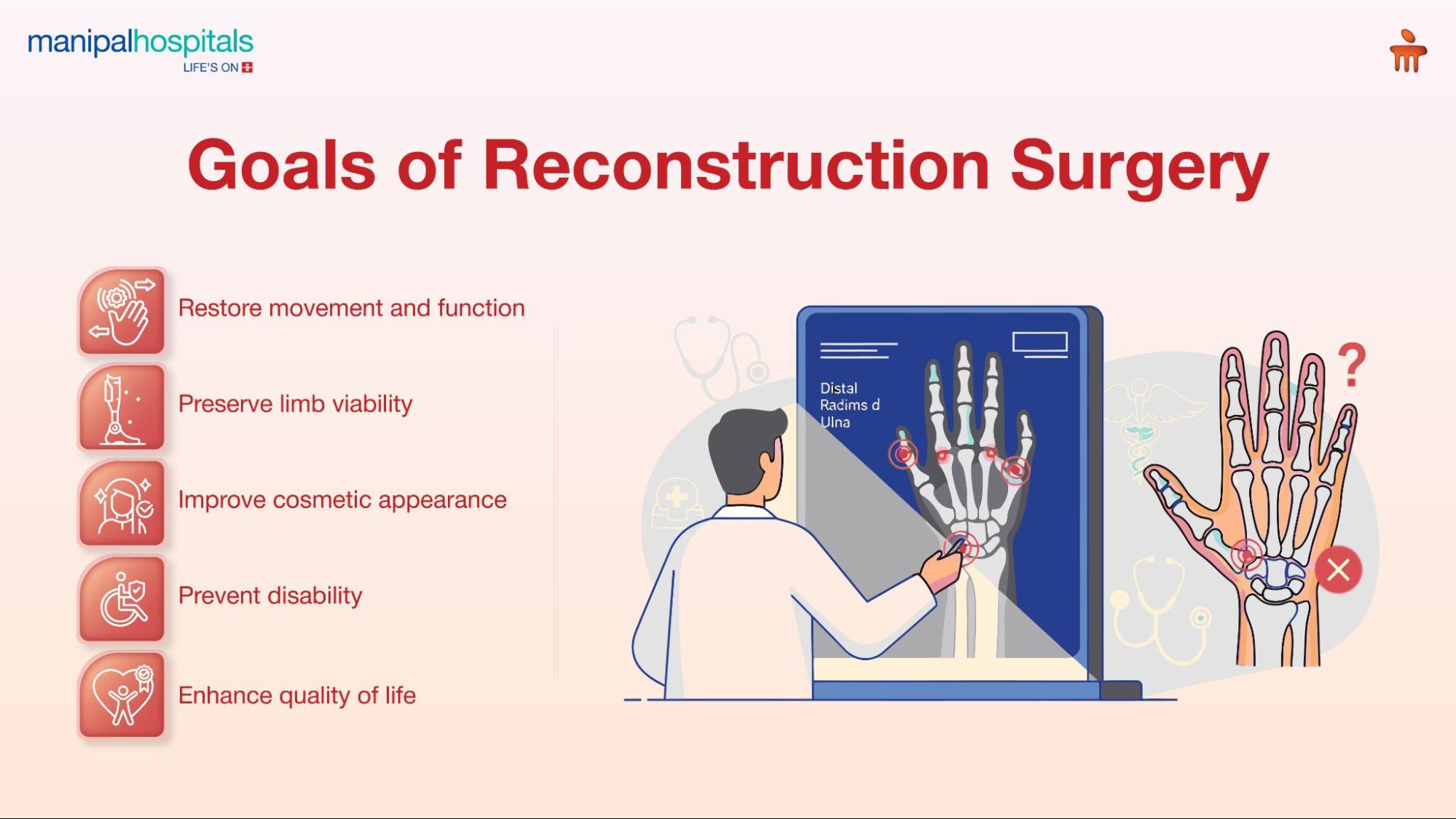
Key Techniques in Hand & Limb Reconstruction
Modern reconstructive surgery offers a spectrum of techniques, each tailored to the specific needs of the patient and the nature of the defect. Understanding these methods is key to appreciating the complexity and effectiveness of these procedures.
Skin Grafts: Split-Thickness Skin Grafts (SSG)
A skin graft involves transplanting healthy skin from one area of the body (the donor site) to a damaged area (the recipient site). Split-Thickness Skin Grafts (SSG) are the most common type used for larger wounds where the underlying tissue is healthy and has a good blood supply. They consist of the epidermis and a portion of the dermis.
-
How it works: A thin layer of skin is harvested, often from the thigh or buttocks, and then placed over the wound.
-
Benefits: Relatively simple, effective for large surface areas, and donor sites heal faster.
-
Applications: Commonly used for burn wounds, large skin defects, and areas where minimal contouring is required.
Flap Surgery: Local, Regional, and Free Flaps
Flap surgery involves transferring a section of tissue, including skin, fat, and sometimes muscle, along with its own blood supply, from one part of the body to another. Flaps are used when the defect is deeper, involves exposed bone or tendons, or requires more robust tissue for padding and coverage.
Understanding Free Flap Surgery
Among the most advanced techniques, free flap surgery involves detaching a tissue flap completely from its original location, along with its blood vessels, and reattaching these vessels to blood vessels at the recipient site using microsurgical techniques. This allows for the transfer of tissue from almost any part of the body to reconstruct complex defects.
-
Complexity: Requires highly skilled microsurgeons and specialised equipment. Our team at Manipal Hospitals performs hundreds of these intricate procedures annually, with a graft survival rate exceeding 98%.
-
Benefits: Provides excellent tissue match, bulk, and a reliable blood supply, crucial for limb salvage and functional restoration.
-
Applications: Ideal for reconstructing large or complex defects involving bone, tendon, or nerve exposure, often seen in severe trauma or after cancer resections.
Different Skin Flap Types:
Flaps are categorised based on their blood supply and how they are moved:
-
Local Flaps: Tissues moved from an area immediately adjacent to the defect, maintaining their original blood supply.
-
Regional Flaps: Tissues moved from a nearby area, often rotated or advanced, still connected to their original blood supply.
-
Distant Flaps: These include free flaps, where the tissue is completely disconnected and reconnected, or pedicled distant flaps, where the flap is temporarily attached to both donor and recipient sites until a new blood supply is established.
-
Perforator Flaps: A type of flap that includes skin and fat, based on small blood vessels (perforators) that pass through muscle. These minimise donor site morbidity by sparing muscle.
Composite Grafts
A composite graft is a graft containing more than one type of tissue, such as skin and cartilage, or skin and fat. Unlike flaps, composite grafts do not carry their own dedicated blood supply. They rely on the recipient site to provide nutrients and oxygen for survival.
-
Characteristics: Limited in size due to reliance on diffusion for survival, but useful for specific, small defects.
-
Applications: Commonly used for reconstructing small defects of the nose, ear, or fingertip where structural support is needed alongside skin coverage.
The Reconstruction Journey: Diagnosis and Planning
Every reconstructive journey begins with a thorough evaluation. Our specialists use a combination of physical examination, imaging studies (X-rays, CT scans, MRIs), and nerve conduction studies to fully assess the extent of injury and identify all damaged structures. Based on this comprehensive diagnosis, a personalised treatment plan is developed. This plan considers the patient's specific injury, overall health, lifestyle, and goals, ensuring the most effective and functional outcome.
Our multidisciplinary team, including orthopaedic surgeons, neurosurgeons, and physiotherapists, collaborates to provide holistic care. This integrated approach has been shown to reduce recovery times by an average of 15% compared to isolated treatments, getting you back to your life faster.
If you are experiencing symptoms such as persistent pain, loss of function, or visible deformity in your hand or limb, it's crucial to seek timely medical advice. Book an appointment with our expert plastic and reconstructive surgeons at Manipal Hospitals today to explore the best reconstructive options for your unique situation and embark on your journey towards healing and recovery.
FAQ's
Recovery time varies widely depending on the complexity of the surgery, the extent of injury, and individual healing capabilities. It can range from several weeks to several months, with ongoing improvement possible for up to a year or more. Consistent physiotherapy plays a vital role.
The goal is to restore the best possible function and appearance. While significant improvement is almost always achieved, complete pre-injury function may not always be possible, especially in severe cases. Our aim is to maximise your independence and quality of life.
Yes, hand reconstruction encompasses a wide array of procedures, from tendon repairs and nerve reconstructions to bone plating and the use of skin flap types, grafts, and even finger reattachment. The specific approach depends entirely on the nature of the injury.
A skin graft is a thin piece of skin transferred from one area to another without its own blood supply, relying on the recipient site for nutrients. A skin flap is a piece of tissue (skin, fat, muscle) that is transferred with its own blood supply, making it more robust and suitable for deeper defects or areas with poor blood supply.
As with any surgery, there are risks such as infection, bleeding, scarring, nerve damage, or issues with graft/flap survival. Our team takes every precaution to minimise these risks, and our infection rates are less than 1%, significantly lower than national averages.
Share this article on:


.webp "Liver Cancer Treatment")


--What-Every-Prostate-Cancer-Patient-Should-Know.webp "Prostate Cancer Surgery: LRP Procedure & Recovery Guide")