




 7 Min Read
Bile duct cancer, medically known as cholangiocarcinoma, is a rare but aggressive form of cancer that originates in the bile ducts. These vital tubes connect the liver and gallbladder to the small intestine, playing a crucial role in digestion. While considered uncommon, recent data indicate a concerning trend: the incidence of cholangiocarcinoma is steadily rising globally, presenting a significant challenge to medical communities worldwide. At Manipal Hospitals, our oncologists in Delhi-NCR are at the forefront of diagnosing and treating this complex condition, dedicated to providing comprehensive care and improving patient outcomes.
Understanding this intricate disease is the first step towards early detection and effective management. This article aims to demystify bile duct cancer, exploring its causes, symptoms, diagnostic methods, and the advanced treatment options available, including the expertise offered by our specialists.
Synopsis
- What is Cholangiocarcinoma?
- Why is the Incidence Rising? Exploring Bile Duct Cancer Causes
- Symptoms: Recognising the Signs: Cholangiocarcinoma Symptoms
- Diagnosis and Staging: Cholangiocarcinoma Diagnosis
- Treatment Approaches at Manipal Hospitals
- Understanding Prognosis: Bile Duct Cancer Survival Rate
What is Cholangiocarcinoma?
Cholangiocarcinoma is a malignancy that forms in the cells lining the bile ducts. These ducts transport bile, a digestive fluid, from the liver to the gallbladder and then to the small intestine. When these cells become cancerous, they can disrupt this crucial process and spread to other parts of the body.
-
Intrahepatic Cholangiocarcinoma: This type originates in the bile ducts within the liver. It accounts for approximately 10-20% of all primary liver cancers and is the form showing the most significant increase in incidence, with some regions observing an annual rise of 2-3%.
-
Extrahepatic Cholangiocarcinoma: This form develops in the bile ducts outside the liver. It is further categorised into perihilar (Klatskin tumour, near the liver) and distal (further down towards the small intestine) types. These constitute the majority of bile duct cancer cases.
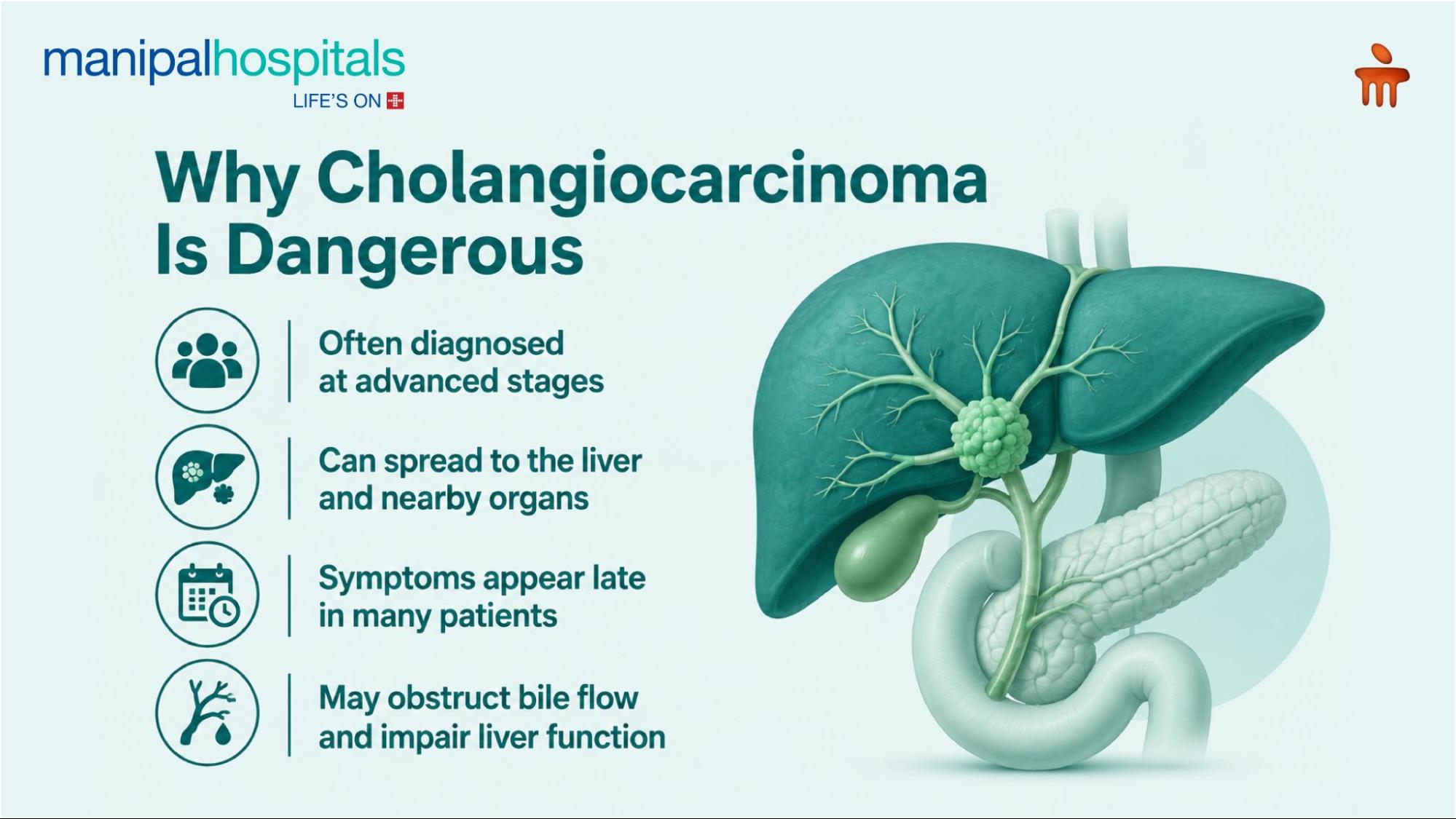
Why is the Incidence Rising? Exploring Bile Duct Cancer Causes
The exact reasons behind the rising incidence of cholangiocarcinoma are still being investigated, but several risk factors and environmental influences are strongly associated with its development. Recognising these factors is crucial for prevention and early detection strategies:
-
Chronic Inflammation: Long-standing inflammation of the bile ducts is a primary risk factor. Conditions like primary sclerosing cholangitis (PSC), a chronic liver disease, significantly increase the risk.
-
Liver Fluke Infection: In certain endemic regions, parasitic infections (e.g., Opisthorchis viverrini, Clonorchis sinensis) are a major cause of bile duct cancer.
-
Choledochal Cysts: These are congenital dilations of the bile ducts that can lead to chronic inflammation and an elevated risk of malignancy.
-
Hepatitis B and C: Chronic infections with these viruses, which lead to liver cirrhosis, are also linked to an increased risk.
-
Obesity and Diabetes: Growing evidence suggests that metabolic syndromes, including obesity and type 2 diabetes, are emerging as potential risk factors, mirroring trends seen in other gastrointestinal cancers.
-
Alcohol and Smoking: While not direct causes, these lifestyle factors can contribute to overall liver damage and may indirectly increase risk.
The global rise in conditions like obesity and chronic liver diseases may contribute to the observed increase in bile duct cancer cases, making continued research and public health awareness critical.
Symptoms: Recognising the Signs: Cholangiocarcinoma Symptoms
One of the biggest challenges with bile duct cancer is that `cholangiocarcinoma symptoms` often do not appear until the disease has reached an advanced stage. When symptoms do emerge, they can be non-specific, making early diagnosis difficult. It's vital to be aware of the following `Bile duct cancer symptoms`:
-
Jaundice: This is one of the most common and noticeable symptoms, characterised by yellowing of the skin and eyes. It occurs when a tumour blocks the bile duct, causing bile to back up into the liver and bloodstream.
-
Itching (Pruritus): The buildup of bile salts in the skin due to bile duct obstruction can cause intense itching.
-
Dark Urine and Pale Stools: Jaundice often leads to dark, tea-colored urine (due to bilirubin excretion) and pale, clay-colored stools (due to lack of bile in the intestines).
-
Abdominal Pain: Pain in the upper right quadrant of the abdomen is common, often dull and persistent.
-
Unexplained Weight Loss: Significant and unintentional weight loss can be a sign of many cancers, including cholangiocarcinoma.
-
Fever and Chills: These can indicate an infection in the bile ducts, which sometimes accompanies obstruction.
-
Nausea and Vomiting: Digestive discomfort can occur as the tumour grows and affects nearby organs.
If you experience any of these persistent symptoms, especially jaundice, it's crucial to seek medical attention promptly. Early diagnosis significantly improves treatment outcomes.
Diagnosis and Staging: Cholangiocarcinoma Diagnosis
Diagnosing `bile duct cancer` involves a combination of imaging tests, blood tests, and tissue biopsies. Manipal Hospitals employs state-of-the-art diagnostic tools to ensure accurate and timely detection:
-
Blood Tests: Liver function tests (LFTs) can indicate bile duct obstruction, and tumour markers like CA 19-9 may be elevated, though not specific to cholangiocarcinoma.
-
Imaging Studies:
-
Ultrasound: Often the first imaging test, it can detect dilated bile ducts and sometimes the tumour itself.
-
CT Scan: Provides detailed images of the liver, bile ducts, and surrounding organs, helping to determine tumour size and how fast bile duct cancer spreads.
-
MRI and MRCP (Magnetic Resonance Cholangiopancreatography): Offer excellent visualisation of the bile ducts, detecting blockages and tumour involvement more precisely.
-
ERCP (Endoscopic Retrograde Cholangiopancreatography) or PTC (Percutaneous Transhepatic Cholangiography): These invasive procedures can visualise the bile ducts directly, allow for stenting to relieve obstruction, and enable tissue biopsy.
-
EUS (Endoscopic Ultrasound): Can help identify small tumours and guide biopsies.
-
-
Biopsy: A definitive diagnosis requires a tissue sample (biopsy) of the suspected tumour, which is then examined under a microscope by a pathologist. This can be obtained during ERCP, PTC, EUS, or surgically.
Once diagnosed, the cancer is staged to determine its extent, which guides treatment decisions. Staging indicates whether the cancer is localised, has spread to nearby lymph nodes, or has metastasised to distant organs.
Treatment Approaches at Manipal Hospitals
Treatment for bile duct cancer is complex and often involves a multidisciplinary team approach. At Manipal Hospitals, our team, including our oncologists in Delhi-NCR, surgeons, radiologists, and pathologists, collaborates to create personalised treatment plans based on the type, stage, and location of the cancer, as well as the patient's overall health.
-
Surgery: For early-stage, resectable tumours, surgery to remove the affected portion of the bile duct and surrounding tissue is the primary treatment and offers the best chance for cure. Surgical resection can lead to a 5-year survival rate of up to 20-40% in carefully selected patients.
-
Chemotherapy: Chemotherapy may be used before surgery (neoadjuvant) to shrink the tumour, after surgery (adjuvant) to eliminate remaining cancer cells, or as palliative care for advanced or unresectable cancers.
-
Radiation Therapy: This uses high-energy rays to kill cancer cells. It can be used alone, with chemotherapy, or for symptom management.
-
Targeted Therapy and Immunotherapy: For some patients, specific genetic mutations or biomarkers in the tumour may respond to targeted therapies or immunotherapies, which are cutting-edge treatments that leverage the body's immune system to fight cancer.
-
Palliative Care: For advanced cancers, palliative treatments focus on relieving symptoms and improving quality of life, which may include stenting to relieve jaundice or pain management.
Understanding Prognosis: Bile Duct Cancer Survival Rate
The `bile duct cancer survival rate` depends heavily on the stage at diagnosis, the tumour's location, and the patient's response to treatment. While the prognosis for advanced cholangiocarcinoma can be challenging, significant advancements in treatment mean that hope remains.
-
For localised, resectable tumours, the 5-year survival rate can range from 20% to 40%.
-
However, for patients diagnosed with `Bile duct cancer stage 4 life expectancy` is generally shorter, but advancements in chemotherapy, targeted therapies, and supportive care have shown promising results, with some patients experiencing a 15-20% increase in median survival time compared to a decade ago.
It's important to remember that these are statistics, and individual experiences can vary widely. Factors like age, overall health, and treatment efficacy all play a role. Our expert team, including our oncologists in Delhi-NCR, focuses on providing individualised care to maximise each patient's prognosis and quality of life.
FAQ's
While most cases of bile duct cancer are sporadic, certain genetic conditions and inherited syndromes can increase the risk in a small percentage of individuals. If you have a strong family history, discuss it with your doctor.
Cure is possible, especially if the cancer is detected at an early stage and can be completely surgically removed. For advanced cases, treatment focuses on controlling the disease, improving quality of life, and extending survival.
Key risk factors include chronic inflammation of the bile ducts (e.g., from PSC), liver fluke infections (in endemic areas), choledochal cysts, and potentially chronic hepatitis B or C. Lifestyle factors like obesity and diabetes are also being increasingly recognised.
Early detection is extremely important. As symptoms often appear late, diagnosis at an earlier stage significantly improves the chances of successful surgical removal and long-term survival. Any concerning symptoms should be investigated promptly.
Manipal Hospitals offers comprehensive support services, including oncology nutritionists, pain management specialists, psychologists, and patient navigators. Our multidisciplinary team, including our oncologists in Delhi-NCR, ensures holistic care throughout your journey.
Share this article on:


1.webp "functional dyspepsia")

--The-Infection-That-Can-Silently-Damage-Fertility.webp "Pelvic inflammatory disease treatments")





