8 Min Read
As men age, many silently struggle with frustrating urinary issues: waking up multiple times a night, dealing with a weak stream, straining to empty the bladder, or suddenly needing to rush to the bathroom. While these symptoms develop slowly, they can eventually have a serious impact on sleep, daily comfort, and overall confidence. When medications stop working, surgery becomes necessary to keep the blockage from causing long-term damage to your bladder or kidneys. For decades, the standard treatment for an enlarged prostate was traditional prostate surgery. Today, advanced options like HoLEP surgery are completely changing how these conditions are treated, giving patients a much better alternative.
With patients today prioritising safer options, minimal complications, and faster recovery, the core question is straightforward: Between HoLEP and traditional prostate surgery, which option is genuinely better? Comparing how these 2 procedures perform regarding healing times, patient benefits, and long-term results is the best way to determine the right choice for your care. This blog covers everything you need to know about both treatments to help you make an informed decision.
Synopsis
- What is an enlarged prostate/BPH?
- Common Enlarged Prostate Symptoms
- When is surgery needed for BPH?
- What is Traditional Prostate Surgery (TURP)?
- What Is HoLEP Surgery?
- HoLEP vs. Traditional Surgery: Key Differences
- Why Is HOLEP Surgery Becoming the Norm?
- Is HoLEP Surgery Safe?
- Risks Associated with Prostate Surgery
- The Verdict: Which Choice Is Best for You?
- Conclusion
What is an enlarged prostate/BPH?
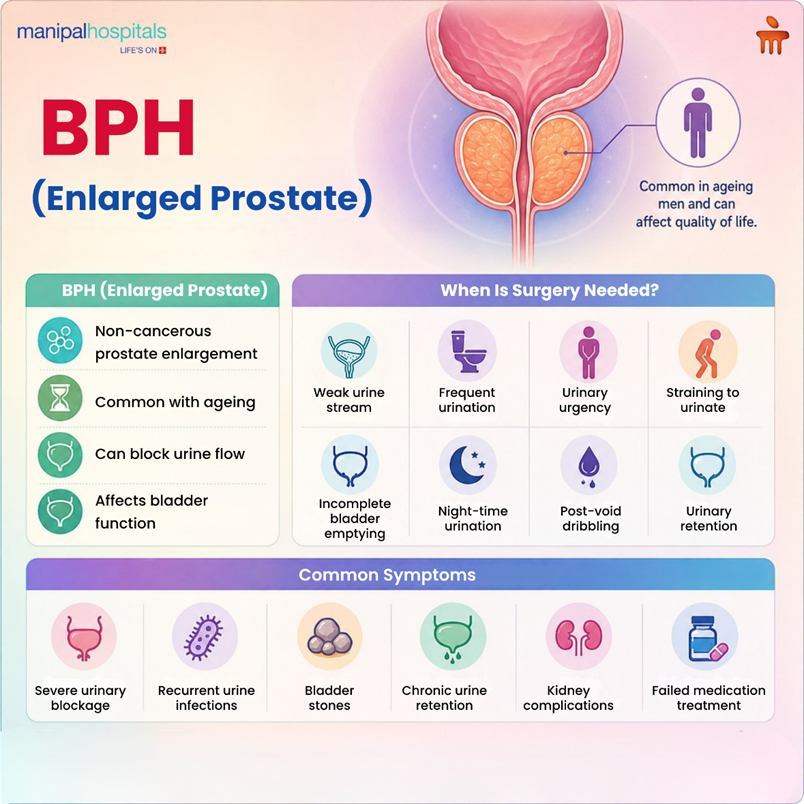
Benign Prostatic Hyperplasia (BPH), commonly known as an enlarged prostate, is a non-cancerous enlargement of the prostate gland that commonly occurs as men grow older. The prostate sits just below the bladder and surrounds the urethra, i.e., the tube that carries urine out of the body. When the prostate becomes enlarged, it squeezes the urethra and blocks the normal flow of urine. This blockage leads to frustrating urinary symptoms and, if left untreated, can damage the bladder and kidneys over time.
BPH is not prostate cancer, but its symptoms can severely affect quality of life. While several advanced surgical options exist today, traditional TURP surgery and modern HoLEP laser surgery remain two of the most widely performed and heavily relied-upon procedures for removing blocking prostate tissue. Among many are 2 main surgical options available to remove the blocking tissue: traditional TURP surgery and modern HoLEP laser surgery.
Common Enlarged Prostate Symptoms
Many men will live for years with symptoms before being treated.
Common enlarged prostate symptoms include:
-
A weak or hesitant urine stream
-
Needing to urinate frequently throughout the day
-
Difficulty or straining to start urinating
-
The constant feeling that your bladder isn't fully empty
-
A sudden, uncontrollable urgency to run to the bathroom
-
Waking up multiple times a night to use the restroom
-
Dribbling or leaking after you think you're finished
-
Urinary retention (completely being unable to pass urine)
Persistent symptoms of an enlarged prostate should always be evaluated by a urologist because untreated blockage can affect bladder and kidney function.
When is surgery needed for BPH?
Doctors usually begin treating an enlarged prostate with basic changes like adjusting daily fluid intake and using prescription medications. But if these initial steps do not relieve your symptoms or if the urinary blockage gets worse, surgery becomes necessary to prevent permanent damage to your bladder and kidneys.
|
Condition |
Why Surgery Is Needed |
|
Severe urinary blockage |
Difficulty passing urine |
|
Recurrent urine infections |
Incomplete bladder emptying |
|
Bladder stones |
Chronic urine retention |
|
Kidney problems |
Long-term urinary obstruction |
|
Failed medication treatment |
Persistent symptoms |
There are several effective surgical options available today. The right choice for you will depend entirely on the overall size of your prostate, your age, and your general health.
What is Traditional Prostate Surgery (TURP)?
For decades, the standard, traditional way to operate on an enlarged prostate has been a procedure called TURP surgery (transurethral resection of the prostate).
During this procedure, the surgeon reaches the prostate by passing a specialised instrument through the urethra, meaning there are no outside cuts on your body. The surgeon then uses an electrical wire loop to gradually resect obstructing prostate tissue, improving urine flow until the obstruction is relieved. While it has helped millions of men, scraping tissue with electricity carries a higher risk of bleeding and isn't ideal for larger prostates.
What Is HoLEP Surgery?
HoLEP surgery (Holmium Laser Enucleation of the Prostate) is a modern, minimally invasive prostate surgery that approaches the problem completely differently.
Instead of an electrical loop, it uses a high-powered laser to cleanly lift away the entire blocking portion of the prostate gland. Like traditional surgery, the procedure is performed entirely through the urethra, with no external incisions. Because the laser cuts precisely and seals blood vessels at the exact same time, it causes much less tissue damage and minimises bleeding during the procedure.
HoLEP vs. Traditional Surgery: Key Differences
Knowing the differences helps patients choose the right treatment option. The following are some of the key differences between the two procedures:
|
Feature |
HoLEP Surgery |
Traditional Surgery (TURP) |
|
Traditional Surgery (TURP) |
The laser completely removes the blocking tissue core |
An electrical loop scrapes away tissue pieces |
|
Bleeding Risk |
Significantly lower (laser seals blood vessels) |
Moderate |
|
Hospital Stay |
Usually shorter (often just 24 hours) |
Slightly longer |
|
Catheter Duration |
Shorter (typically 1 to 2 days) |
Longer |
|
Good for Large Prostates |
Effective across a wide range of prostate sizes, including larger glands |
Limited effectiveness for very large glands |
|
Recovery Speed |
Faster return to daily activities |
Moderate |
|
Risk of Repeat Surgery |
Extremely low (blockage is cleanly gone) |
Higher (tissue can grow back over time) |
Both procedures are highly effective at clearing up frustrating urinary symptoms. However, HoLEP provides patients with a clear advantage in terms of less discomfort and a much faster recovery because it uses advanced laser technology instead of scraping the tissue with electricity.
Why Is HOLEP Surgery Becoming the Norm?
More urologists are recommending HoLEP today because its precision offers a much smoother patient experience. The major prostate laser treatment benefits explain why it is rapidly replacing older, traditional methods:
-
Significantly Less Bleeding: As the laser cuts away the blocking tissue, it instantly seals the surrounding blood vessels, making the procedure much safer.
-
Faster Recovery: Because the laser causes minimal trauma, patients heal quickly, spend less time using a catheter, and leave the hospital sooner.
-
Effective for Any Size: Traditional surgery struggles with very large prostates. HoLEP handles even massively enlarged glands entirely through the urethra without external cuts.
-
Extremely Low Recurrence: Because the laser cleanly removes the entire inner core of the blockage, there is almost no tissue left behind to grow back, preventing the need for repeat surgery.
Is HoLEP Surgery Safe?
As with any medical procedure, all surgeries carry some risk. However, HoLEP surgery is considered safe when performed by experienced urologists.
Possible temporary side effects include the following: burning urination, mild bleeding, temporary urinary leakage, frequent urination during recovery, and retrograde ejaculation. Most symptoms get better gradually after healing.
Risks Associated with Prostate Surgery
There is an inherent risk with all procedures, although complications are uncommon.
Possible risks include:
-
Infection
-
Bleeding
-
Urinary leakage
-
Erectile dysfunction (rare)
-
Scar tissue formation
-
Temporary difficulty controlling urine
Temporary urinary incontinence (loss of bladder control) may occur in some patients, but symptoms often improve as healing progresses.
The Verdict: Which Choice Is Best for You?
When comparing both options side-by-side, HoLEP surgery stands out as the superior, more advanced choice for most men. However, the best option ultimately depends on your specific health situation. Here is how to look at which procedure is better for your needs:
-
Choose HoLEP surgery: If you want a faster recovery, minimal bleeding, or a shorter hospital stay, or if you have a very large prostate gland. It also offers the best long-term reassurance, as the blockage is completely removed and almost never grows back.
-
Traditional surgery remains a solid option if: Your prostate is only mildly or moderately enlarged, your local hospital does not have advanced laser equipment, or your urologist recommends it based on specific medical conditions.
If frustrating urinary issues are impacting your everyday life, do not put off getting help. Schedule a consultation with a skilled urologist. They can evaluate your prostate size and help you choose the absolute safest and most effective path to long-term relief.
Conclusion
An enlarged prostate can gradually affect everyday activities, sleep, bladder function, and overall quality of life. Both TURP and HoLEP surgeries are effective in relieving urinary obstruction, but modern laser procedures are often associated with faster recovery, less bleeding, and better long-term outcomes in selected patients. As one of the best urology hospitals in Bhubaneswar, Manipal Hospitals offers advanced minimally invasive prostate surgery options designed with the support of the best urology doctors in Bhubaneswar to improve patient comfort, recovery, and surgical safety.
But if you've been experiencing symptoms of an enlarged prostate for a while, and they're impacting your everyday life, a skilled urologist in Bhubaneswar can help you determine the safest and most effective course of treatment, helping you find relief for the long term.
FAQ's
Yes, nighttime urination can interrupt sleep and cause fatigue, poor concentration, irritability, and low energy levels in daytime activities.
The pelvic muscles need time to adjust after the removal of obstructing prostate tissue, and temporary urinary leakage may occur briefly.
Yes, but the condition is more common after fifty years of age; some younger men may develop prostate enlargement due to genetics, hormonal factors, or chronic inflammation.
Over time, the bladder muscles can weaken due to long-standing urinary obstruction. The bladder may not work as well in the future despite successful surgical treatment.
Yes, regular exercise, maintaining a healthy weight, and reducing caffeine intake can help to improve urinary flow and reduce mild symptoms of prostate problems naturally.
Share this article on:


.webp "ଅଙ୍ଗ ଦାନର ଗୁରୁତ୍ୱ: ମୃତ୍ୟୁ ପରେ କେଉଁ ଅଙ୍ଗ ଦାନ କରାଯାଇପାରିବ?")