6 Min Read
Joint replacement surgery has transformed the quality of life for millions of people suffering from chronic pain, stiffness, and mobility limitations. Among these procedures, knee and hip replacements are the most commonly performed. While surgery itself is a critical step, patients are often most concerned about one question: When will I recover and return to normal life? Understanding knee replacement recovery time is essential for setting realistic expectations and planning rehabilitation effectively.
Recovery after joint replacement depends on several factors, including the type of surgery, the patient’s overall health, adherence to rehabilitation, and the surgical expertise. With advances in orthopaedic techniques and personalised rehabilitation protocols, outcomes have significantly improved, particularly under the guidance of experienced specialists such as our orthopaedics in Patiala, who focus on long-term joint function and safe recovery.
Synopsis
- Understanding Knee and Hip Replacement Surgery
- What Influences Knee Replacement Recovery Time?
- Typical Knee Replacement Recovery Timeline
- Hip Replacement Recovery Compared to Knee Replacement
- Types of Knee Replacement and Their Recovery Impact
- Managing Pain and Swelling During Recovery
- When Can You Resume Daily Activities?
- Role of Specialist Orthopaedic Care
- Long-Term Outcomes After Knee Joint Replacement
- Conclusion
Understanding Knee and Hip Replacement Surgery
Knee and hip replacements involve removing damaged joint surfaces and replacing them with artificial components designed to restore smooth movement. These procedures are typically recommended for patients with advanced osteoarthritis, rheumatoid arthritis, post-traumatic arthritis, or severe joint deformities.
The knee joint replacement procedure may involve replacing one or more compartments of the knee, depending on disease severity. Similarly, hip replacement surgery involves replacing the damaged ball-and-socket joint. Although recovery timelines differ slightly between the two, knee replacement recovery time often requires more structured rehabilitation due to the knee’s complex biomechanics.
What Influences Knee Replacement Recovery Time?
Several factors influence knee replacement recovery time, and understanding them helps patients participate actively in their healing process.
-
Type of Surgery Performed - The recovery duration varies based on the different types of knee replacement, such as total knee replacement, partial knee replacement, or revision surgery. Partial replacements generally have shorter recovery periods compared to total replacements.
-
Patient Age and General Health - Younger patients with good muscle strength and fewer medical conditions often recover faster. Conditions like diabetes, obesity, or cardiovascular disease may slightly extend knee replacement recovery time.
-
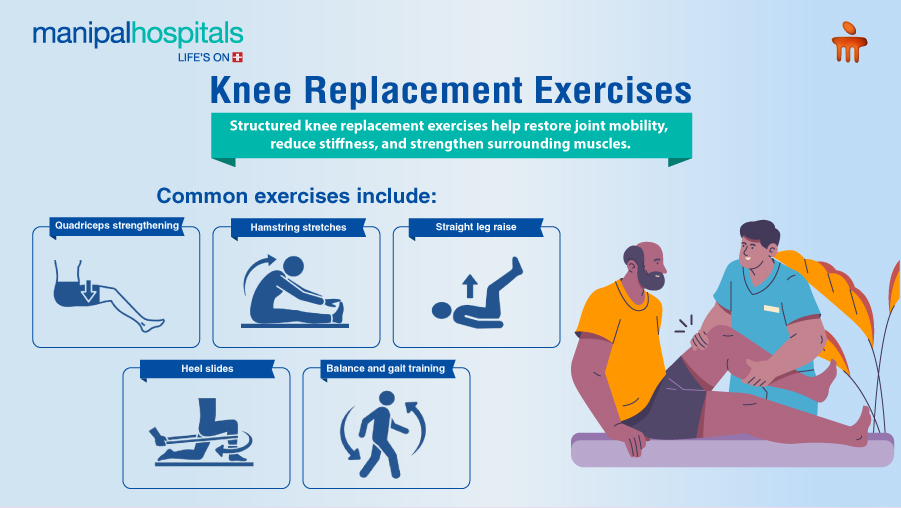
Rehabilitation and Physiotherapy - Adherence to prescribed knee replacement exercises plays a critical role in restoring strength, flexibility, and joint stability.
-
Surgical Technique and Postoperative Care - Modern minimally invasive techniques, enhanced pain control, and early mobilisation protocols significantly reduce recovery challenges.
Typical Knee Replacement Recovery Timeline
Although recovery varies between individuals, knee replacement recovery time generally follows a structured pattern.
-
First 1–2 Weeks - Patients usually begin standing and walking with assistance within 24 hours after surgery. Pain and swelling are expected, but controlled through medication and physiotherapy. Early knee replacement exercises focus on gentle range-of-motion movements and muscle activation.
-
Weeks 3–6 - By this stage, most patients walk with minimal support and achieve improved knee flexibility. Daily activities such as climbing stairs become easier. Knee joint replacement recovery is strongly influenced by consistency with physiotherapy during this phase.
-
Weeks 6–12 - Swelling reduces significantly, strength improves, and patients regain better balance and confidence. Many individuals can resume driving and light work. For most patients, knee replacement recovery time allows a return to a near-normal routine by three months.
-
3–6 Months - Functional recovery continues, with improved endurance and joint coordination. Patients can engage in low-impact activities such as swimming or cycling.
-
6–12 Months - Complete recovery from knee joint replacement, including full muscle strength and joint adaptation, may take up to a year.
Hip Replacement Recovery Compared to Knee Replacement
Hip replacement recovery is often perceived as quicker than knee replacement recovery time, mainly because the hip joint is more stable and less dependent on complex ligament balance.
-
Most hip replacement patients walk independently within 2–4 weeks
-
Pain reduction is often faster
-
Functional recovery typically occurs within 6–12 weeks
However, knee joint replacement requires more extensive rehabilitation due to joint mechanics, making knee replacement exercises especially important for optimal outcomes.
Types of Knee Replacement and Their Recovery Impact
Understanding the types of knee replacement helps patients anticipate recovery duration.
-
Total Knee Replacement - Involves replacing all joint surfaces. Recovery is comprehensive and may take 6–12 months for full functional restoration.
-
Partial Knee Replacement - Only the damaged compartment is replaced. Knee replacement recovery time is often shorter, with faster mobility and less pain.
-
Revision Knee Replacement - Performed when a previous implant fails. Recovery is more complex and generally longer due to extensive tissue involvement.
Each knee joint replacement type requires a customised rehabilitation plan to ensure the safety and durability of the implant.
Managing Pain and Swelling During Recovery
Pain and swelling are common during knee replacement recovery time, but are manageable with proper care.
-
Ice therapy and limb elevation
-
Prescribed medications
-
Gradual increase in activity
-
Compression stockings
Following medical advice closely helps prevent complications and promotes smoother healing after knee joint replacement.
When Can You Resume Daily Activities?
Recovery milestones vary, but typical timelines include:
-
Walking without support: 4–6 weeks
-
Driving: 6–8 weeks
-
Office work: 6–10 weeks
-
Light physical activity: 3 months
-
Full functional recovery: up to 12 months
Adhering to knee replacement exercises ensures steady progress without risking implant stability.
Role of Specialist Orthopaedic Care
Expert surgical planning, precise implant placement, and structured rehabilitation significantly influence knee replacement recovery time. Multidisciplinary teams ensure patients receive comprehensive preoperative counselling and postoperative support.
Under the guidance of our orthopaedics in Patiala, patients benefit from evidence-based protocols that prioritise safety, mobility, and long-term joint health without rushing recovery milestones.
Long-Term Outcomes After Knee Joint Replacement
A successful knee joint replacement can last 15–20 years or more with proper care. Patient's experience:
-
Significant pain relief
-
Improved mobility
-
Enhanced quality of life
-
Better independence
Maintaining a healthy weight, staying active, and continuing periodic strengthening exercises help sustain outcomes and protect the implant.
Conclusion
Understanding knee replacement recovery time allows patients to approach surgery with confidence and realistic expectations. While recovery is gradual, advances in surgical techniques, rehabilitation protocols, and personalised care have made knee and hip replacement outcomes highly successful.
Whether undergoing knee joint replacement or hip replacement, commitment to physiotherapy, adherence to medical advice, and expert guidance play a vital role in achieving long-term success. With structured care and professional oversight, patients can return to active, pain-free lives with renewed mobility and confidence.
FAQ's
Most patients resume normal daily activities within 6–12 weeks, but complete knee replacement recovery time may take up to one year.
Yes, knee replacement exercises are essential for restoring strength, flexibility, and joint stability after knee joint replacement.
Yes, types of knee replacement, such as partial or total replacement, influence recovery duration and rehabilitation intensity.
In general, hip replacement recovery is quicker, but knee replacement recovery time depends more on structured physiotherapy.
Most patients walk independently within 4–6 weeks, depending on adherence to rehabilitation and overall health.
Share this article on: