8 Min Read
Most people assume that if the heart feels fine at rest, it must be healthy overall. But some heart problems only show up when the body is under strain, otherwise lying dormant and undetected while your body is at rest. That’s why doctors use a heart stress test to understand how the heart works during activity. If you’ve been advised to take a treadmill test, it’s natural to wonder what it measures and why it matters. Understanding what is TMT test is can help clear that doubt. It’s not just a routine test but a way to spot early signs of heart-related issues.
In this blog, we’ll walk through how the test works, what to expect during the procedure, how results are interpreted, and what is considered a TMT test normal range.
Synopsis
- What Is a TMT Test?
- Why Is a TMT Test Recommended?
- How Does a Treadmill Test Work?
- Step-by-Step Procedure of a TMT Test
- TMT Test Normal Range and Result Interpretation
- Benefits of a TMT Test
- Who Should Consider a TMT Test?
- Risks and Safety Considerations
- How to Prepare for a TMT Test
- What Happens After the Test?
- Conclusion
What Is a TMT Test?
The TMT test, also known as the treadmill test, is used to check how well the heart works when it is under physical stress. During the test, you are made to walk on a treadmill while your heart rate, heart rhythm, and blood pressure are monitored. As the speed and incline increase, the heart is forced to work harder. This helps doctors see how the heart responds to increasing levels of activity and identify any issues.
The test is especially useful for checking whether the heart muscle is getting enough blood supply. If there is a blockage in the coronary arteries, it often becomes noticeable during cardiac stress tests.
Why Is a TMT Test Recommended?
Doctors usually suggest a treadmill test when symptoms point towards possible heart-related issues but are not clearly visible through basic tests.
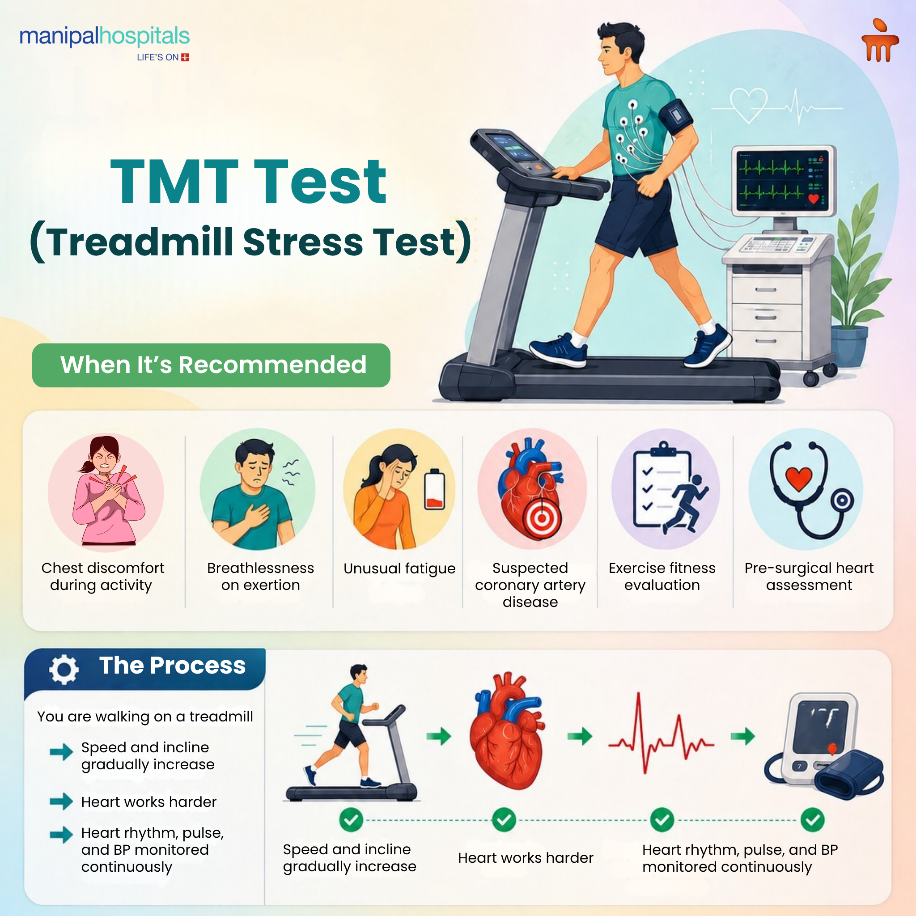
Here are some common reasons:
-
Chest discomfort during walking or exertion
-
Breathlessness that seems unusual
-
Fatigue that appears quickly during activity
-
Suspected coronary artery disease
-
Follow-up for known cardiac conditions
A stress test on the heart is especially useful since it simulates actual life situations that may bring about symptoms. The patient is usually fine when at rest, making this diagnostic procedure critical in identifying underlying problems.
This procedure is used before surgery or commencing an exercise program, especially when the individual is at risk for some health problem such as high blood pressure or diabetes.
How Does a Treadmill Test Work?
The treadmill test works by gradually increasing physical activity while closely monitoring how the heart responds.
Electrodes are placed on your chest to record the heart’s electrical activity, and your blood pressure is checked at regular intervals. As you begin walking, the treadmill slowly increases in speed and incline.
This gradual increase helps doctors understand how your heart handles stress. If there is reduced blood flow or an abnormal heart rhythm, it often shows up during this cardiac stress test. Knowing what is TMT test is also means understanding that the procedure is closely monitored, with your safety always kept in mind.
Step-by-Step Procedure of a TMT Test
Although it may sound technical, the process is quite straightforward.
Initial Preparation
You will be asked to wear comfortable clothing and avoid heavy meals before the test. Your doctor may also review any medications you are taking.
Setting Up Monitoring
Electrodes are placed on your chest to track heart activity throughout the treadmill test.
Baseline Measurements
Your resting heart rate and blood pressure are recorded before starting.
Exercise Phase
You begin walking at a slow pace. Gradually, we increase both speed and incline at fixed intervals.
Continuous Observation
The medical team monitors for any changes in ECG patterns or symptoms during the heart stress test.
Recovery Stage
After stopping, monitoring continues until your heart rate settles back to normal.
The entire cardiac stress test typically lasts around 15 to 20 minutes, though it may vary slightly depending on individual endurance.
TMT Test Normal Range and Result Interpretation
Once the test is completed, doctors analyse several parameters to determine whether the results fall within the TMT test normal range. The following table elucidates these parameters and what they indicate:
|
Parameter |
Expected Normal Response |
What It Indicates |
|
Heart Rate |
Gradual and steady increase |
Healthy cardiac response |
|
Blood Pressure |
Controlled rise during activity |
Proper circulation adjustment |
|
ECG Patterns |
No abnormal changes |
No major blockage signs |
|
Exercise Capacity |
Ability to sustain activity |
Good endurance |
|
Recovery Rate |
Quick return to baseline |
Efficient heart function |
The fact that these readings are beyond the normal range of the TMT test is not always indicative of a problem, although it warrants further investigation.
The doctors consider the trend as a whole and not just one reading. This makes the treadmill test an ideal screening test and not necessarily a definitive one.
Benefits of a TMT Test
The treadmill test is widely used because it is practical, non-invasive, and provides useful information about heart function. Some of the major benefits include:
-
Aids in the early detection of coronary artery disease
-
Can determine arrhythmia
-
Determines the capacity of the heart under physical stress
-
Provides help in making treatment decisions
-
Aids in planning exercises safely
For many patients, knowing what is TMT test makes the assessment less intimidating. It is a simple and effective way to check heart health without needing invasive methods.
Who Should Consider a TMT Test?
Not everyone requires a heart stress test; however, some individuals can gain much from such an examination. A treadmill test may be useful for people who have:
-
Heart complaints while being physically active
-
History of heart problems
-
High risk of having heart disease due to unhealthy habits or existing conditions
-
Planned to start strenuous exercises
-
The necessity of examining the heart prior to surgery
A heart stress test is especially helpful for those experiencing heart problems when being active.
Risks and Safety Considerations
A treadmill test is generally safe and widely used. However, like any test involving physical effort, it does carry minimal risks.
Possible concerns include:
-
Temporary tiredness
-
Mild dizziness
-
Shortness of breath
Serious complications are rare. The cardiac stress test can be stopped immediately if needed due to the presence of trained medical staff.
Understanding what is TMT test is includes recognising that it is designed to be both safe and controlled.
How to Prepare for a TMT Test
The process of preparation will help in achieving accurate results through the treadmill test.
Below are several simple recommendations:
-
Do not have large portions of food before the test
-
Dress comfortably for walking
-
Tell your doctor about the medications you take
-
Do not drink coffee or smoke prior to the test
-
Take rest and relax
Simple preparations will ensure accurate results.
What Happens After the Test?
After the test is completed, you will be observed for a short time during the recovery phase. Most people are able to return to their normal activities soon after the procedure.
The results are then reviewed by a cardiologist at Old Airport Road, Bangalore, who looks at how your heart responded during the test and whether the readings fall within the TMT test normal range. Based on these findings, the doctor decides if any further tests or treatment are needed.
Conclusion
The treadmill test continues to hold an important place in cardiac assessments since it assesses the performance of the heart in real-world scenarios. The more knowledge one has about the TMT test, the easier it is for them to deal with their test. It is a straightforward test that can help detect issues in time.
If your doctors have recommended that you take a heart stress test, or if you feel some symptoms when working out, you should go see a specialist at once. You can visit a professional at our Manipal Hospitals TMT test centre in Old Airport Road to get reliable results.
FAQ's
The TMT test evaluates the heart's response to exercise. This test helps in identifying heart diseases, assessing exercise tolerance, and detecting irregularities in heart rate during stressful conditions.
Normal results usually include an increase in heart rate, a normal blood pressure response, no changes in ECG, and excellent exercise tolerance without any symptoms.
The treadmill test is relatively safe, although it might not suit individuals with severe heart problems or those who have recently experienced a cardiac event.
The time required for a cardiac stress test varies from 15 to 30 minutes; however, it may differ according to the endurance of your body.
Yes, you must prepare yourself for a TMT test. It involves avoiding heavy intake of food before the test and choosing comfortable clothing.
Share this article on: