Having back surgery is often viewed as a path to relief, reduced pain, and more movement, and eventually, a normal life. This is the case for most people who undergo surgery. However, not all people who have back surgery experience the expected results. Some people experience pain, and in some instances, more pain than before the surgery. This is often termed "failed back surgery syndrome." It is often confusing and frustrating to experience pain even after undergoing surgery to alleviate it. It is natural to wonder why the surgery is not yielding the expected results or, in some cases, has led to more pain than before.
It is essential to note that failed back surgery syndrome is not the end of the road. As medical science continues to grow in terms of surgery and healing, so has the knowledge of failed back surgery syndrome and its treatment. It is now possible to identify the cause of pain and, through a precise failed back surgery syndrome diagnosis, find the path to a normal life. This blog will walk you through why this condition happens, what to look out for, and how modern medicine approaches recovery.


Understanding Failed Back Surgery Syndrome
At its core, failed back surgery syndrome is a generalised term for a multi-factorial condition. It isn't a single disease but a result of various biological and mechanical factors that keep the pain signals firing even after the structural issue, like a herniated disc or spinal stenosis, has been addressed.
Think of the spine as a complex electrical and structural grid. Surgery might fix a "short circuit" (like a pinched nerve), but the surrounding "wiring" (the nervous system) might have already become sensitised to pain. In other cases, the "grid" might become unstable elsewhere to compensate for the change. When these issues coalesce into persistent discomfort, doctors begin to categorise the condition as failed back surgery syndrome.
It is estimated that between 10% and 40% of people who undergo back surgery may experience some level of this syndrome. Because the spine is so central to our movement, when failed back surgery syndrome sets in, it can affect everything from your sleep to your ability to walk through a grocery store.
Common Failed Back Surgery Syndrome Symptoms
While the most obvious sign is a lack of pain relief, failed back surgery syndrome symptoms are often more nuanced than a simple ache. Every patient experiences it differently depending on their initial condition and the type of surgery they had.
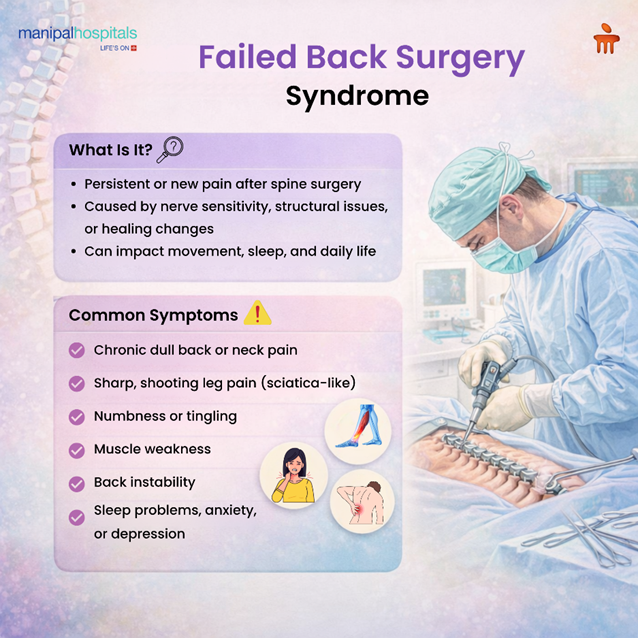
Commonly reported failed back surgery syndrome symptoms include:
-
Chronic Dull Aching: A persistent, heavy pain in the lower back or neck that never truly goes away.
-
Sharp, Shooting Leg Pain: Often described as "electric shocks" or sciatica that continues despite a successful decompression surgery.
-
Neurological Changes: Numbness, tingling ("pins and needles"), or a sense of weakness in the legs or feet.
-
Structural Instability: A feeling that the back "gives out" or that it is difficult to maintain an upright posture for long periods.
-
Sleep and Mood Disruptions: Because the pain is constant, it often leads to secondary issues like insomnia, anxiety, or depression.
Identifying these failed back surgery syndrome symptoms early is crucial because chronic pain can eventually lead to "central sensitisation," where the brain becomes hyper-reactive to even minor sensations.
Why Does It Happen? Contributing Factors
Understanding the "why" is the first step in finding an effective failed back surgery syndrome treatment. There are several reasons why a patient might continue to struggle after an operation.
-
Epidural Fibrosis (Scar Tissue) - After surgery, the body naturally begins healing by forming scar tissue. In some people, this scar tissue develops around the nerve roots. When that happens, the nerves may not move freely, which can lead to discomfort, irritation, or pain when the person bends or twists.
-
Recurrent Disc Herniation - Sometimes the disc problem returns after surgery. The operated level may herniate again, or another level may become involved. This can create pain similar to the original problem, which can make it difficult to tell what has changed without imaging and a careful review.
-
Spinal Instability and Adjacent Segment Disease - When one part of the spine is fused or altered, nearby segments sometimes take on extra stress. Over time, that added strain can cause wear and tear above or below the treated area. This is known as adjacent segment disease, and it can become a new source of pain.
-
Incomplete Decompression - In some cases, the original surgery may have relieved the main compression, but not every smaller area of narrowing. Even a small remaining pressure on a nerve can continue to cause irritation and pain after the operation.
The Path to Clarity: Failed Back Surgery Syndrome Diagnosis
You cannot treat what you haven't accurately identified. A comprehensive failed back surgery syndrome diagnosis is much more involved than a standard check-up. It requires a "detective" mindset from your medical team to distinguish between surgical hardware issues, nerve damage, and inflammatory responses.
The process for a failed back surgery syndrome diagnosis typically includes:
-
Detailed Clinical History: Your doctor will compare your pre-surgery pain with your current symptoms to see if the pattern has changed.
-
Advanced Imaging: While X-rays show the hardware and alignment, an MRI or CT scan with contrast is often needed to see the "soft" changes, such as new scar tissue or recurrent herniations.
-
Diagnostic Injections: Sometimes, a doctor will inject a small amount of anaesthetic into a specific area (like a facet joint or nerve root). If the pain disappears temporarily, it confirms that the specific spot is the culprit.
-
Electromyography (EMG): This test checks the electrical activity of your muscles and nerves to see if there is ongoing nerve irritation or permanent damage.
Modern Failed Back Surgery Syndrome Treatment Options
The most important thing to remember is that "treatment" does not always mean "more surgery." In fact, many experts prefer conservative or interventional approaches for failed back surgery syndrome treatment before considering a revision operation.
Conservative Management
This is often the first line of defence. It focuses on calming the nervous system and strengthening the supporting structures of the spine.
-
Specialised Physical Therapy: This isn't just standard exercise; it involves "nerve gliding" techniques and core stabilisation tailored for post-surgical spines.
-
Medication Management: Using nerve-pain stabilisers (like gabapentinoids) or anti-inflammatories to reduce the "volume" of the pain signals.
Interventional Procedures
If lifestyle changes and therapy aren't enough, doctors may look at minimally invasive interventions as a core part of failed back surgery syndrome treatment.
-
Epidural Steroid Injections: Aimed at reducing inflammation around irritated nerve roots.
-
Spinal Cord Stimulation (SCS): Often called a "pacemaker for pain," this device sends mild electrical pulses to the spinal cord to mask pain signals before they reach the brain. It is one of the most successful options for failed back surgery syndrome.
-
Radiofrequency Ablation: Using heat to temporarily "turn off" the tiny nerves sending pain signals from the facet joints.
Revision Surgery
In specific cases where there is a clear mechanical failure (like a loose screw or a new herniation), a second surgery may be necessary. However, this is usually a last resort, as the risk of failed back surgery syndrome can increase with subsequent operations.
How to Manage Life with Failed Back Surgery Syndrome
Living with persistent pain requires a shift in strategy. While you work with your doctor on a clinical failed back surgery syndrome treatment, there are steps you can take at home to regain a sense of control.
-
Pace Your Activities: Avoid the "boom and bust" cycle where you overdo it on a good day and pay for it for the next three days.
-
Focus on Anti-Inflammatory Nutrition: A diet rich in omega-3s, turmeric, and leafy greens can help lower the overall inflammatory load on your body.
-
Mind-Body Techniques: Techniques like Mindfulness-Based Stress Reduction (MBSR) have been clinically proven to help the brain "reprocess" chronic pain signals, reducing their intensity.
-
Gentle Movement: Activities like hydrotherapy (water aerobics) allow you to move your spine without the harsh impact of gravity.
Understanding that failed back surgery syndrome is a management journey, rather than a quick fix, can actually help reduce the psychological stress that often worsens physical pain.
Conclusion
The experience of persistent pain after spine surgery can be deeply discouraging, especially when you expected clear relief. Still, failed back surgery syndrome is a recognised condition, and it has a structured path of evaluation and care. The most important step is not to ignore the pain or assume it has no explanation. A careful failed back surgery syndrome diagnosis can uncover the real source of the problem. If you are dealing with ongoing symptoms after a spine procedure, speaking to a spine specialist or pain management expert at Manipal Hospitals can help you understand what comes next. With the right team, the focus can shift from the label to recovery, function, and a better quality of life.