When you are dealing with chronic back pain or that strange, radiating numbness that travels down your legs, it can feel like your world has shrunk. Simple things like standing in a grocery line or taking a short walk around the block become tasks you have to mentally prepare for. Often, this discomfort comes from nerves in your spine being squeezed or "pinched" because the space they usually occupy has become too cramped. If physical therapy or medication hasn't given you your life back, a specialist might suggest a procedure to "decompress" those nerves.
As you start looking into your options, you will likely come across two terms that sound almost identical: laminotomy and laminectomy. It is completely normal to feel a bit confused by the similar names. At their core, both procedures are designed to do the same thing: make more room for your spinal nerves so you can move without pain. However, the way they get that job done is slightly different. Choosing between them usually depends on how much space your nerves need and the specific structure of your spine.
This blog helps you understand the laminotomy vs laminectomy debate in plain language. We will look at what each procedure involves, how the recovery process feels, and what you should expect as you prepare for a more comfortable future.
Exploring the Laminotomy Meaning
To understand these procedures, it helps to have a clear picture of your spine. Your spinal bones (vertebrae) have a bony arch on the back side called the lamina. You can consider the lamina to be a protective wall that covers the back of your spinal canal, which is the tunnel where your nerves live.
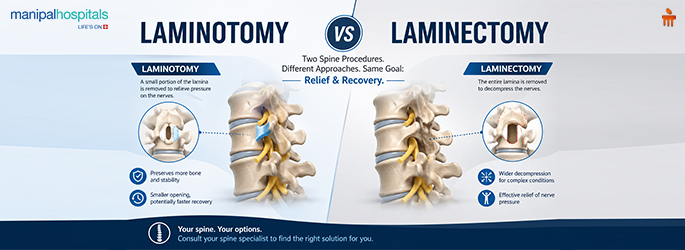
The laminotomy meaning refers to a procedure where a surgeon removes just a small piece of that bony wall. Instead of taking the whole thing away, they create a small "window" or opening. This procedure is usually done to reach a specific problem, like a disc that is bulging out and hitting a nerve. Because a laminotomy surgery only removes a small portion of the bone, it leaves more of the natural structure of your spine intact. This is often a great option when the pressure on the nerve is very localised, and the rest of the spinal canal is still wide enough.
Understanding Laminectomy Surgery
In some cases, a small window isn't enough to give the nerves the space they need. If you have widespread narrowing in your spinal canal, often caused by ageing or large bone spurs, your surgeon might recommend a laminectomy.
In this version of the procedure, the surgeon removes the entire lamina (the whole "wall") of the affected vertebrae. This creates a much larger opening and provides immediate, significant decompression for the nerves. While it is a bit more involved than a laminotomy surgery, it is a well-established way to treat conditions where the nerves are being squeezed from multiple sides. By removing the entire bony arch, the surgeon ensures that the nerves have plenty of room to function without being irritated by bone or thickened ligaments.
Laminotomy vs Laminectomy: The Key Differences
While both procedures aim to relieve nerve pressure, the "best" choice really depends on your specific anatomy. Here is a breakdown of how laminotomy and laminectomy compare:
|
Feature |
Laminotomy Surgery |
Laminectomy Surgery |
|
Amount of Bone Removed |
Only a small portion (a "window"). |
The entire bony arch (the lamina). |
|
Primary Goal |
To reach a specific disc or a small bone spur. |
To clear a large area of narrowing in the canal. |
|
Spinal Stability |
Leaves most of the natural bone structure. |
Removes more bone, which may require fusion. |
|
Typical Use Case |
Herniated discs in younger or active patients. |
Significant spinal narrowing in older adults. |
|
Approach |
Often minimally invasive with smaller cuts. |
It can be minimally invasive or a traditional open cut. |
Understanding the laminotomy vs laminectomy distinction helps you understand why your surgeon might pick one over the other based on your imaging results.
Why Surgeons Choose One Over the Other
The decision between laminotomy and laminectomy is rarely about which surgery is "better" overall but rather which one is better for you. Surgeons look at several factors before making a recommendation:
-
The Cause of Pressure: If a single herniated disc is the problem, a laminotomy surgery might be all that is needed to reach and resolve the issue.
-
The Extent of Narrowing: If your spinal canal is tight across several levels, a laminectomy provides a more complete "opening" of the tunnel.
-
Bone Health: The surgeon will consider the strength of your bones and whether removing the whole lamina might make the spine less stable.
-
Previous Surgeries: If you have had work done on your back before, that might influence which approach is safest.
In many modern practices, laminotomy and laminectomy can be performed using "minimally invasive" techniques. This means the surgeon uses smaller incisions and specialised tools to do the work, which often leads to less muscle damage and a faster trip home.
What to Expect During the Procedure
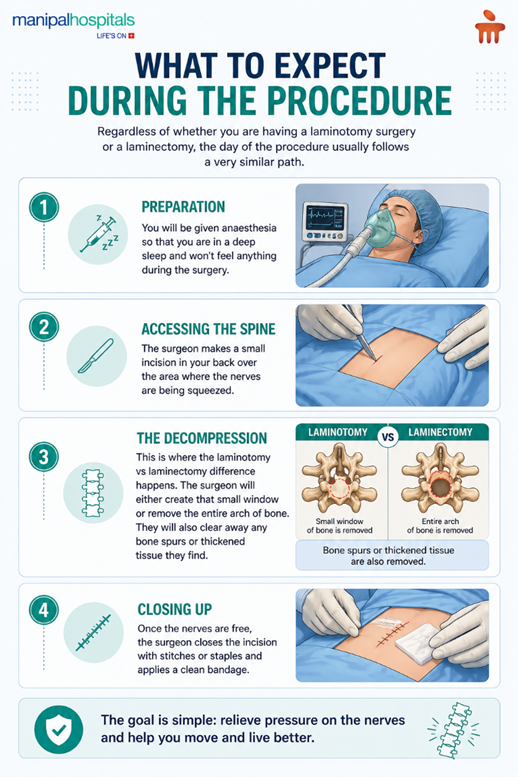
Regardless of whether you are having a laminotomy surgery or a laminectomy, the day of the procedure usually follows a very similar path.
-
Preparation: You will be given anaesthesia so that you are in a deep sleep and won't feel anything during the surgery.
-
Accessing the Spine: The surgeon makes a small incision in your back over the area where the nerves are being squeezed.
-
The Decompression: This is where the laminotomy vs laminectomy difference happens. The surgeon will either create that small window or remove the entire arch of bone. They will also clear away any bone spurs or thickened tissue they find.
-
Closing Up: Once the nerves are free, the surgeon closes the incision with stitches or staples and applies a clean bandage.
Most of these procedures take between one and three hours, and many patients are able to head home on the same day or after a single night in the hospital.
The Journey of Recovery
Recovering from laminotomy and laminectomy requires a bit of patience, but most people are surprised by how quickly they can start moving again.
-
The First 48 Hours: You will likely feel some soreness at the incision site. Your medical team will give you a plan for pain relief and will encourage you to take short, gentle walks almost immediately.
-
The "BLT" Rule: For the first few weeks, you will be asked to avoid Bending, Lifting (anything heavier than a few pounds), and Twisting. This protects the area while the soft tissues heal.
-
Physical Therapy: This is a vital part of your recovery. A therapist will help you strengthen the muscles that support your spine, which makes the results of your laminotomy surgery or laminectomy last longer.
-
Returning to Work: If you have a desk job, you might be back at work in two to four weeks. If your job involves heavy lifting, you will likely need more time.
Potential Risks and Safety Points
Every surgery has risks, and it is important to be aware of them so you can monitor your healing. While laminotomy and laminectomy are considered very safe, your surgeon will discuss the following with you:
-
Infection: Keeping the incision site clean and dry is the best way to prevent this.
-
Nerve Sensitivity: Sometimes the nerves can feel a bit "crankier" for a few days after being moved during the procedure.
-
Fluid Leaks: Very rarely, the protective sac around the nerves can get a tiny tear, which the surgeon usually fixes during the surgery.
-
Persistent Pain: While most people feel much better, there is always a chance that some symptoms might linger, especially if the nerve was squeezed for a long time before the surgery.
Conclusion
Deciding to have surgery on your spine is a big step, but understanding the tools your surgeon uses can make it feel much more manageable. Whether you and your doctor decide on a laminotomy surgery to fix a specific disc issue or a laminectomy to clear a larger area, the goal at Manipal Institute of Robotic Spine Surgery (MIRSS) remains the same: getting you back to a life where you aren't defined by your pain.
Your spine is incredibly strong, and sometimes it just needs a little bit of help to function at its best again. By learning the laminotomy meaning, identifying the signs that it’s time for help, and following your recovery plan, you are doing exactly what you need to do to protect your mobility, with guidance and support from the expert spine surgery team at MIRSS, Manipal Hospitals.