If you have ever felt a sharp, shooting pain that travels from your lower back all the way down your leg, you know how quickly it can take over your life. This sensation, often called sciatica, can make even the simplest movements, like sitting at a dinner table or putting on your shoes, feel nearly impossible. Often, this condition happens because one of the soft cushions between the bones of your spine has slipped or bulged out of place, putting direct pressure on a nerve. When this happens, and when rest or physical therapy hasn't provided the relief you need, a doctor might suggest a discectomy.
The idea of having surgery on your spine is naturally a big deal, and it is completely normal to have questions about what the process involves. A discectomy surgery is one of the most common and effective ways to treat a "pinched nerve" caused by a damaged disc. It isn't about replacing the entire disc or doing a massive overhaul of your back; instead, it is a very targeted procedure to remove the specific piece of tissue that is causing the problem.
This blog explains what discectomy surgery is, it looks at how the procedure works, and describes what the recovery feels like.
What Exactly Is a Discectomy?
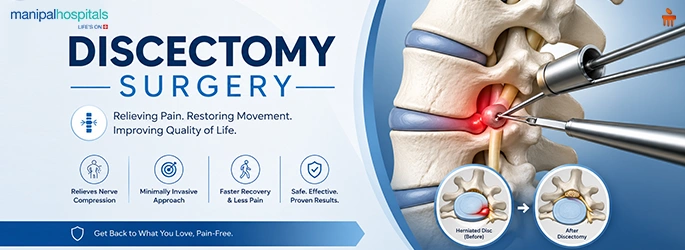
To understand a discectomy, it helps to know how your spine is put together. Your spine is made of bones called vertebrae, and between each bone is a spinal disc. These discs act like shock absorbers, allowing you to bend and twist. They have a tough outer layer and a soft, jelly-like centre. If the outer layer tears or weakens, the soft centre can push out; this is what people mean when they talk about a herniated or "slipped" disc.
A spinal discectomy is the surgical procedure used to remove the herniated portion. During a discectomy surgery, the surgeon focuses only on the part of the disc that is pressing against the nerve. By removing that small piece of material, the pressure is released, which is often the quickest way to stop the shooting pain in the legs or arms. While it is a significant medical step, a discectomy is considered a very reliable way to resolve the mechanical issue of nerve compression.
Why a Spinal Discectomy Might Be Necessary
A discectomy is rarely the first thing a specialist will recommend. Most of the time, your medical team will start with conservative care, such as non-steroidal anti-inflammatory drugs, steroid injections, or several weeks of physical therapy.
However, if those treatments don't help, a discectomy surgery might be the next step.
You and your doctor might consider a spinal discectomy if you experience:
-
Persistent Leg or Arm Pain: The pain in your limbs is much worse than the pain in your actual back.
-
Weakness or Numbness: You find it hard to stand on your toes or heels, or you have a "dead" feeling in a part of your leg or foot.
-
Loss of Daily Function: You can't perform your job or take care of your home because the nerve pain is too intense.
-
Imaging Proof: A scan, like an MRI, clearly shows that a piece of your disc is squashing a nerve root.
In some cases, a diskectomy is needed urgently if the nerve pressure is affecting your ability to control your bladder or bowels, though this scenario is quite rare. For most, a discectomy is a planned decision made to improve their quality of life.
Modern Advancements: Robotic and Minimally Invasive Discectomy
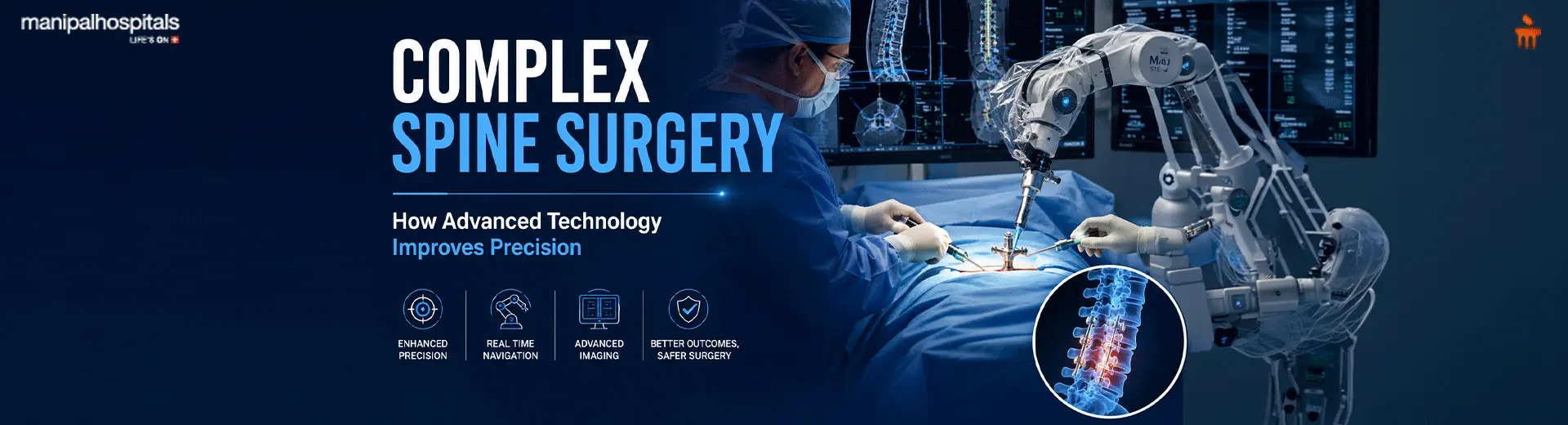
In the past, a spinal discectomy required a larger incision and a longer recovery. Today, things have changed significantly. Many surgeons now perform what is called a "microdiscectomy" or a robotic-assisted discectomy surgery.
-
Smaller Incisions: Using specialised microscopes or cameras, the surgeon can perform the discectomy through a very small opening, which means less damage to the surrounding muscles.
-
Robotic Precision: In robotic spine care, advanced software helps the surgeon map out your anatomy before the discectomy surgery even begins. The robot provides a steady guide, ensuring the tools go exactly where they are needed for the discectomy.
-
Faster Recovery: Because the spinal discectomy is so targeted, patients often experience less pain after the procedure and can head home much sooner.
Using these modern tools for a discectomy allows the surgeon to be incredibly precise, removing only the tissue that is causing the problem while leaving the rest of the disc and spine untouched.
The Discectomy Procedure: What Happens During Surgery?
Knowing what happens in the operating room can take away a lot of the mystery. Whether you are having a traditional discectomy or a robotic diskectomy, the steps are generally similar.
-
Preparation: You will be given anaesthesia so that you are in a deep sleep and won't feel anything during the discectomy surgery.
-
Accessing the Disc: The surgeon makes an incision over the affected part of your spine. If it is a minimally invasive discectomy, this incision might be less than an inch long.
-
Clearing the Path: The surgeon may need to move a small amount of bone or ligament to see the nerve and the disc. This part is often called a laminotomy, and it is a standard part of a spinal discectomy.
-
The Removal: The surgeon identifies the herniated part of the disc and carefully removes it. This is the "core" of the discectomy. They will also check for any other loose fragments that might cause trouble later.
-
Closing Up: Once the nerve is free, the incision is closed with stitches or staples, and a small bandage is applied.
The entire discectomy surgery usually takes about an hour, and many patients feel a significant reduction in their leg pain almost as soon as they wake up.
Recovery and Life After a Discectomy
One of the best things about a discectomy is that the recovery is often faster than people expect. While you do need to be careful, you aren't going to be stuck in bed for weeks.
-
The First Day: You will likely be encouraged to stand up and take a short walk within hours of your discectomy surgery. Most people go home the same day or after one night in the hospital.
-
Managing Discomfort: You will have some soreness at the incision site, which can be managed with prescribed medicine or non-steroidal anti-inflammatory drugs.
-
Activity Restrictions: For the first few weeks after your discectomy, you will need to follow the "No BLT" rule: no Bending, Lifting (anything heavier than a gallon of milk), or Twisting.
-
Physical Therapy: After about four to six weeks, you might start a gentle exercise program to strengthen the muscles around your spine. This is a vital part of making sure the results of your spinal discectomy last.
Most people can return to a desk job in two to four weeks, though if your work involves heavy lifting, you might need six to eight weeks before you are ready to go back after a discectomy surgery.
Benefits and Potential Risks
Like any medical procedure, a discectomy has both its "pros" and its risks. It is important to have a balanced view of what a diskectomy can and cannot do.
The Benefits:
-
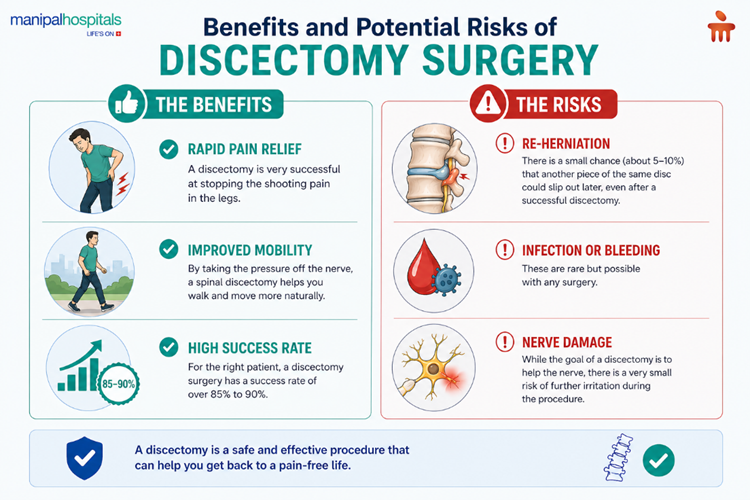
Rapid Pain Relief: A discectomy is very successful at stopping the shooting pain in the legs.
-
Improved Mobility: By taking the pressure off the nerve, a spinal discectomy helps you walk and move more naturally.
-
High Success Rate: For the right patient, a discectomy surgery has a success rate of over 85% to 90%
The Risks:
-
Re-herniation: There is a small chance (about 5-10%) that another piece of the same disc could slip out later, even after a successful discectomy.
-
Infection or Bleeding: These are rare but possible with any surgery.
-
Nerve Damage: While the goal of a diskectomy is to help the nerve, there is a minimal risk of further irritation during the procedure.
Comparing Discectomy to Other Procedures
Sometimes, a discectomy is performed alongside other surgeries. It helps to know how they differ.
|
Procedure |
What It Does |
|
Discectomy / Diskectomy |
Removes only the herniated part of a spinal disc. |
|
Laminectomy |
Removes the bony "roof" of the spinal canal to create more space. |
|
Spinal Fusion |
Joins two bones together to stop painful movement. |
|
Discectomy + Fusion |
Removes the whole disc and fuses the bones (often for severe wear). |
A simple spinal discectomy is usually the most conservative surgical option because it preserves as much of your natural anatomy as possible.
Conclusion
Dealing with chronic nerve pain is exhausting, but a discectomy offers a clear path toward feeling like yourself again. By focusing on removing just the tissue that is causing the pressure, a discectomy surgery provides a targeted solution with a relatively quick recovery time. Whether it is a traditional approach or a robotic-assisted spinal discectomy, the goal remains the same: to get you back on your feet and moving without pain. If you are considering a discectomy, the best thing you can do is have an open conversation with a specialist at the Manipal Institute of Robotic Spine Surgery (MIRSS). With the right care and a successful discectomy surgery, you can put the shooting pain behind you and look forward to a much more active and comfortable future.