


 7 Min Read
There are few things more distressing than watching your baby cry for hours and not knowing how to help. The feeding is on time, the nappy is clean, and their body temperature feels fine, yet the crying continues, intense and inconsolable, often at the same time each day. This pattern is what many parents come to know as infantile colic. Although it is common and temporary, infantile colic can feel overwhelming in the moment. Often, parents fear they are overlooking something serious or making a mistake. The truth is far more reassuring. It is a recognised condition in early infancy, with well-defined patterns and a predictable course.
In this blog, we explore the causes and symptoms of infantile colic, how it is diagnosed, and the most effective evidence-based approaches for the management of infantile colic at home and in clinical settings.
Synopsis
- What is infantile colic?
- Recognising the Symptoms of Infantile Colic
- Why Do Infants Get Colic?
- Warning Signs That Crying May Not Be Colic
- Evidence-Based Infantile Colic Treatment
- Infantile Colic Treatment Guidelines at a Glance
- Supporting Parental Wellbeing
- The Natural Course and Prognosis
- Conclusion
What is infantile colic?
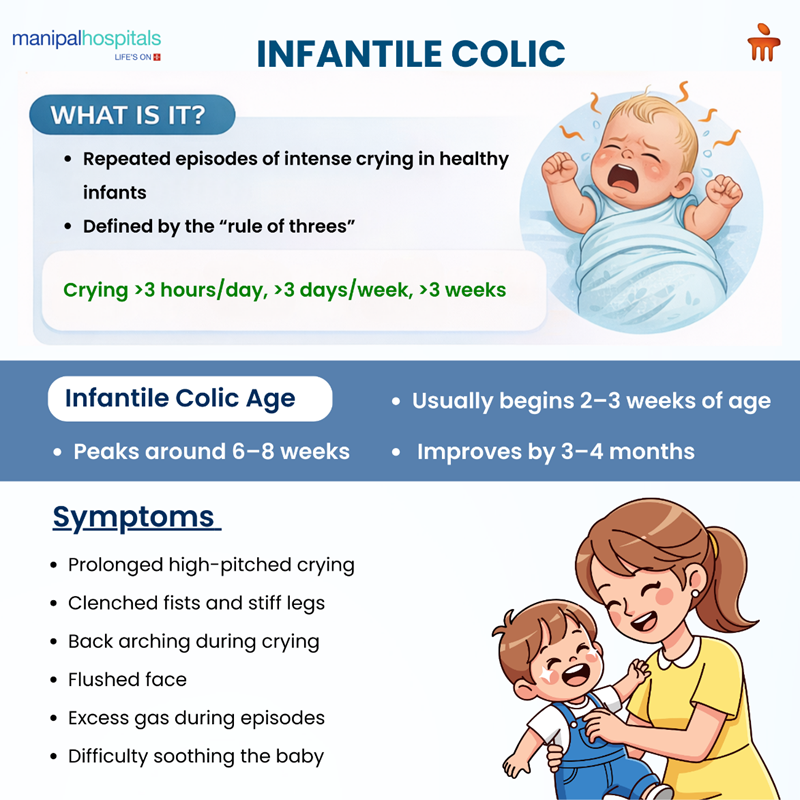
Infantile colic is not a disease. It is a behavioural pattern seen in otherwise healthy, well-fed infants. Traditionally, it is defined using the “rule of 3s”:
-
Crying for more than 3 hours a day
-
For more than 3 days a week
-
For at least 3 weeks
without an identifiable medical cause.
Colic usually begins around 2 to 3 weeks of age, peaks at 6 to 8 weeks, and gradually improves by 3 to 4 months. This typical infantile colic age pattern is important because crying that starts much later or continues beyond five months needs further assessment.
Despite its intensity, babies with colic grow normally, feed adequately, and show no signs of illness on examination.
Recognising the Symptoms of Infantile Colic
Parents often describe a very specific crying pattern. It feels different from hunger or tiredness. It may begin suddenly, often in the late afternoon or evening.
Common symptoms of infantile colic include:
-
Prolonged, high-pitched crying episodes
-
Crying that seems unrelated to feeding or nappy changes
-
Clenched fists and stiffened legs
-
Arching of the back
-
A flushed face during crying spells
-
Passing gas during or after episodes
-
Difficulty being soothed despite usual comforting measures
Between episodes, the baby appears calm, feeds normally, and behaves like any healthy infant.
One of the most reassuring signs is that growth and developmental milestones remain on track. If weight gain is poor or feeding is disrupted, the diagnosis must be reconsidered.
Why Do Infants Get Colic?
One of the most common questions that parents have is, “Why do infants get colic if everything seems normal?” The honest answer is that there is no single cause. Instead, colic appears to arise from a combination of developmental and environmental factors. The current understanding of the causes of infantile colic includes:
-
Immature digestive function: Early gut motility patterns may be uncoordinated, leading to transient discomfort.
-
Gut microbiome imbalance: Differences in intestinal bacteria have been observed in some colicky infants.
-
Heightened nervous system sensitivity: Some babies may be more reactive to stimulation.
-
Parental-infant interaction patterns: Overstimulation or difficulty settling may contribute in certain cases.
-
Cow’s milk protein sensitivity: In a small percentage of infants, especially those with eczema or a family history of allergies.
It is important to understand that excess gas is usually a result of crying rather than the primary cause. Swallowing air during prolonged crying leads to bloating, which can worsen discomfort.
Colic is not caused by poor parenting. It is not a sign of neglect. And it is not your fault.
Warning Signs That Crying May Not Be Colic
Before confirming infantile colic, doctors carefully rule out medical conditions that can mimic it. Persistent crying should never be dismissed without proper evaluation. Red flags that require immediate medical review include:
-
Fever
-
Poor feeding
-
Vomiting that is green or forceful
-
Abdominal swelling
-
Blood in the stool
-
Lethargy
If blood is seen in the stool, this may suggest a protein intolerance or other gastrointestinal condition. Prompt evaluation is essential, and specialised assessment should be sought if you are based locally.
Diagnosis of colic is therefore one of exclusion. A thorough clinical history and examination are often all that is required.
Evidence-Based Infantile Colic Treatment
Parents understandably look for quick relief. While there is no single cure, several strategies can reduce crying intensity and support both baby and caregiver.
The foundation of infantile colic treatment begins with reassurance and structured support. Beyond that, interventions are considered based on feeding type and symptom pattern.
Feeding-Related Adjustments
For breastfed infants:
-
Review the feeding technique and latch
-
Consider a short maternal dairy elimination trial (2-3 weeks) if allergy is suspected
For formula-fed infants:
A trial of extensively hydrolysed formula may be advised in select cases
Routine switching between multiple formulas without guidance is discouraged.
Soothing Techniques
Many babies respond to sensory calming strategies. While these techniques may not eliminate colic entirely, they can shorten the episodes significantly.
-
Gentle rocking or rhythmic movement
-
Swaddling (when done safely)
-
White noise
-
Carrying in a sling
-
Warm baths
-
Tummy time when awake and supervised
Probiotics
Certain probiotic strains, particularly Lactobacillus reuteri, have shown benefit in some breastfed infants. Effects are variable and should be discussed with a paediatrician.
Medications
Simethicone drops have limited evidence. Antispasmodics are generally not recommended due to safety concerns. Medication is rarely first-line in the management of infantile colic.
Infantile Colic Treatment Guidelines at a Glance
Clinical recommendations emphasise minimal intervention and strong parental support. The following table summarises the current infantile colic treatment guidelines and the strength of evidence behind them.
|
Intervention |
Recommended For |
Evidence Strength |
Notes |
|
Parental reassurance & education |
All infants |
Strong |
First-line approach |
|
Feeding assessment |
All infants |
Strong |
Ensures no underlying feeding issue |
|
Maternal dairy elimination |
Breastfed infants with allergy suspicion |
Moderate |
Trial limited to 2-3 weeks |
|
Extensively hydrolysed formula |
Formula-fed infants with allergy suspicion |
Moderate |
Avoid repeated formula changes |
|
Lactobacillus reuteri probiotic |
Select breastfed infants |
Moderate |
Variable response |
|
Simethicone drops |
General use |
Weak |
Limited proven benefit |
|
Antispasmodics |
Routine use |
Not recommended |
Safety concerns |
This structured approach helps avoid unnecessary treatments while focusing on safe, practical strategies that work.
Supporting Parental Wellbeing
Colic does not only affect the baby. Sleep deprivation, constant crying, and feelings of helplessness can take a significant toll on parents.
Important steps include:
-
Taking turns caring for the baby
-
Placing the baby safely in a cot and stepping away briefly if overwhelmed
-
Seeking support from family or friends
-
Discussing emotional strain with a healthcare provider
Persistent crying is one of the strongest triggers for parental burnout. Addressing caregiver well-being is a critical component of the management of infantile colic.
The Natural Course and Prognosis
Colic is self-limiting. Most infants improve significantly by three to four months. Long-term developmental outcomes are normal.
There is no evidence that infantile colic causes permanent digestive problems or behavioural issues. However, early parental stress may affect bonding, which is why early reassurance and structured care are essential.
Conclusion
Infantile colic can feel relentless, especially in the early weeks of parenthood when everything already feels new and fragile. Yet it follows a recognisable pattern, has identifiable features, and resolves naturally with time. Understanding the symptoms of infantile colic, the possible causes of infantile colic, and the safest approaches to infantile colic treatment allows families to move from panic to perspective. If unusual signs such as poor weight gain or blood in the stool appear, seek timely medical evaluation, including expert treatment for infantile colic in Malleshwaram at Manipal Hospital Malleshwaram, Bangalore, whenever needed. With the right guidance and reassurance, even the longest evenings become manageable.
FAQ's
Colic occurs in both groups at similar rates. However, responses to certain interventions, such as probiotics or maternal dietary adjustments, may differ slightly. The feeding method alone does not determine severity or duration.
Current research does not show a direct link between infantile colic and long-term gastrointestinal disease. Most babies with colic grow into healthy children without ongoing digestive concerns.
Many infants experience peak crying in late afternoon or evening hours due to accumulated sensory stimulation and fatigue. However, timing can vary, and some babies cry earlier in the day.
Yes. Persistent vomiting, bilious (green) vomit, fever, lethargy, abnormal stools, or failure to gain weight require urgent medical evaluation. Colic should not be diagnosed without excluding these possibilities.
Babies are sensitive to environmental cues. While anxiety does not cause colic, a tense environment may make soothing more difficult. Structured support and calm routines can improve settling responses.
Share this article on:


