7 Min Read
Do you often feel the desperate urge to pass urine, only to find that nothing comes out, no matter how hard you try? Acute urinary retention can be one of the most distressing experiences a person can face. The pain builds quickly, the lower abdomen feels tight and heavy, and anxiety sets in as minutes stretch uncomfortably. While this condition demands immediate medical attention, what many don’t realise is that it often signals an underlying prostate problem. Without proper treatment, the episode can repeat, each time more alarming than the last.
In this blog, an experienced urologist and andrologist in Hebbal discusses what acute urinary retention really means, why it happens, how it is managed in an emergency, and how HoLEP surgery can offer a durable, long-term solution.
Synopsis
- What Is Acute Urinary Retention?
- Recognising Acute Urinary Retention Symptoms
- Why Does Acute Urinary Retention Happen?
- Emergency Acute Urinary Retention Management
- How Doctors Evaluate the Underlying Cause
- Why Recurrence is Common
- HoLEP: A Modern Surgical Solution
- Benefits of HoLEP
- Risks and Considerations After HoLEP
- What to Expect After Surgery
- Conclusion
What Is Acute Urinary Retention?
Acute urinary retention is the sudden and complete inability to empty the bladder, despite it being painfully full. It is not simply “difficulty passing urine.” It is a medical emergency.
The bladder continues to fill, but the outflow pathway becomes blocked. As pressure rises, discomfort intensifies. In most adult men, the common underlying cause is an enlarged prostate gland that compresses the urethra, narrowing the passage for urine.
Although AUR is considered a urological emergency due to severe discomfort and the risk of bladder or kidney strain, it is rarely immediately life-threatening unless complicated by infection (urosepsis) or prolonged obstruction affecting kidney function.
It is important to distinguish acute from chronic urinary retention:
-
Acute retention is sudden and painful.
-
Chronic retention develops gradually, may be painless, and can silently damage the kidneys over time if left undetected.
This difference matters because chronic retention may go unnoticed for months
Recognising Acute Urinary Retention Symptoms
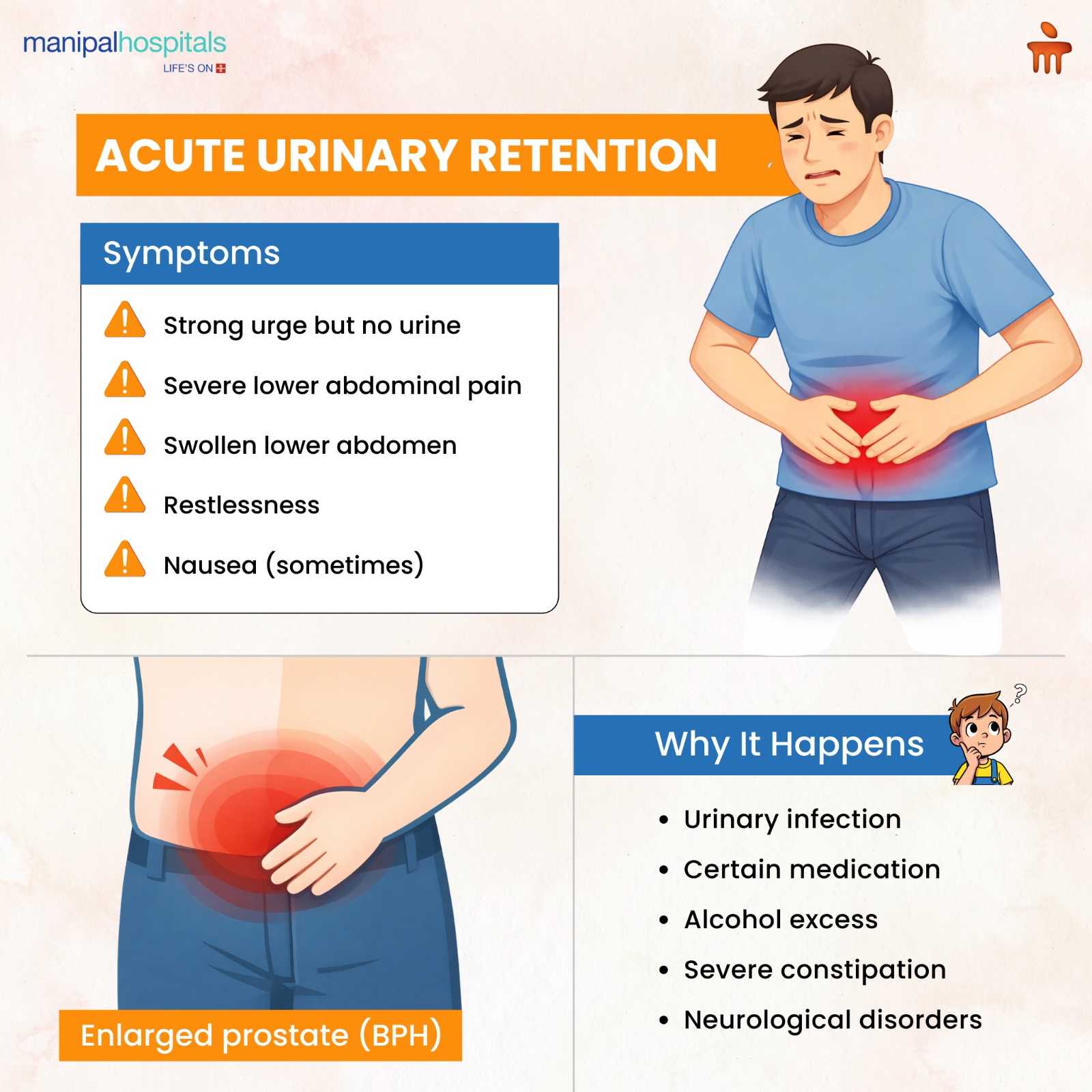
Understanding acute urinary retention symptoms can help you act quickly. Thankfully, the signs are easy to identify, making it easy to get prompt treatment as well. Some concerning signs may include:
-
Sudden inability to pass urine
-
Severe lower abdominal pain or pressure
-
A visibly or palpably swollen lower abdomen
-
Restlessness due to discomfort
-
Nausea, in some cases, is due to intense pain
Occasionally, men may notice warning signs before a full episode occurs. These may include a weak stream, straining to pass urine, interrupted flow, or frequent night-time urination. Ignoring these early changes often leads to an emergency situation later.
Why Does Acute Urinary Retention Happen?
While several conditions can trigger acute urinary retention, one of the biggest reasons is age. In men over 50, benign prostatic enlargement remains the leading cause. Some other possible triggers include:
-
Severe urinary tract infection causing swelling
-
Certain medications that tighten the bladder neck
-
Alcohol excess
-
Severe constipation
-
Prolonged immobility
-
Neurological disorders affecting bladder control
In many cases, the prostate gradually enlarges over the years. The urinary channel narrows silently. Then one day, a minor trigger such as dehydration or medication pushes the bladder beyond its ability to compensate, resulting in complete blockage.
Emergency Acute Urinary Retention Management
When a patient presents with acute urinary retention, the priority is immediate relief. This is achieved through catheterisation.
A sterile tube is gently inserted through the urethra into the bladder to drain the trapped urine. The relief is often dramatic. Pain subsides within minutes as pressure decreases. However, catheterisation is not the final answer. It is a temporary step in acute urinary retention management.
How Doctors Evaluate the Underlying Cause
Following emergency relief, proper evaluation is essential to prevent recurrence. So, the real question becomes: why did it happen, and how do we prevent it from happening again? To get the answers to these questions, doctors usually perform:
-
Ultrasound to assess prostate size and bladder health
-
Post-void residual volume measurement
-
Blood tests to evaluate kidney function
-
PSA testing, when appropriate
-
Uroflowmetry (urine flow rate test)
-
Cystoscopy in selected cases
If the prostate is significantly enlarged, medication may be tried initially. Not every case of acute urinary retention requires surgery immediately. A detailed consulting urology in Manipal Hospitals Hebbal, Bangalore helps determine the most pressing factors and the most appropriate acute urinary retention treatment plan. But when episodes recur or the obstruction is severe, surgery becomes the definitive solution.
Why Recurrence is Common
Many men experience a cycle. A catheter is inserted. It is removed after a few days. Urination improves briefly. Then retention happens again.
This repeated pattern occurs because the underlying mechanical obstruction has not been corrected. Medication may relax prostate muscles, but it cannot remove the excess tissue causing blockage. Each time the issue reappears, it only increases the risk of:
-
Damage to the bladder muscles
-
Recurrent infections
-
Reduced function of the kidneys
-
Emotional stress and fear of another sudden episode
Breaking this stressful cycle requires addressing the root cause directly.
HoLEP: A Modern Surgical Solution
Holmium Laser Enucleation of the Prostate (HoLEP) is an advanced surgical technique designed to remove obstructive prostate tissue precisely and completely. Unlike traditional surgery, HoLEP uses a high-energy holmium laser passed through a telescope inserted via the urethra. There are no external cuts. The laser separates and removes the enlarged portion of the prostate, restoring a clear urinary channel.
HoLEP is particularly effective for:
-
Large prostate glands
-
Recurrent urinary retention
-
Patients requiring durable long-term relief
HoLEP works by physically eliminating the obstruction. Once the excess tissue is removed, urine flows freely without resistance.
Benefits of HoLEP
For men who have endured repeated catheterisations, HoLEP offers not just treatment but reassurance. Key advantages include:
-
Suitable for very large prostates
-
Minimal bleeding due to laser precision
-
Short hospital stay
-
Low recurrence rate
-
Durable, long-term results
Most patients are catheter-free within a short period after surgery. The fear of sudden blockage disappears because the anatomical cause has been resolved.
Risks and Considerations After HoLEP
Like any surgical procedure, HoLEP has potential side effects:
-
Temporary urinary incontinence (usually resolves within weeks)
-
Temporary urgency or frequency
-
Retrograde ejaculation (common and usually permanent)
-
Rare urethral stricture
Most men experience a significant improvement in urinary flow. Burning during urination and mild blood in urine may occur temporarily. Discussing expectations beforehand ensures informed decision-making.
What to Expect After Surgery
Recovery from HoLEP is generally smooth. Although you may experience mild burning during urination and slight blood in urine for a few days, these symptoms gradually settle, and your urinary flow will improve massively.
Many patients describe the difference as life-changing. Sleep improves because nighttime urgency reduces. Daytime confidence returns.
Follow-up visits ensure healing is progressing well and bladder function is stable.
Conclusion
Acute urinary retention is more than a painful inconvenience. It is a warning sign that the urinary system is under strain. Emergency catheterisation provides relief, but lasting freedom requires addressing the obstruction itself. For men dealing with repeated episodes, HoLEP has emerged as a reliable and durable solution.
If you are exploring options for acute urinary retention treatment or seeking expert acute urinary retention management, consulting an experienced urologists at Manipal Hospital Hebbal, Bangalore, can help you make an informed choice. Our specialized centers offer comprehensive evaluation and HoLEP expertise to ensure safe and effective care.
FAQ's
If left untreated for prolonged periods, back pressure from a full bladder can impair kidney function. However, when treated promptly and followed by correction of the underlying cause, kidney damage is usually reversible. Early medical attention is crucial to prevent long-term complications.
Not necessarily. Some men with moderately enlarged prostates develop severe obstruction, while others with larger glands may have milder symptoms. The direction of growth and its impact on the urinary channel often matter more than size alone.
Recurrence can happen within days or weeks if the obstruction remains significant. This unpredictability is why definitive treatment is often recommended after repeated episodes.
Limiting alcohol intake, avoiding medications that worsen urinary flow, staying hydrated without over-distending the bladder, and managing constipation can reduce risk. However, these measures cannot reverse significant prostate enlargement.
HoLEP is often considered safer than traditional surgery because it involves minimal bleeding and shorter anaesthesia time. Many elderly patients with cardiac or metabolic conditions tolerate it well after an appropriate medical evaluation.
Share this article on: