5 Min Read
Finding a hard lump near a bone can be unsettling, especially when it appears without pain or injury. While such discoveries naturally raise concerns about serious conditions, it is important to know that many bone growths are harmless. One of the most common benign bone tumours is osteochondroma.
An osteochondroma is a non-cancerous growth made of bone and cartilage, accounting for nearly 35% of all benign bone tumours. It usually develops near the growth plate of a bone during childhood or adolescence. At Manipal Hospital Pune, our experienced orthopaedic specialists help patients understand this condition clearly and guide them with evidence-based, compassionate care at every stage.
Synopsis
- What Is Osteochondroma?
- Understanding Osteochondroma Causes
- Osteochondroma Symptoms: When to Be Concerned
- Can Osteochondroma Turn Cancerous?
- Accurate Diagnosis at Manipal Hospital Baner, Pune
- Advanced Osteochondroma Treatment Options
- Do’s and Don’ts for Patients with Osteochondroma
- Expert Orthopaedic Care at Manipal Hospital Baner, Pune
What Is Osteochondroma?
Osteochondroma is an abnormal outward growth of bone that is capped with cartilage. Instead of growing in length like a normal bone, a portion of cartilage grows outward, forming a lump on the bone surface.
These growths most commonly occur in:
-
The femur (thigh bone)
-
Tibia (shin bone)
-
Humerus (upper arm bone)
-
Around the knee, shoulder, or pelvis
In most cases, osteochondromas are slow-growing, painless, and stop enlarging once skeletal growth is complete.
Understanding Osteochondroma Causes
Many patients ask, “Why did this happen to me?” While the exact cause of a single osteochondroma is not always known, medical research points to a few well-established factors.
1. Growth Plate Abnormality
The most widely accepted explanation is a minor defect in the growth plate during childhood. A small fragment of cartilage grows outward instead of contributing to normal bone length, forming an osteochondroma.
2. Genetic Factors
When multiple osteochondromas are present, the cause is often genetic. This condition is known as Multiple Hereditary Exostoses (MHE), linked to mutations in the EXT1 or EXT2 genes.
-
MHE is inherited
-
Each child of an affected parent has a 50% chance of developing the condition
3. Previous Injury or Trauma
Although less common, some experts believe trauma to a growing bone may trigger abnormal cartilage growth. However, this link is not conclusively proven.
Osteochondroma Symptoms: When to Be Concerned
Many people live with osteochondroma without any symptoms, discovering it accidentally during an X-ray for another problem. When symptoms occur, they usually depend on the size and location of the growth.
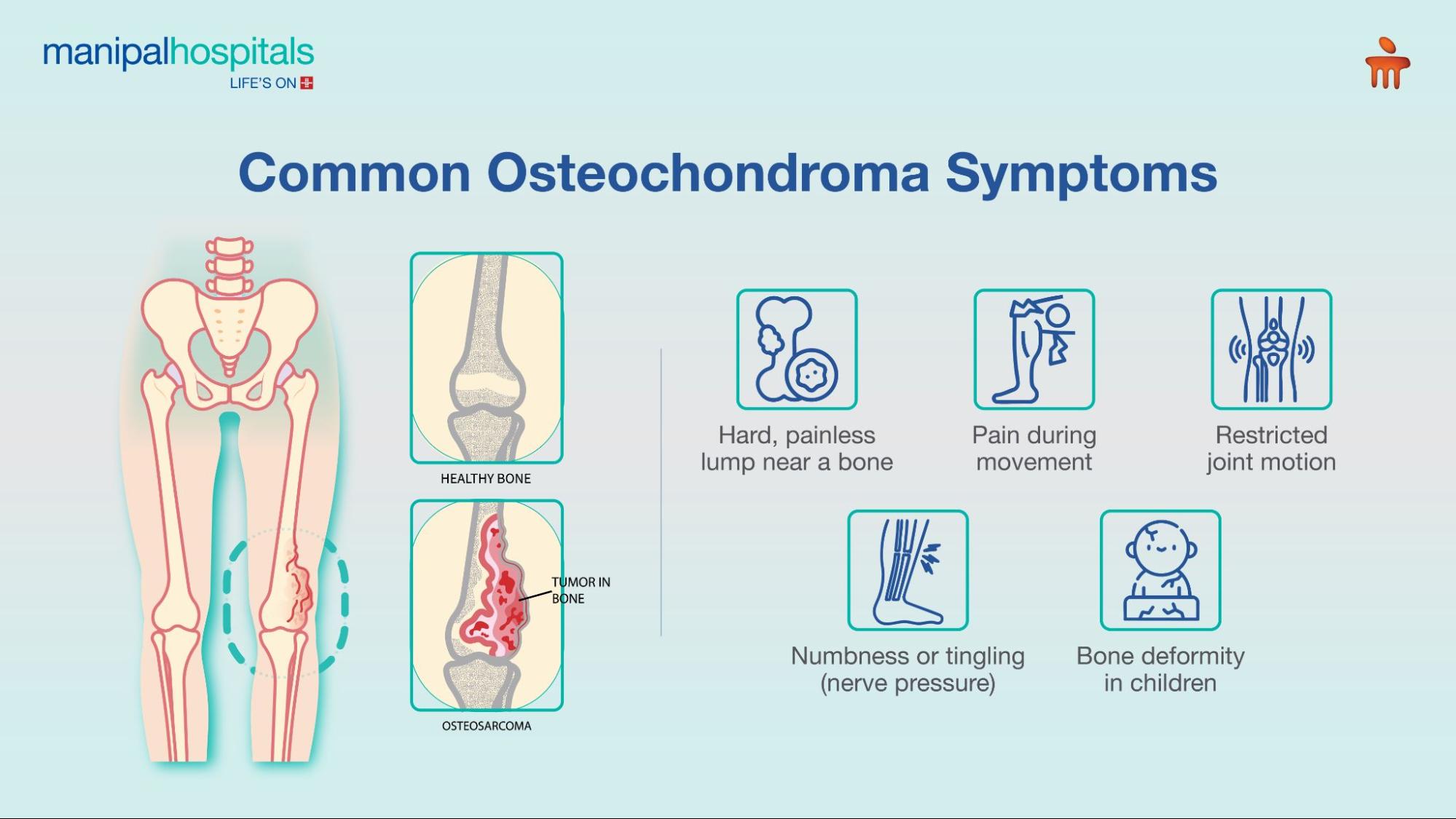
Common Osteochondroma Symptoms Include:
-
Hard, painless lump near a joint
-
Pain or discomfort, especially during movement
-
Restricted joint movement if the growth interferes with mobility
-
Numbness, tingling, or weakness due to nerve compression
-
Swelling or inflammation from irritated muscles or tendons
-
Bone deformity in children if growth affects bone development
Can Osteochondroma Turn Cancerous?
This is one of the most common fears. Thankfully, malignant transformation is extremely rare:
-
Less than 1% risk for a single osteochondroma
-
3–5% lifetime risk in patients with MHE
However, sudden pain, rapid growth after adulthood, or increasing swelling should be evaluated immediately, as these may indicate rare osteochondroma cancer symptoms.
Accurate Diagnosis at Manipal Hospital Baner, Pune
At Manipal Hospital Baner, accurate diagnosis is the foundation of effective treatment. Our orthopaedic team uses advanced imaging and clinical expertise to ensure precise evaluation.
Diagnostic Steps Include:
-
Physical Examination - The doctor assesses the lump, checks joint movement, and looks for nerve or blood vessel involvement.
-
X-rays - X-rays are usually sufficient to diagnose osteochondroma, clearly showing the bone growth and its connection to the parent bone.
-
CT Scan - CT scans provide detailed, three-dimensional images, especially useful when surgery is being considered.
-
MRI Scan - MRI helps evaluate the cartilage cap and surrounding soft tissues. A thickened cartilage cap may require closer monitoring.
-
Biopsy (Rarely Needed) - A biopsy is only recommended if imaging raises concern for malignancy.
Advanced Osteochondroma Treatment Options
Not every osteochondroma requires treatment. The management approach depends on symptoms, age, and functional impact.
Watchful Waiting
For small, painless osteochondromas, regular monitoring with periodic X-rays is often the best option.
Non-Surgical Treatment
Mild symptoms may be managed with:
-
Activity modification
-
Pain relief medications
-
Physiotherapy to reduce irritation
Surgical Excision
Surgery is advised when the osteochondroma causes:
-
Persistent or worsening pain
-
Nerve or blood vessel compression
-
Limited joint movement
-
Cosmetic deformity
-
Suspicion of malignancy
The procedure involves the complete removal of the growth, including the cartilage cap. At Manipal Hospital Pune, our orthopaedic surgeons use precise surgical techniques with excellent outcomes.
-
90–95% of patients experience complete symptom relief
-
Recurrence after complete removal is very rare
Do’s and Don’ts for Patients with Osteochondroma
Do’s:
-
Do consult an orthopaedic specialist for any unexplained bone lump
-
Do attend follow-up appointments as advised
-
Do report new pain, growth, or numbness immediately
-
Do maintain a record of symptom changes
Don’ts:
-
Don’t panic, most osteochondromas are harmless
-
Don’t ignore pain or restricted movement
-
Don’t rely on self-diagnosis
-
Don’t strain the affected area without medical advice
Expert Orthopaedic Care at Manipal Hospital Baner, Pune
If you or your child has noticed a bone lump or are experiencing symptoms related to osteochondroma, early evaluation is essential. At Manipal Hospital Baner, Pune, our expert orthopaedic surgeons combine advanced diagnostics with personalised treatment plans to ensure safe and effective care.
Book your consultation today for clarity, confidence, and comprehensive bone care.
Disclaimer: This article is for informational purposes only and does not replace professional medical advice. Please consult a qualified orthopaedic specialist for diagnosis and treatment.
FAQ's
It is a benign bone tumour made of bone and cartilage, commonly found near growth plates in children and adolescents.
No, it is usually harmless. Cancerous change is very rare.
It usually stops growing after skeletal maturity, typically in the late teens or early twenties.
No. Surgery is only required if symptoms affect daily life or if complications arise.
Yes, most people can exercise normally unless pain or joint restriction is present.
Single osteochondroma is not hereditary, but multiple osteochondromas (MHE) are genetic.
Share this article on: