8 Min Read
For many women, a breast cancer diagnosis comes as a sudden diagnosis, especially when there is no obvious family history or genetic warning, and when that happens, the immediate questions that echo in their minds are, "How did this happen?" Could it have been prevented?
For years, breast cancer has largely been understood in terms of factors we cannot control, such as age, genetics, and hormonal changes. Among these, inherited mutations like BRCA1 and BRCA2 have been especially important to identify, particularly in families with a history of breast or ovarian cancer. These genetic changes significantly increase lifetime risk, and screening for them has enabled earlier monitoring and better outcomes for many women.
However, this information is only part of the picture. Recent studies show that the small choices we make each day may have a bigger impact than we once believed. This does not mean lifestyle is the only cause, but it does shift the conversation from thinking breast cancer is unavoidable to recognising that some risks can be managed.
In this blog, we examine the shifting understanding of breast cancer risk, combining established knowledge with emerging insights, as explained by a leading oncologist in Yelahanka, Bangalore.
Synopsis
- A New Way of Thinking About Risk
- The Numbers We Can’t Ignore
- The Silent Shift in Risk Patterns
- When Lifestyle Turns into a Risk Factor
- How Lifestyle Affects the Body
- A New Risk Profile: Younger Women
- Prevention: A Shift from Reaction to Awareness
- Simple Lifestyle Measures That Matter
- Why This Perspective Matters
- When Should You Be More Vigilant?
- Conclusion
A New Way of Thinking About Risk
In the past, breast cancer risk was linked to things that couldn't be changed. These are:
-
Getting older: The risk increases as women age.
-
Genetics: Mutations like BRCA1 and BRCA2 greatly increase the risk.
-
Family history: Having close relatives with breast cancer raises the risk.
These are still important, but they don't fully explain why so many women who don't have these risk factors still get the disease.
Recent global research, including findings published in The Lancet Oncology, has pointed out an important fact: a substantial percentage of breast cancer cases may be associated with modifiable lifestyle and metabolic factors.
This gives us a new perspective: risk does not always appear suddenly. It can build up gradually over time.
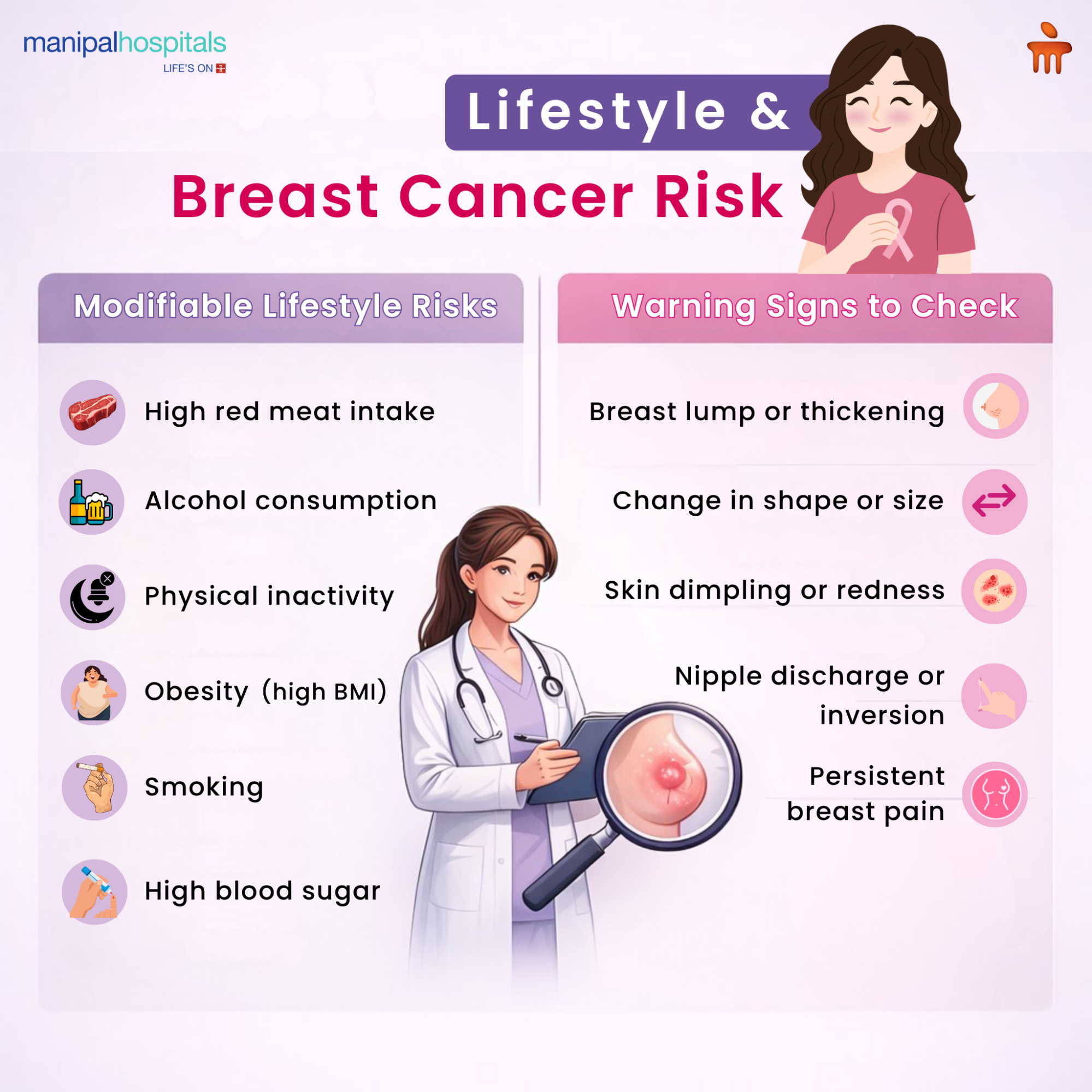
The Numbers We Can’t Ignore
Recent findings highlight how daily habits can affect breast cancer risk. No single factor is responsible, but their combined effect matters.
Lifestyle Factors Linked to Breast Cancer Risk:
|
Risk Factor |
Estimated Contribution |
What It Means |
|
High red meat intake |
~11% |
Diet patterns may influence hormonal and metabolic pathways |
|
Tobacco use |
~8% |
Smoking affects cellular health and increases cancer risk |
|
High blood sugar |
~8% |
Poor glucose control impacts metabolic balance |
|
High BMI (overweight/obesity) |
6–7% |
Excess fat tissue can alter hormone levels |
|
Alcohol consumption |
~2% |
Even moderate intake may slightly increase risk |
|
Physical inactivity |
~2% |
Lack of movement affects metabolism and hormone regulation |
These numbers might seem small individually, but together they account for a significant part of the overall breast cancer risk. It's not just the percentage that matters; it's the pattern. These risks are often linked and grow over time.
The Silent Shift in Risk Patterns
In recent years, there has been a clear change in how breast cancer risk presents, especially in cities.
Some areas have seen a decrease in the risks associated with smoking, but other factors have quietly emerged as contributors:
-
Rising obesity rates: Particularly in younger women
-
Increasing diabetes and insulin resistance: Even in the 30s and 40s
-
Sedentary lifestyles: Long hours of sitting, minimal physical activity
-
Dietary changes: Increased consumption of processed and high-calorie foods
This shift is especially noticeable in places like India, where new work patterns, changing lifestyles, and rapid urbanisation are affecting people's overall health.
This trend does not mean traditional risks are less important. It means there are more layers of risk that we are only beginning to understand.
When Lifestyle Turns into a Risk Factor
Metabolic changes develop slowly, unlike genetic mutations or sudden illnesses. They often do not show clear signs at first. Common contributing patterns include:
-
Long working hours with minimal movement
-
Irregular meal timings or frequent processed food intake
-
Chronic stress with little recovery time
-
Poor sleep patterns
-
Gradual weight gain over the years
These habits may seem manageable on their own, but together they can affect the body's function.
How Lifestyle Affects the Body
-
Hormonal imbalance: Excess body fat can increase estrogen levels
-
Insulin resistance: Affects how the body uses sugar and energy
-
Chronic inflammation: Increases the risk of diseases developing in the body
-
Cellular stress: Prolonged metabolic stress alters typical cellular function
Over time, these changes can increase the risk of diseases like breast cancer.
A New Risk Profile: Younger Women
More women aged 30 to 50 are getting breast cancer, which is concerning.
A lot of women have no significant family history, do not carry known genetic mutations, and appear otherwise healthy. This is where lifestyle and metabolic factors may play a bigger role. For this group, the risk is often hidden. It does not follow the usual patterns, which makes early detection more difficult. This does not mean lifestyle alone causes breast cancer. However, it shows that the range of risks is broader than we once thought.
Prevention: A Shift from Reaction to Awareness
It is important to note: Living a healthy life does not eliminate the risk of getting breast cancer.
But it can lower the risk, which is where preventive oncology becomes important. There is now more emphasis on long-term health patterns instead of just detection.
Simple Lifestyle Measures That Matter
-
Maintain a healthy weight: Helps regulate hormone levels
-
Stay physically active: Even moderate exercise improves metabolic health
-
Balanced diet: Focus on whole foods, fibre, and reduced processed intake
-
Limit alcohol consumption: Even small reductions can help
-
Control blood sugar levels: Important for overall metabolic balance
-
Manage stress: Chronic stress affects hormonal health
-
Prioritise sleep: Supports immune and metabolic function
These changes are relatively simple. They are small, regular habits that support your health over time.
Why This Perspective Matters
For a long time, people believed breast cancer happened without warning. While this is still true in many cases, our changing understanding gives us something valuable: a sense of control. There is no blame or guilt involved. This is not about saying your lifestyle causes cancer.
Instead, it is about realising that the risk may increase over time and add up with small habits. Being aware lets you act sooner. This shift in thinking can be empowering. It changes the conversation from feeling helpless to making informed choices.
When Should You Be More Vigilant?
Being aware of your lifestyle matters, but regular check-ups and medical advice remain essential.
If you see any of the following, you should think about seeing a doctor:
-
A lump or thickening in the breast
-
Changes in breast shape or size
-
Skin changes such as dimpling or redness
-
Nipple discharge or inversion
-
Persistent breast pain
Women with a higher risk (due to a family history or genetic predisposition) may be advised to undergo screening earlier and more often.
Conclusion
Breast cancer is complicated. It can't always be predicted, and it can't always be stopped. But it is becoming more and more clear that some aspects of risk can be modified.
Risks we often overlook, such as daily habits, metabolic health, and long-term lifestyle patterns, can affect outcomes over time. Knowing these facts should not cause fear. It helps people become more aware. When you combine awareness with regular screenings and good choices, you can make a real difference.
You do not need to make significant changes or have perfect routines to care for your health. Small, regular choices can help your body over time. Sometimes, the risks we do not notice are the ones that deserve the most attention.
FAQ's
No, making changes to your lifestyle cannot completely stop breast cancer. But they can lower the risk by improving metabolic health, hormone balance, and general health, which may lower the chances of getting the disease.
Genetics is a factor, but many women with breast cancer do not have a family history. More and more, people are realising that lifestyle and environmental factors add to overall risk.
Different groups have different recommendations for when women should start getting regular mammograms. Most women should start getting them around age 40, or sooner if they have a family history or genetic risk factor.
Yes, regular exercise helps keep a healthy weight, balance hormones, and lower inflammation, all of which can lower the risk of cancer over time.
Yes, there has been a clear increase in cases among younger women. Changing lifestyle and metabolic factors may be making this trend happen, even though it is still less common than in older women.
Share this article on: