6 Min Read
Prostate health often becomes a concern as men grow older, especially when urinary changes start showing up. Many people ask what size of prostate is dangerous, but the answer depends on age. The prostate is a small gland in younger men, and it slowly increases in size with age.
An increase in size is common and happens in many men after 50. It does not always mean something serious. At the same time, a larger prostate can start pressing on the urinary passage and cause discomfort. That is where questions like "Is enlarged prostate dangerous?" begin to come in.
In this blog we present clinical insights from a top urologist in Yelahanka, Bangalore, to help you understand how the prostate size impacts your overall health. We also discuss the symptoms and causes of an enlarged prostate and when to ignore it and when to get it checked.
Synopsis
Understanding Normal Prostate Size
A clear idea of prostate size helps you understand what is normal and what needs attention. In younger men, the prostate is about the size of a walnut. Its weight stays around 20 to 30 grams and is about 20 to 30 cubic centimeters (cc) in volume. At this stage, it does not cause any pressure on the urinary passage.
With age, the gland slowly increases in size. This change is linked to a condition called benign prostatic hyperplasia, or BPH. It is not cancer, but a natural growth pattern seen in many men. By the time a man crosses 50, the prostate may grow beyond 30 grams (30 cc) and continue increasing over time.
Prostate Size Chart by Age
Looking at prostate size enlargement across age groups gives a better sense of what changes are expected. The prostate does not stay the same size throughout life. Most men experience a slow growth pattern with age. The table below shows how size tends to increase and how it is classified based on volume in cubic centimeters (cc).
|
Age Range |
Typical Prostate Size |
Classification |
|
20–40 |
20–30 cc |
Normal |
|
40–60 |
30–50 cc |
Mildly Enlarged |
|
60+ |
50–80 cc |
Moderately Enlarged |
|
70+ |
80+ cc |
Severely Enlarged |
What Size of Prostate Is Dangerous?
Many patients ask what size of prostate is dangerous, but there is no single number that fits everyone. An increase in size from 30 cc to 50 cc may sound significant, but it does not always lead to symptoms. Doctors do not define danger only by size. Still, some ranges help give a rough idea. A prostate above 40 to 50 cc often begins to cause symptoms in many men. When it reaches around 80 to 100 cc or more, it is considered significantly enlarged and more likely to affect daily life.
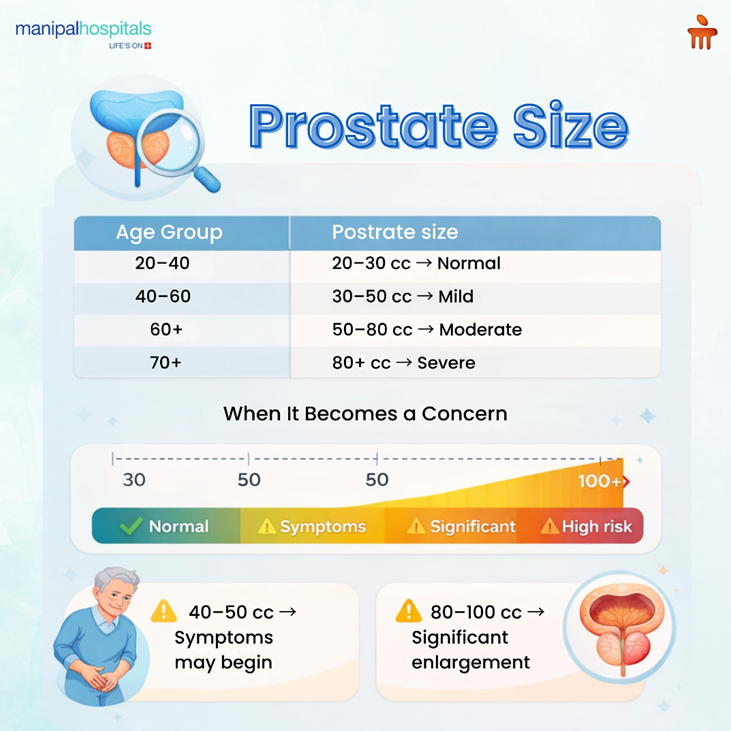
The main issue is not just the size; it’s what the enlarged gland does in the body. The prostate surrounds the urethra, the tube that carries urine out. As it grows, it presses on this tube and blocks urine flow.
Problems that can develop include:
-
Difficulty starting urination
-
Weak or interrupted urine stream
-
Feeling that the bladder is not fully empty
-
Sudden inability to pass urine (urinary retention)
-
Repeated urine infections
-
In severe cases, pressure affecting bladder and kidney function
So, when people ask if an enlarged prostate is dangerous, the answer depends more on symptoms and complications than the number alone.
Signs That Prostate Enlargement Needs Attention
Certain symptoms can appear early and should not be ignored. First, many men notice changes in their urination pattern. The flow may feel weaker than before, or there may be a frequent urge to pass urine.
Common signs include:
-
Weak or slow urine stream
-
Passing urine more often, especially at night (frequent urination)
-
Sudden urge to urinate that is hard to control (urinary urgency)
-
Feeling that the bladder is not fully empty (incomplete bladder emptying)
Some symptoms need quicker attention as they may point to significant blockage or irritation:
-
Inability to pass urine at all (urinary retention)
-
Blood in urine (hematuria)
-
Pain during urination or discomfort in the lower abdomen
Medical help is needed if these symptoms start affecting daily routine, sleep, or overall comfort. Early evaluation can help prevent complications and make treatment easier.
Does an Enlarged Prostate Affect a Man Sexually?
This issue is a common concern when symptoms begin. An enlarged prostate does not directly stop sexual activity, but some men may notice changes in certain situations.
These changes are usually linked to urinary symptoms, age-related factors, or side effects of treatment rather than the enlargement itself. Some men may notice:
-
Difficulty in getting or maintaining an erection
-
Reduced force or volume of ejaculation
-
Mild discomfort during or after ejaculation
Many men with prostate enlargement continue to have normal sexual function without any problems.
Treatment Options
Treatment depends on symptoms, prostate size, and how much it affects daily life. Not every case needs surgery, and many men manage well with simple steps.
Treatment options include:
-
Lifestyle changes such as reducing caffeine, limiting fluids at night, and improving bladder habits
-
Medications like alpha blockers that relax muscles and 5-alpha reductase inhibitors that help shrink the prostate over time
-
Minimally invasive procedures to improve urine flow without major surgery
-
Surgery in cases where symptoms are severe or not improving with other treatments
When to Seek Medical Help
It is important to see a doctor if symptoms start affecting daily routine or do not improve. Early care can help prevent complications.
Seek medical attention if you notice:
-
Difficulty passing urine or sudden inability to urinate
-
Frequent urination that disrupts sleep
-
Blood in urine
-
Pain or discomfort in the lower abdomen
Conclusion
When people think about what size of prostate is dangerous, the answer depends on how much the gland is starting to affect them. Some men with a larger prostate may feel fine. Others may struggle even with a smaller enlargement and have difficulty with urine flow.
Ignoring symptoms can lead to discomfort and complications over time. If you are noticing changes, it is better to get checked without delay. For reliable evaluation and enlarged prostate treatment in Yelahanka, you can consult our urology specialists at Manipal Hospital Yelahanka for proper guidance and care.
FAQ's
A prostate gland volume above 30 cc can be considered enlarged. Many men cross this size after 50. A young person’s prostate measures between 20 cc and 30 cc.
No, not always. Many men live with an enlarged prostate and do not face serious issues. The concern starts when it begins to affect urine flow, sleep, or comfort. That is when it needs attention.
Yes, in many cases. Medicines can relax or shrink the prostate over time. Simple changes like reducing caffeine and managing fluids also help. Surgery is only needed if symptoms are severe or do not improve.
No, prostate enlargement and prostate cancer are different conditions. One does not directly turn into the other. Still, regular check-ups help rule out any serious problems early.
You should see a doctor if you notice weak urine flow, frequent urination, or discomfort. Seek care if you cannot pass urine, notice blood, or feel pain. Early advice helps manage the condition better and avoid complications.
Share this article on: