7 Min Read
In the modern landscape of 2026, the timeline of a woman’s life looks very different from it did just a few decades ago. Many women are choosing to prioritise higher education, establish complex careers, and achieve financial independence before starting a family. This shift has made delayed motherhood a very common choice across the globe.
While this decision allows for emotional and professional maturity, it is also a choice that interacts with our biology in specific ways. Our bodies operate on a hormonal clock that hasn't quite caught up with our social progress, and this creates a unique set of considerations for long-term health.
One of the most discussed topics in women’s wellness is the relationship between the timing of pregnancy and breast health. There are numerous aspects in connection with age and breast cancer; however, one of the primary aspects that needs to be considered is the age of women's first pregnancy. As this age grows, certain processes take place in the body, influencing the overall well-being of females, especially in terms of breast cancer risks.
In this blog, we discuss the link between delayed pregnancy and the increased risk of breast cancer, as explained by a leading oncologist in Yelahanka, Bangalore.
Synopsis
- What Happens to Breast Tissue Over Time?
- The Role of First Pregnancy Age
- Understanding Hormonal Exposure Over the Years
- Pregnancy After 35: What Changes?
- The Impact of Breastfeeding
- The Role of Nulliparity
- Comparing Early and Delayed Motherhood
- Putting Risk into Perspective
- Emotional and Social Considerations
- Practical Steps for Breast Health
- When to Seek Medical Advice
- Conclusion
What Happens to Breast Tissue Over Time?
Breast tissue is dynamic and highly responsive to hormones such as estrogen and progesterone. These hormones regulate growth, development, and cyclical changes throughout a woman’s life. Before a full-term pregnancy, breast cells remain in a relatively immature state.
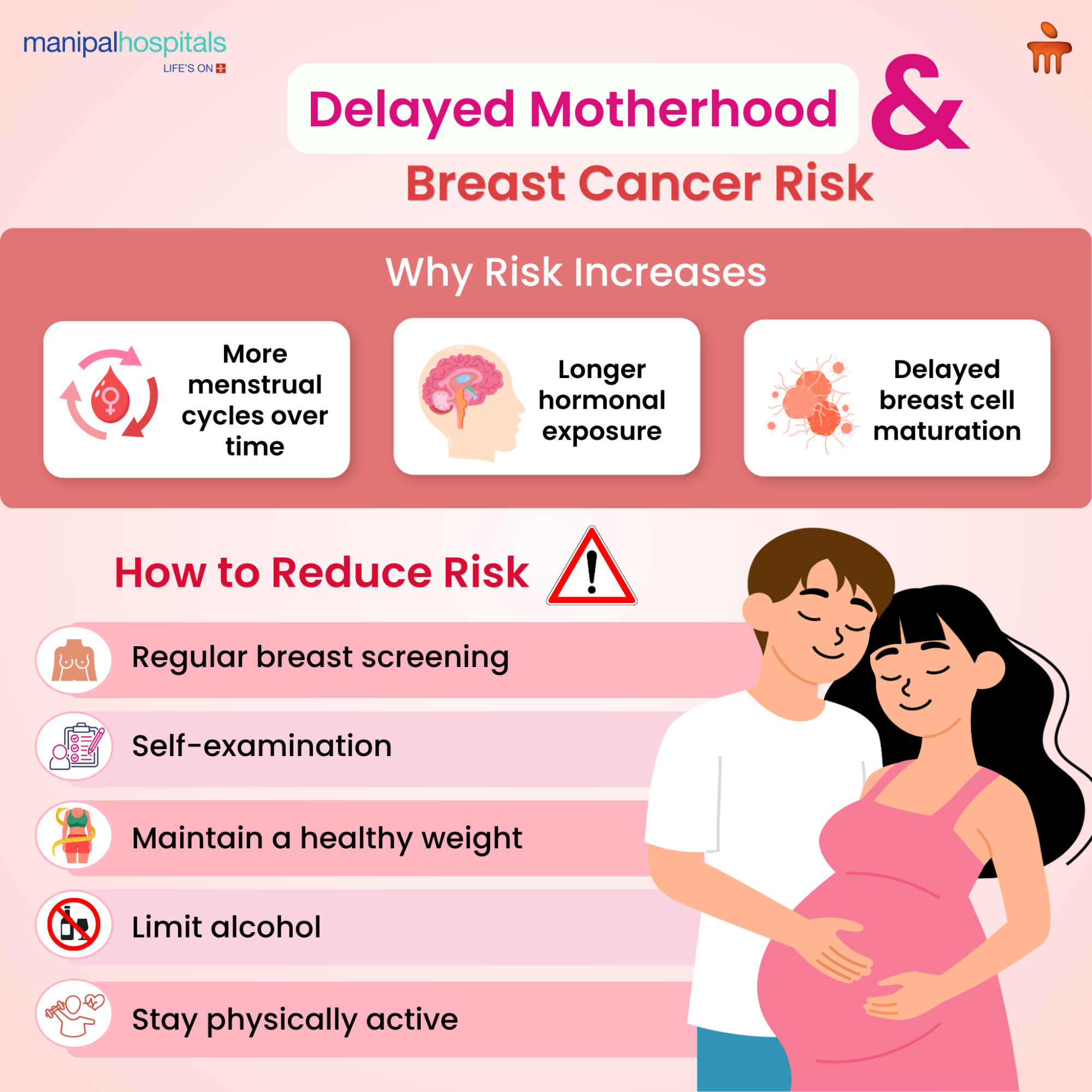
With each menstrual cycle, these cells undergo repeated stimulation. They grow, divide, and then regress if pregnancy does not occur. This ongoing process contributes to hormonal exposure and breast cancer risk over time.
When looking at breast tissue changes with age, it becomes clear that prolonged exposure to these cycles increases the cumulative effect on cells. While most changes are harmless, the longer this pattern continues, the greater the possibility of cellular alterations.
A full-term pregnancy interrupts this cycle. It causes breast cells to mature and become more specialised, making them less sensitive to hormonal fluctuations. This biological shift is one reason why earlier pregnancy is often associated with reduced long-term breast cancer risk.
The Role of First Pregnancy Age
The age of the first pregnancy is vital for defining when breast tissue achieves this more protected condition. Those women who become mothers at a younger age gain protective effects earlier.
In contrast, delayed motherhood extends the duration during which breast tissue is exposed to repeated hormonal cycles. This does not directly cause cancer, but it alters the biological environment over time.
Research on reproductive factors and breast cancer shows that:
-
Women who have their first child later may experience a slightly higher risk - with an estimated ~3% relative increase in risk for each year of delay
-
The risk of breast cancer after 35 is higher compared to earlier pregnancies
-
Women with nulliparity and breast cancer association have a ~20–30% higher relative risk compared to women who have had an early first childbirth
It is important to emphasise that these are relative risks. For most individuals, the absolute increase remains small.
Understanding Hormonal Exposure Over the Years
The role of hormones and breast cancer exposure is important in this context. Each monthly period is a source of hormonal stimulation for the breast. With time, the effect becomes cumulative.
When pregnancy occurs early:
-
The number of menstrual cycles is reduced
-
Hormonal stimulation is interrupted sooner
-
Breast cells mature earlier
Due to delayed motherhood, the exposure period becomes prolonged. There is continued hormone activity in the cells for many more years, resulting in the eventual changes in risk patterns—including the cumulative ~3% per year relative increase with delayed first childbirth.
Thus, the relationship between delayed pregnancy and breast cancer can be understood not through causality but through biology.
Pregnancy After 35: What Changes?
When addressing potential risks associated with late pregnancy, it is vital to remember that those risks do not come into play instantaneously. For women who give birth for the first time after age 35, there is an elevated chance of breast cancer developing shortly after pregnancy ends.
The reason for this lies in the rapid development of changes occurring in the breast during pregnancy and post-delivery. Breast cells proliferate, change their structure, and adjust to hormonal shifts. This increase reflects underlying biological changes and cumulative exposure — not a sudden or dramatic jump, but part of the gradual risk increase seen with delayed first pregnancy.
Nevertheless, the risks are only temporarily higher than usual because pregnancy eventually protects the woman from breast cancer. The relationship between age and breast cancer is therefore dynamic rather than fixed.
The Impact of Breastfeeding
Another critical component that should be considered here is the role of breastfeeding in cancer risk. Breastfeeding has been shown to serve as an effective preventive measure for breast cancer, which is explained by:
-
Reduced number of menstrual cycles
-
Lower overall hormonal exposure
-
Continued maturation of breast tissue
Even a relatively short period of breastfeeding may help prevent breast cancer, but longer periods have more positive effects, with an estimated ~3–5% reduction in breast cancer risk associated with breastfeeding.
The Role of Nulliparity
The terms "nulliparity" and "breast cancer" refer to women who have never had a full-term pregnancy. Research has found that nulliparous women might be at slightly more risk than women who have previously borne a child.
This occurs mainly because of continuous cycles of hormones without any intermission. The lack of pregnancies leads to a failure of the breast tissues to mature through childbirth. This condition is associated with a ~20–30% higher relative risk compared to women with early first childbirth, though the absolute risk remains modest.
Once again, this risk is only a marginal increase and needs to be considered within the larger health framework.
Comparing Early and Delayed Motherhood
|
Factor |
Early Pregnancy |
Delayed Motherhood |
|
First pregnancy age |
Younger age |
Older age |
|
Hormonal exposure |
Reduced duration |
Prolonged duration |
|
Breast cell maturity |
Occurs earlier |
Occurs later |
|
Short-term risk after childbirth |
Lower |
Slight temporary increase |
|
Long-term breast cancer risk |
Lower |
Slightly higher but moderate |
This comparison highlights how reproductive factors and breast cancer interact over time rather than determining a fixed outcome.
Putting Risk into Perspective
While the connection between delayed motherhood and breast cancer risk is supported by research, it is important not to overstate its impact. The increase in risk is generally modest and influenced by multiple variables.
Even where numbers exist, such as:
-
~3% relative increase in risk per year of delay in first childbirth
-
~20–30% higher relative risk with nulliparity
-
~3–5% risk reduction with breastfeeding
These represent relative changes, not large absolute risks for most individuals.
Other important factors include:
-
Genetic predisposition
-
Lifestyle routines such as physical activity and diet
-
Alcohol consumption
-
Body weight
-
Access to regular screening
The relationship between breast cancer risk and pregnancy is only one part of a much larger picture. Understanding these factors helps individuals make balanced decisions without unnecessary concern.
Emotional and Social Considerations
Decisions about motherhood are deeply personal. Women today balance multiple responsibilities and aspirations, and delayed motherhood often reflects thoughtful planning rather than avoidance.
Medical insights should support informed decision-making, not create pressure. Understanding the connection between age and breast cancer empowers women to take proactive measures while pursuing their goals.
Open discussions with healthcare professionals can provide personalised guidance based on individual circumstances.
Practical Steps for Breast Health
Regardless of when pregnancy occurs, maintaining breast health is essential.
-
Attend regular screening appointments
-
Perform self-examinations to detect changes early
-
Maintain a healthy weight and balanced diet
-
Limit alcohol consumption
-
Stay physically active
These measures can significantly reduce overall breast cancer risk and improve early detection outcomes.
When to Seek Medical Advice
It is advisable to consult a doctor if:
-
There is a family history of breast cancer
-
You are planning a pregnancy at a later age
-
There are noticeable changes in the breast structure or skin
-
You have concerns about late pregnancy risks
Early consultation helps in understanding individual risk profiles and planning appropriate preventive strategies.
Conclusion
The trend of delayed motherhood reflects changing lifestyles and evolving priorities. While it is associated with a modest increase in breast cancer risk, this relationship is influenced by multiple biological and lifestyle factors.
Understanding how the first pregnancy age, hormonal exposure, reproductive factors, and breast cancer interact over time provides clarity rather than concern. Women can make informed decisions by balancing medical knowledge with personal goals.
If you are considering pregnancy later in life or want personalised advice on your breast cancer risk, consult our experienced oncologists at Manipal Hospital Yelahanka for expert guidance, risk assessment, and comprehensive care.
FAQ's
Delayed motherhood is linked to a modest increase in breast cancer risk. However, the absolute risk remains low for most women, especially with healthy lifestyle choices and regular screening practices.
The age of the first pregnancy influences how long breast tissue remains hormonally active. Earlier pregnancy promotes cell maturation, reducing long-term exposure to hormonal changes associated with breast cancer risk.
Breastfeeding and cancer risk are linked through reduced hormonal exposure. Breastfeeding lowers the number of menstrual cycles and promotes breast cell maturation, offering modest protection over time.
The risk of breast cancer after 35 is slightly higher compared to earlier pregnancies. However, this increase is modest and should be interpreted alongside other health and lifestyle factors.
Not necessarily. Although there is a correlation between delayed pregnancy and breast cancer, the increase in risk is minimal. Decisions should consider personal circumstances, with medical guidance for informed and balanced choices.
Share this article on: