8 Min Read
Shoulder pain is a common yet often misunderstood condition that affects people across all age groups. From young athletes and fitness enthusiasts to office professionals and older adults, shoulder discomfort can significantly interfere with work, sleep, and daily activities. One of the most frequent causes behind persistent shoulder pain is a rotator cuff tear.
While many people initially dismiss shoulder pain as “just a strain,” ignoring symptoms can lead to worsening damage, prolonged discomfort, and functional limitations. Understanding the causes, rotator cuff tear symptoms, and available rotator cuff tear treatment options can help patients seek timely care and achieve better outcomes.
Synopsis
- What is the Rotator Cuff?
- What is a Rotator Cuff Tear?
- Causes of Rotator Cuff Tear
- Recognizing Rotator Cuff Tear Symptoms
- What is Arthroscopy?
- Benefits of Arthroscopic Surgery
- Why Choose Arthroscopic Repair at Manipal Hospitals?
- Recovery After Rotator Cuff Tear Surgery
- Why Early Recognition Matters
- Common Rotator Cuff Tear Symptoms
- A Key Warning Sign: Night Pain
- Modern Surgical Treatment: Arthroscopic Rotator Cuff Repair
- Conlusion
What is the Rotator Cuff?
The shoulder joint is designed for remarkable mobility. However, this flexibility requires precise muscular coordination to maintain stability. This aspect is where the rotator cuff plays a vital role.
The rotator cuff consists of four muscles and their tendons that form a supportive sleeve around the shoulder joint:
-
Supraspinatus – Helps lift the arm
-
Infraspinatus – Assists outward rotation
-
Teres Minor – Supports rotation and stability
-
Subscapularis – Enables inward rotation
Together, these muscles form a protective sleeve around the shoulder joint, keeping the “ball” (humeral head) centered in the “socket” (glenoid). This coordination ensures smooth motion, strength, and joint stability.
What is a Rotator Cuff Tear?
A rotator cuff tear occurs when one of the rotator cuff tendons is partially or completely damaged. Tears may develop suddenly due to trauma or gradually because of degeneration and overuse.
Rotator cuff tears are extremely common, particularly in individuals over 40, but they can affect younger patients as well.
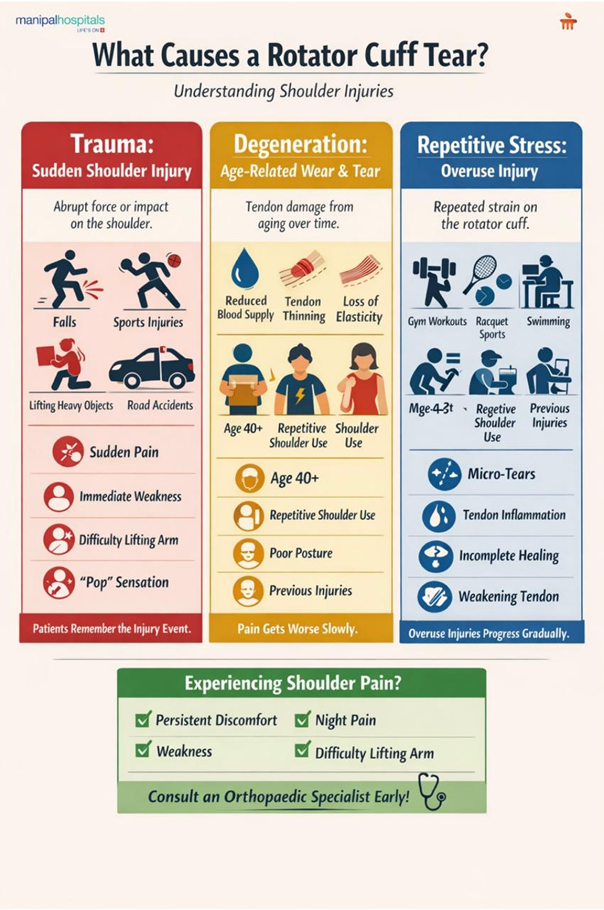
Causes of Rotator Cuff Tear
A rotator cuff tear can develop suddenly or gradually, depending on the underlying cause. Understanding how these injuries occur helps patients recognize risk factors and seek timely treatment.
Recognizing Rotator Cuff Tear Symptoms
Early identification of rotator cuff tear symptoms plays a crucial role in preventing worsening damage, chronic pain, and long-term shoulder dysfunction. Many patients ignore early warning signs, assuming the pain will resolve on its own. However, untreated rotator cuff injuries may progress from mild inflammation to partial or even complete tears.
Understanding the nature of symptoms helps patients seek timely medical evaluation and begin appropriate treatment.
What is Arthroscopy?
Arthroscopic surgery, commonly known as keyhole surgery, is a minimally invasive procedure used to diagnose and treat shoulder problems, including rotator cuff tears.
The Procedure Involves:
-
Small, precise incisions
-
Insertion of a high-definition camera (arthroscope)
-
Use of specialized microsurgical instruments
-
Accurate visualization of internal structures
-
Precise tendon repair
The camera projects magnified images onto a monitor, enabling the surgeon to perform highly controlled repairs without opening the joint extensively.
Benefits of Arthroscopic Surgery
Compared to traditional open surgery, arthroscopy offers several advantages:
-
Minimally invasive approach
-
Smaller scars
-
Less postoperative pain
-
Faster recovery
-
Lower risk of complications
-
Reduced blood loss
-
Short hospital stay (often day care)
At Manipal Hospitals Varthur Road, most patients undergoing arthroscopic rotator cuff repair are mobilized early and typically return home the same day or the next day, depending on the individual case.
Why Choose Arthroscopic Repair at Manipal Hospitals?
The expert team at Manipal Hospitals Varthur Road for Arthroscopic Repair is equipped with:
-
Experienced orthopaedic shoulder specialists
-
Advanced arthroscopic equipment
-
Personalised surgical planning
-
Comprehensive rehabilitation programs
-
Multidisciplinary care
The goal is not just to repair the tendon but to restore strength, mobility, and long-term shoulder function.
Recovery After Rotator Cuff Tear Surgery
Recovery following rotator cuff tear surgery is a structured, gradual process that requires patience, consistency, and active participation. While modern arthroscopic techniques reduce surgical trauma, proper rehabilitation is essential to restore shoulder strength, mobility, and function.
Healing occurs in stages, and each phase plays a critical role in ensuring a successful outcome.
|
Phase |
Duration |
Focus |
Key Components |
Goals / Guidance |
|
Phase 1: Protection (Immediate Post-Surgery Phase) |
Typically, first 3–6 weeks |
Protect the repaired tendon and allow initial healing |
Sling Usage: Supports the arm, minimizes strain, and prevents sudden or accidental movements. Duration depends on tear size and the surgeon's advice. |
Avoid lifting or active arm use |
|
Phase 2: Mobility Restoration |
Around weeks 6–10 (varies by case) |
Regain shoulder movement after early healing |
Guided Physiotherapy: Supervised rehabilitation with gradual exercise progression. |
Improve flexibility |
|
Phase 3: Strengthening Phase |
Approximately weeks 10–16 |
Rebuild muscle strength and shoulder stability |
Progressive Muscle Training: Resistance band exercises, light weight training, rotator cuff strengthening. |
Restore shoulder strength |
|
Phase 4: Return to Activity |
Around months 4–6 |
Prepare for normal lifestyle, work, and sports |
Work-Specific Conditioning: Lifting mechanics and occupational movements. |
Safe return to full activity |
Why Early Recognition Matters
|
Early Diagnosis Can Help With: |
Delayed Diagnosis May Lead To: |
|
Conservative treatment |
Tear progression |
|
Targeted physiotherapy |
Persistent pain |
|
Faster recovery timelines |
Shoulder stiffness |
|
Reduced need for surgery |
Muscle weakness |
Common Rotator Cuff Tear Symptoms
Rotator cuff symptoms can vary depending on the size and severity of the tear. Some patients experience gradual onset, while others report sudden pain after an injury.
|
Symptom |
Description / Patient Experience |
|
Persistent Shoulder Pain |
This is often the earliest and most noticeable symptom. Pain is typically dull and aching, felt deep within the shoulder. It may last for weeks or months and can occur even at rest. The discomfort may start mild but gradually worsen over time. |
|
Pain Radiating to the Arm |
Pain commonly spreads beyond the shoulder into the upper arm. Patients often report discomfort near the deltoid region and increased pain with arm movement. Unlike nerve-related pain, it usually does not extend beyond the elbow. |
|
Night Pain (Especially Severe) |
One of the most characteristic features is the presence of night pain. Pain worsens at night due to reduced distractions, tendon compression when lying down, increased inflammation sensitivity, and altered circulation. Patients may struggle to fall asleep, wake up due to pain, or frequently change sleeping positions. |
|
Difficulty Sleeping on the Affected Side |
Pressure on the injured shoulder causes sharp pain. Patients may be unable to lie comfortably on one side, leading to sleep disturbances and reduced sleep quality. |
|
Shoulder Weakness |
Weakness becomes noticeable during activities involving lifting or arm elevation. Daily challenges may include lifting objects, reaching overhead, carrying bags, combing hair, or fastening clothes. The arm may feel heavy or unstable. |
|
Pain While Lifting or Rotating the Arm |
Specific movements trigger pain, such as raising the arm sideways, reaching behind the back, overhead activities, or throwing motions. A “painful arc” may occur, especially between 60° and 120° of arm elevation. |
|
Limited Range of Motion |
Increasing pain and inflammation reduce shoulder mobility. Patients may experience stiffness, difficulty fully raising the arm, restricted rotation, and decreased functional ability. Prolonged immobility may lead to frozen shoulders (adhesive capsulitis). |
A Key Warning Sign: Night Pain
Night pain is particularly important because it often indicates:
-
Tendon inflammation
-
Impingement
-
Partial tear
-
Progressing injury
Many patients report that the pain becomes more intense when lying down, especially when rolling onto the affected side.
Modern Surgical Treatment: Arthroscopic Rotator Cuff Repair
Advancements in orthopedic surgery have revolutionized the treatment of rotator cuff injuries. Today, many shoulder conditions that once required large incisions can now be treated using minimally invasive arthroscopic techniques.
At Varthur Road, arthroscopic shoulder surgery is performed using state of the art technology, allowing for precision, safety, and faster recovery.
Conlusion
A rotator cuff tear is a common cause of shoulder pain, but with timely diagnosis and appropriate care, it is highly treatable. Early recognition of symptoms such as persistent pain, night discomfort, and weakness can prevent tear progression and long-term complications. Treatment may range from rest and physiotherapy to advanced arthroscopic surgery, depending on the severity of the injury.
Modern surgical techniques allow faster recovery with minimal discomfort, but rehabilitation remains essential for restoring strength and mobility. Ignoring shoulder pain can lead to chronic stiffness and functional limitations.
If your symptoms persist, consult the orthopaedic specialists at Manipal Hospitals Varthur Road for a thorough evaluation and personalised treatment plan to help you recover faster and return to your daily activities with confidence.
FAQ's
While both conditions can cause discomfort, a rotator cuff tear usually presents with persistent pain, noticeable weakness, difficulty lifting the arm, and especially night pain. Unlike a simple strain, symptoms often do not improve with rest alone and may gradually worsen. You might also experience pain during specific movements like reaching overhead or rotating the arm. If pain lasts more than a few weeks or interferes with sleep and daily activities, medical evaluation is strongly recommended.
Yes, many partial tears and mild injuries respond well to conservative treatment, including rest, activity modification, physiotherapy, and pain management. Structured rehabilitation helps strengthen surrounding muscles and restore mobility. However, large, full-thickness tears or injuries causing significant weakness may require surgery. Early diagnosis plays a key role—timely intervention can prevent tear progression and reduce the likelihood of surgical repair.
Night pain is one of the most characteristic symptoms of a rotator cuff problem. Pain may intensify due to tendon inflammation, increased sensitivity, and compression of the shoulder structures while lying down. Many patients report difficulty sleeping or inability to lie on the affected side. Persistent night pain may indicate impingement, tendon irritation, or a progressing tear, making it an important symptom that should not be ignored.
Arthroscopic (keyhole) surgery is a minimally invasive technique using small incisions and a high-definition camera. Compared to traditional open surgery, it offers smaller scars, less postoperative pain, reduced blood loss, faster recovery, and shorter hospital stays. The surgeon gains precise visualization of the joint, enabling accurate tendon repair. Most patients also experience earlier mobilization and improved comfort during recovery.
Manipal Hospitals Varthur Road provides access to experienced orthopaedic shoulder specialists, advanced arthroscopic technology, and personalized treatment planning. Patients benefit from a comprehensive rehabilitation program designed to restore strength, mobility, and function. The multidisciplinary approach ensures continuity of care from diagnosis through recovery. Many arthroscopic procedures are performed as day care surgeries, enabling faster returns home and smoother recovery experiences.
Share this article on: