5 Min Read
Shoulder pain is a common problem that can happen due to injury, improper posture, arthritis or other underlying reasons. Conventional methods like medication, pain relief and physiotherapy are often used as treatment options. However, persistent shoulder pain can disrupt your ability to do simple tasks, impacting your quality of life significantly. When conventional treatment approaches fail, doctors may recommend shoulder arthroscopy, a minimally invasive procedure to treat shoulder pain at its roots. This guide will walk you through essential information about shoulder arthroscopy, covering its purpose, the procedure itself, and what to expect during your recovery journey.
Synopsis
Understanding Shoulder Arthroscopy
Shoulder arthroscopy is a minimally invasive surgical procedure where orthopaedic surgeons use a small camera and specialised instruments to visualise, diagnose, and treat problems inside the shoulder joint. Instead of large incisions, the surgeon makes several small cuts, called portals, through which the arthroscope and other tools are inserted. This approach offers several advantages over traditional open surgery, including less pain, faster healing, reduced complications, quicker return to activities, and minimal scarring.
When is a Shoulder Arthroscopy Needed?
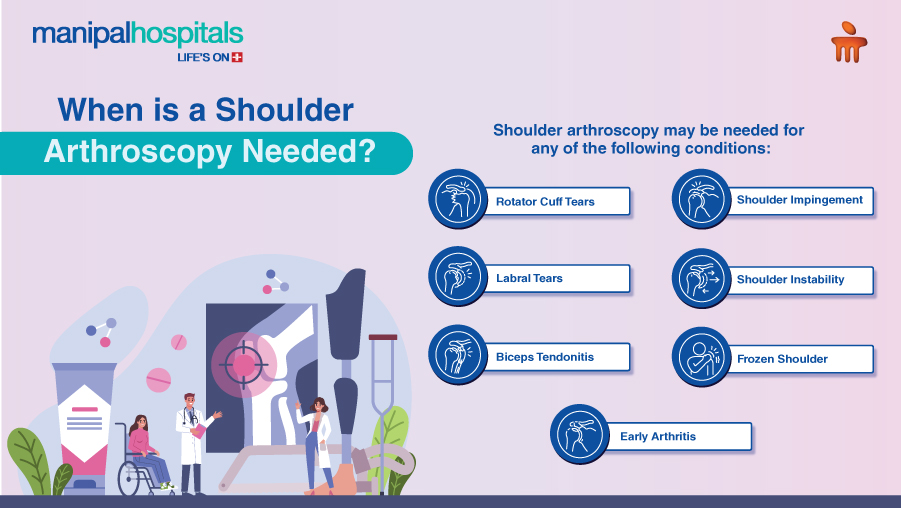
Shoulder arthroscopy may be needed for any of the following conditions:
-
Rotator Cuff Tears: Tears in the tendons surrounding the shoulder joint.
-
Shoulder Impingement: Where rotator cuff tendons are pinched.
-
Labral Tears: Damage to the cartilage rim stabilising the joint (e.g., SLAP tears and Bankart lesions).
-
Shoulder Instability: Recurrent dislocations.
-
Biceps Tendonitis: Inflammation or tears of the biceps tendon.
-
Frozen Shoulder: Stiffness requiring release of scar tissue.
-
Early Arthritis: Removal of loose bodies or inflamed tissue.
For many conditions, shoulder arthroscopy surgery has a high success rate, with clinical studies showing significant improvement in pain and function for a majority of patients.
The Shoulder Arthroscopy Procedure
The shoulder arthroscopy procedure typically involves the following steps:
-
Anaesthesia: You will receive general anaesthesia or a regional nerve block with sedation.
-
Preparation: The surgical area is cleaned, and your arm might be placed in traction for better visibility.
-
Incision and Scope Insertion: The surgeon makes a small incision to insert the arthroscope, transmitting images to a monitor.
-
Fluid Infusion: Sterile fluid expands the joint for clearer viewing.
-
Diagnosis and Repair: Additional small incisions are made for instruments to perform repairs, such as trimming damaged cartilage, repairing tears, or removing inflamed tissue.
-
Closure: Incisions are closed, and a sling is applied to protect the arm.
Shoulder Arthroscopy Recovery
Recovery is a gradual process, varying based on the condition's severity and the extent of repair. While incisions heal quickly, internal tissue healing takes longer.
-
Immediate Post-Op (Days 0-7): The arm is put in a sling, the patient is prescribed pain management via medication and ice, and initial gentle movements are recommended.
-
Early Rehabilitation (Weeks 1-6): Formal physical therapy begins, focusing on restoring range of motion. The sling may be gradually removed.
-
Strengthening and Functional Return (Weeks 6-12+): Strengthening exercises are introduced, gradually progressing to daily activities.
-
Advanced Strengthening (Months 3-6+): For those returning to sports, advanced drills are incorporated.
Full recovery following shoulder arthroscopy can take 3 to 6 months, sometimes longer. A consistent physical rehabilitation programme is crucial. Patients who diligently follow their regimen typically achieve excellent range of motion and strength, fully regaining their ability to move their shoulder joints without pain and discomfort.
Care Essentials: Do's and Don'ts
Some essential, yet simple, rules will help fasten recovery and provide long-term results:
Do's
-
Attend all physical therapy appointments.
-
Take prescribed pain medication.
-
Apply ice regularly to the shoulder area after the procedure.
-
Keep incision sites clean and dry.
-
Wear your sling as directed.
-
Communicate any concerns to your medical team.
Don'ts
-
Don't lift heavy objects or engage in overhead activities.
-
Don't ignore pain; avoid pushing through sharp or increasing discomfort.
-
Don't remove your sling prematurely.
-
Don't drive until cleared by your doctor.
-
Don't skip your exercises.
Conclusion
At Manipal Hospitals Siliguri, our highly trained orthopaedic specialists are dedicated to providing personalised treatment plans to help you achieve a lifelong solution to your shoulder problems. If you are suffering from chronic shoulder issues, book an appointment at Manipal Hospitals Siliguri today!
FAQ's
While some discomfort is expected after shoulder arthroscopy, pain is generally well-managed with medication and ice packs. The minimally invasive nature often results in less pain compared to open surgery, and it progressively decreases during your recovery time with proper post-operative care.
Yes, physical therapy is an essential component of recovery following shoulder arthroscopy. A structured rehabilitation programme is crucial for regaining range of motion, strength, and function.
The duration of a shoulder arthroscopy procedure varies depending on the complexity of the condition being treated. Simple diagnostic arthroscopies might take less than an hour, while more complex repairs (like extensive rotator cuff tears) could take 1-2 hours or more. Your surgeon will provide a more precise estimate during your consultation.
While generally safe, as with any surgical procedure, shoulder arthroscopy surgery carries some potential risks. These can include infection, bleeding, nerve damage, blood clots, stiffness, or a reaction to anaesthesia. However, the benefits of shoulder arthroscopy far outweigh the risks.
The timeline for returning to normal activities, including work and sports, largely depends on the specific repair performed and your individual healing process. For sedentary jobs, you might return within a few days to a week. For physically demanding jobs or sports, the shoulder arthroscopy recovery time can range from 3 to 6 months, or even longer, with progressive rehabilitation.
Share this article on: