7 Min Read
Have you ever noticed a mouth ulcer that just wouldn’t go away and wondered if it could be something serious? Many early changes inside the mouth look harmless at first, and many willfully ignore professional treatment for those changes. However, those very changes can potentially lead to mouth cancer. Mouth cancer develops when cells lining the lips, tongue, cheeks, gums, floor of the mouth, or palate begin growing uncontrollably due to genetic mutations. Since early stages are often painless, delays in diagnosis are common. Understanding the warning signs and acting early can make a meaningful difference in treatment outcomes. In this blog, we will understand the risk factors associated with mouth cancer and what patients can expect from mouth cancer treatment in Old Airport Road, Bangalore.
Synopsis
Understanding the Risk Factors for Mouth Cancer
When we talk about mouth cancer, the first question that comes up is, why does it happen? Most cases involve multiple causes and develop gradually. It develops over time when the DNA inside normal cells becomes damaged, the causes for which can be varied. Accordingly, when it is not treated promptly, it can lead to severe cell mutations that become known as cancer.
Some common avoidable and unavoidable risk factors include:
-
Tobacco use: Smoking or using smokeless tobacco keeps the delicate lining of the mouth in constant contact with carcinogens. Over time, these chemicals damage the DNA inside cells, and the body tries to repair this damage. But with prolonged use of tobacco products, abnormal cell growth can begin and lead to oral cancer.
-
Alcohol consumption: Heavy drinking can weaken and irritate the tissues inside the mouth. When alcohol and tobacco are used together, the risk of mouth cancer rises sharply because alcohol enables cancer-causing substances to penetrate deeper into the tissues.
-
Human papillomavirus (HPV) infection: HPV, in particular HPV-16, is the primary strain linked to oral/oropharyngeal cancer. Along with HPV-18, these high-risk strains of HPV can alter the genetic material inside healthy cells. In the case of HPV-16, these viral infections can trigger uncontrolled growth in the oral cavity.
-
Betel nut chewing: This highly common habit in India causes constant friction and chemical irritation. Over the years, it can lead to stiffening of the mouth lining and precancerous changes.
-
Prolonged sun exposure: Continuous exposure to ultraviolet rays increases the risk of cancers of the lip, particularly in people who work outdoors.
-
Age and gender: Oral cancer is seen more often after the age of 50 and is more common in men, though younger individuals are not immune.
Recognising Early Symptoms Of Oral Cancer
The early symptoms of mouth cancer do not always look alarming. Many patients say they thought it was “just an ulcer” or a minor irritation. In the early stages, there may be no severe pain.
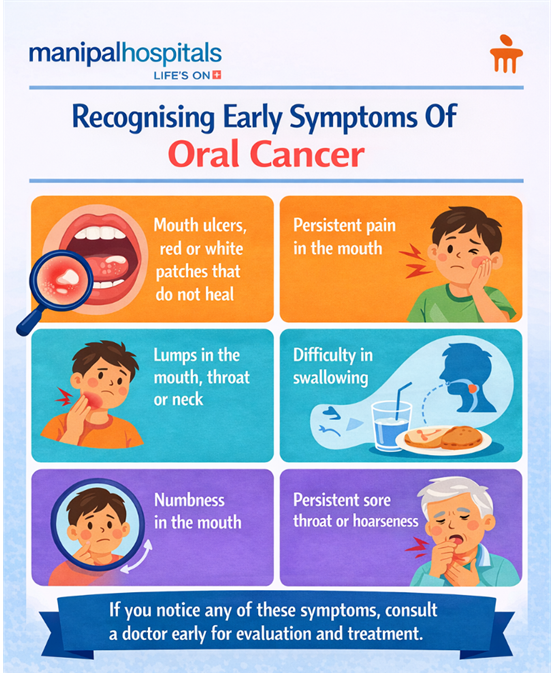
Because of that, people wait for weeks or months. If any change inside the mouth lasts more than two weeks, it deserves a proper examination. Here are some mouth cancer symptoms that should not be ignored:
-
Non-healing ulcers: A small sore that refuses to heal, even after home remedies or routine treatment, should raise concern. Most simple ulcers settle within days. When one lingers beyond two weeks, it needs to get looked at.
-
White or red patches: Some of the earliest changes are painless, flat patches inside the mouth. A white patch (leukoplakia) or a red patch (erythroplakia) that does not disappear deserves medical evaluation, even if it feels harmless.
-
Lumps or unexplained bleeding: A new thickened area, a small swelling, or bleeding without accidentally biting the area.
-
Difficulty chewing or swallowing: A persistent feeling of discomfort while eating, or the sense that food is catching inside the mouth.
-
Persistent pain or numbness: Ongoing soreness, burning, or reduced sensation in part of the mouth can indicate a potential risk.
How Mouth Cancer Is Diagnosed: What Happens During a Biopsy?
When a doctor sees a suspicious area inside your mouth, the next step is to understand what it is. A careful clinical examination is done first, where the specialist looks at your lips, tongue, cheeks, and gums. If something looks unusual and hasn’t gone away with time, the doctor will recommend a biopsy.
What is a Biopsy?
A biopsy is the only way to confirm whether a lesion is cancerous. The process involves taking a small sample of tissue from the area and sending it to the laboratory for microscopic examination. There are two ways the biopsy can be performed:
-
Incisional biopsy: A tiny piece of the suspicious area is cut out and collected for testing. It helps the pathologist see if there are cancer cells present.
-
Brush biopsy: A less accurate form of biopsy, a soft brush is used in this method to scrape cells from the surface of the lesion. These cells are then examined under a microscope.
What to Expect in a Biopsy?
The biopsy is done under local anaesthesia, so you do not feel any pain. The procedure itself is usually quick, often completed during an outpatient visit. Afterward, you may have mild tenderness or slight swelling for a short time. Once the sample is extracted, it goes to the pathology lab, where it undergoes the necessary tests, and the results are declared after a few days. If cancer is confirmed, imaging tests such as scans are arranged to find out how far it has spread and to decide the next treatment steps.
Mouth Cancer Treatment Options: What Patients Can Expect
Once the biopsy confirms the diagnosis and staging tests are complete, a clear treatment plan is discussed. Mouth cancer treatment is not the same for everyone. It depends on the size of the tumour, its exact location, and whether nearby lymph nodes are involved.
Surgical Treatment
For early-stage disease, surgery is often the first step.
-
Tumour removal: The surgeon removes the visible tumour along with a small border of healthy tissue around that place. This reduces the risk of leaving behind any cancer cells.
-
Neck dissection: If lymph nodes in the neck appear to be affected, they may be removed during the same procedure.
-
Reconstruction: When a larger portion of tissue is removed, reconstructive surgery may be performed to restore appearance and function.
Additional Therapies
Some patients need more than surgery:
-
Radiation therapy: Often advised after surgery to lower the chance of recurrence.
-
Chemotherapy: Used in more advanced stages, sometimes combined with radiation.
-
Targeted therapy or immunotherapy: Considered in selected cases depending on tumour characteristics.
Recovery and Follow-Up
Hospital stay for recovery can be for a few days in simpler cases, or more if reconstruction is required in the area where the tumour was removed. You can expect swelling and discomfort post-surgery, which can impact speech and swallowing. Rehabilitation support helps patients adapt gradually, while soft diets are advised during healing to minimise impact on the affected area. Regular follow-up visits are important to monitor recovery and detect any early signs of recurrence.
Is Mouth Cancer Curable?
Realistically, it depends on when the cancer is detected:
-
Early-stage disease: When the cancer is small and limited to one area, treatment works better. Many patients diagnosed at this stage respond well to surgery, sometimes with additional therapy if required.
-
Advanced-stage disease: When it has spread to nearby lymph nodes or deeper tissues, treatment becomes more involved. Outcomes are not the same as early-stage cases, and therapy may need to be combined.
Treatment does not end after surgery or radiation. Regular reviews are necessary to monitor healing and check for recurrence. Care continues over time, not just during the initial phase.
Conclusion
Oral cancer often presents with symptoms that are mild in the beginning, which is why timely evaluation is important. Recognising risk factors and proceeding with an early biopsy allows treatment to begin at a more manageable stage. A structured plan, guided by specialists, helps patients understand each step clearly. If you need evaluation or guidance regarding mouth cancer surgery in Old Airport Road, Bangalore, our team at Manipal Hospitals Old Airport Road can assess your condition and advise on appropriate treatment options.
FAQ's
A sore that does not heal within two weeks, a white or red patch, a lump, or unexplained bleeding are early warning signs. Difficulty chewing or numbness should also be checked.
When detected at an early stage, treatment outcomes are better. Surgery at this stage can control the disease effectively in many cases.
A biopsy is done under local anaesthesia. You may feel pressure, but sharp pain is uncommon. Mild soreness can last a few days.
Recovery varies depending on the extent of surgery. Some patients recover within weeks, while more extensive procedures may take longer.
People who use tobacco, consume alcohol heavily, chew betel nut, or have persistent oral changes should undergo regular examination.
Share this article on: