7 Min Read
For complex gastrointestinal issues, especially those affecting the small intestine, traditional methods can fall short. This is where capsule endoscopy offers a revolutionary, non-invasive solution. If you experience persistent digestive symptoms like unexplained bleeding, chronic abdominal pain, or malabsorption, your doctor might recommend a capsule endoscopy procedure. This blog is a comprehensive guide that tells you all about capsule endoscopy how and why it is done, its benefits and more.
Synopsis
What is Capsule Endoscopy?
A capsule endoscopy is an advanced diagnostic procedure which is used to diagnose conditions primarily affecting the small intestine. This approach involves swallowing a capsule no bigger than a vitamin capsule, and it has a camera attached to it. Once inside your small intestine, the camera inside the capsule captures thousands of images inside the small intestine as it naturally passes through your digestive tract. Unlike traditional endoscopy, which uses a flexible tube, capsule endoscopy provides a thorough, comfortable, and comprehensive examination of the small intestine – an area that is often difficult to reach.
This innovative technology helps detect abnormalities in the small bowel that might otherwise remain hidden, offering valuable visual information to pinpoint the source of various conditions.
The Capsule Endoscopy Procedure
Capsule endoscopy is a diagnostic procedure that has been designed for patient comfort. While swallowing a camera may sound alarming, the small capsule travels painlessly through your system, capturing multiple pictures inside your intestine. The capsule also contains a light and a transmitter, allowing your doctor to see the images clearly. The capsule leaves your body after 24-48 hours naturally.
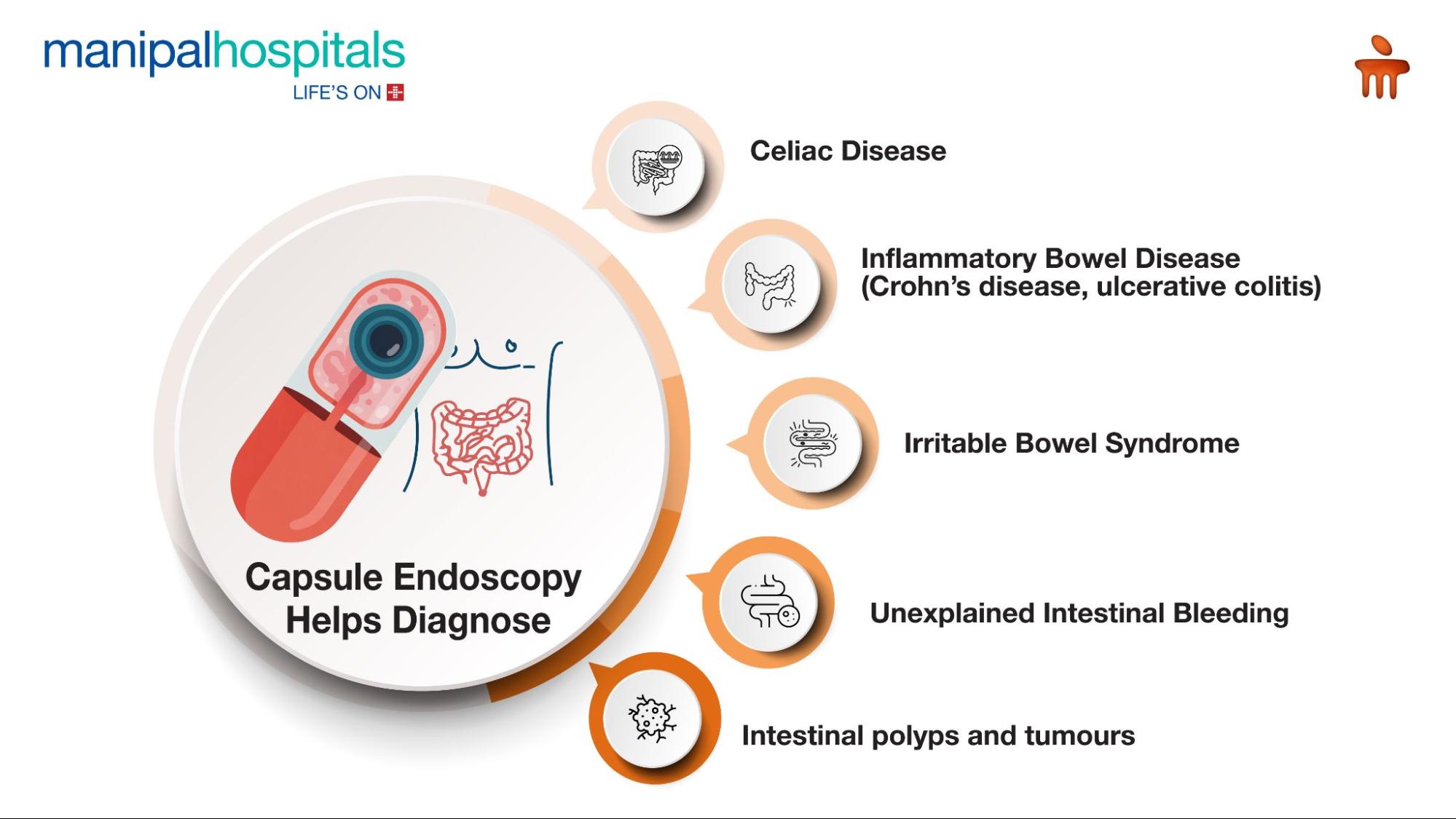
What is Capsule Endoscopy Used For?
Capsule endoscopy is used for diagnosing conditions like:
-
Celiac Disease
-
Inflammatory Bowel Disease (Crohn’s disease, ulcerative colitis)
-
Irritable Bowel Syndrome
-
Unexplained intestinal bleeding that cannot be determined through upper endoscopy or ultrasonography
-
Intestinal Polyps and Tumours
Benefits of Capsule Endoscopy
Capsule endoscopy is an advanced procedure that offers several benefits over conventional methods. They include:
-
Non-Invasive and Painless: This non-invasive procedure involves no tubes or sedation. Thus, patients do not feel any pain.
-
Comprehensive Small Bowel Examination: Unparalleled view of the entire small intestine.
-
High Diagnostic Accuracy: Effective in identifying sources of obscure gastrointestinal bleeding, Crohn's disease, polyps, and other abnormalities.
-
Enhanced Patient Comfort: Patients can maintain daily activities during the examination.
-
Early Detection: Aids in early diagnosis and timely intervention.
Conclusion
Capsule endoscopy is a non-invasive technique used to determine abnormalities in the small intestine which cannot be seen with conventional methods. At Manipal Hospitals Broadway, the department of Gastroenterology is powered by experts who use advanced procedures like capsule endoscopy for proper diagnosis and customised treatment plans to meet each patient’s individual needs. If you are experiencing persistent digestive symptoms, consult with our expert gastroenterologists at Manipal Hospitals Broadway for precise diagnosis and personalised care.
FAQ's
Capsule endoscopy procedure is non-invasive and painless. One simply has to swallow a pill-like capsule which passes naturally.
The capsule passes through your digestive tract and is typically excreted within 24-48 hours.
Specific instructions will be given. Usually, you can resume drinking clear liquids a few hours after swallowing.
Specific instructions will be given. Usually, you can resume drinking clear liquids a few hours after swallowing.
Risks are very low. The primary concern is of capsule retention, which is rare and often predictable in patients with known intestinal narrowing.
Setting up the procedure and swallowing the capsule generally takes a few minutes. However, the following procedure can take anywhere between 8-10 hours, including analysis of the images and final reports.
Share this article on:


--Symptoms,-Stroke-Risk-and-Modern-Treatment-Options.webp "Atrial Fibrillation (AFib): Symptoms, Stroke Risk and Modern Treatment Options")