8 Min Read
Living with chronic kidney disease can be physically draining and emotionally difficult. When the kidneys are no longer able to filter waste effectively, day-to-day life may begin to revolve around fatigue, dietary limits, fluid restriction, and, for many people, dialysis. Dialysis is often essential, but it can also be time-consuming and exhausting. It is at this stage that many patients and families start thinking about a kidney transplant.
By understanding the kidney transplant procedure and what recovery involves, the journey becomes easier to approach with clarity. In this blog, we explore donor options, the surgical process, and what it takes to protect a new kidney over time.
Synopsis
Understanding Kidney Transplant: Living vs. Deceased Donors
A transplant is a major step, and it is completely normal to feel both hopeful and uncertain. For many people, it offers the chance to move away from a dialysis-dependent routine and regain a greater sense of independence. At the same time, it requires careful testing, donor evaluation, and a clear understanding that the surgery is only the beginning of long-term care.
One of the first decisions in the kidney transplant journey is where the new kidney will come from. That choice affects timing, preparation, and coordination with the transplant team.
To help you compare the two main options, the table below outlines the key differences between a living donor kidney transplant and a deceased donor kidney transplant:
|
Feature |
Living Donor Transplant |
Deceased Donor Transplant |
|
Donor Source |
A healthy person, usually a relative or friend |
A person who has recently passed away |
|
Timing |
Planned in advance at a suitable time |
Performed when an organ becomes available |
|
Organ Longevity |
Often lasts longer, around 15–20 years on average |
Often lasts a little less, around 10–15 years on average |
|
Wait Time |
Usually short once the donor is cleared |
Can range from months to several years |
|
Recovery for Donor |
Requires a separate surgical recovery |
Not applicable |
The choice depends on medical compatibility, donor availability, and the overall health of the recipient. Whatever the source, the purpose of the kidney transplant is the same: to provide a functioning kidney that can take over the work of filtering blood and balancing fluid levels.
The Goal and Purpose of the Surgery
The main reason for undergoing kidney transplant surgery is end-stage renal disease (ESRD), when kidney function drops to the point that the body cannot remain stable without treatment. At this stage, the kidneys usually function at only about 10% to 15% of normal capacity. Dialysis can support the body, but a transplant is often considered the better long-term solution when it is medically possible.
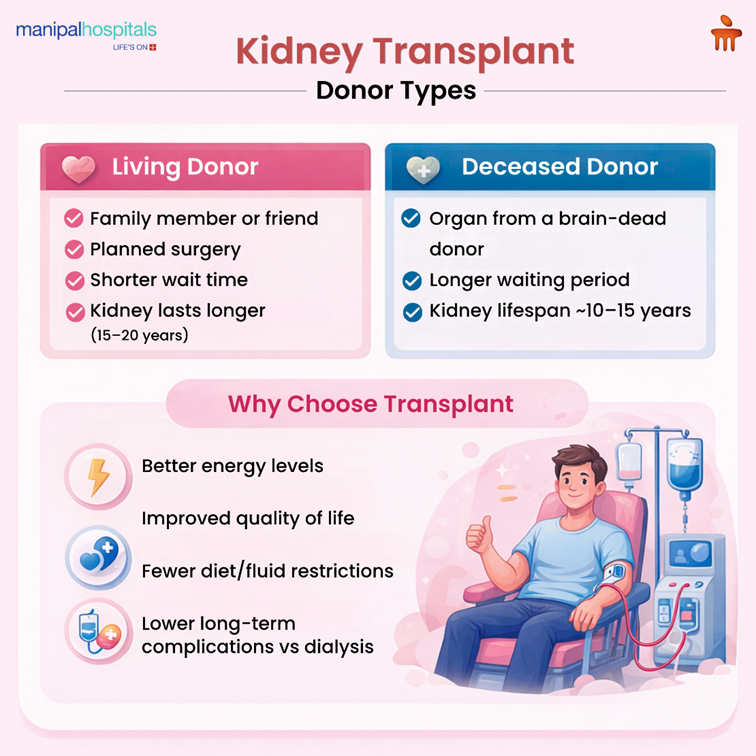
A successful transplant can offer several important benefits compared with ongoing dialysis:
-
Better energy and overall quality of life
-
Fewer restrictions on food and fluid intake, although healthy habits are still important
-
A lower risk of death compared with remaining on dialysis
-
Lower long-term cost in many cases
For many patients, the kidney transplant procedure offers not just medical benefit but also a more manageable daily routine and a stronger sense of normalcy.
Preparing for the Kidney Transplant Procedure
Before surgery can happen, a thorough evaluation is needed. This helps make sure the body is ready for the operation and that the new kidney has the best possible chance of being accepted by the immune system.
The evaluation process usually includes:
-
Blood typing: Your blood group must be compatible with the donor’s.
-
Tissue typing (HLA matching): Doctors compare genetic markers to assess how closely the donor and recipient match.
-
Cross-matching: A small sample of your blood is mixed with the donor’s to see whether antibodies may attack the new kidney.
-
Mental health assessment: Because transplant care continues for life, support systems and readiness for long-term follow-up are reviewed carefully.
-
Physical health screening: You may undergo heart tests, chest X-rays, cancer screening, and other checks to make sure there are no major medical issues that could complicate surgery.
This stage is important because a successful kidney transplant surgery depends on more than the operation itself. Good preparation improves safety and supports a smoother recovery.
The Step-by-Step Surgical Process
The kidney transplant procedure usually takes about three to five hours and is done under general anaesthesia, so you are fully asleep throughout the surgery.
Here is what typically happens during the operation:
-
The incision: The surgeon makes an incision in the lower abdomen, usually on one side. In most cases, the original kidneys are left in place unless they are causing infection, severe enlargement, or other problems.
-
Placing the new kidney: The donor kidney is positioned in the lower abdomen, where it can be connected easily to major blood vessels and the bladder.
-
Connecting blood vessels: The kidney’s artery and vein are attached to your blood vessels so blood can begin flowing through the new organ.
-
Connecting the ureter: The ureter, which carries urine from the kidney, is connected to the bladder so that urine can pass normally.
-
Closing the incision: Once the connections are secure and the surgeon confirms good blood flow or urine output, the incision is closed with stitches or staples.
In many cases, the kidney begins working right away. In others, it may take several days or even weeks to function fully. During that time, temporary dialysis may still be needed.
A kidney transplant is a major milestone, but it is also the start of a new phase of care. With the right follow-up, medication, and monitoring, many patients are able to move forward with more freedom and better day-to-day health.
The Healing Timeline: What to Expect
A common question patients ask is, "How long is the kidney transplant surgery recovery?" The answer varies, but it can generally be divided into two phases.
Acute Recovery
The first phase is the acute recovery, which takes place over the first 6 to 8 weeks. During this time, your incision is healing, and your body is adjusting to the high doses of new medications. You will be told to avoid lifting heavy objects or performing strenuous exercise. You will also have frequent follow-up appointments, often twice a week initially, to check your blood work.
Long-term Goals
The second phase is the long-term stabilisation. By the 3 to 6-month mark, most patients feel a significant return of energy. Most people find they can return to work or school within 8 to 12 weeks, provided their job isn't physically demanding. However, full structural healing and the fine-tuning of your medication levels can take up to a year.
It is important to remember that while the physical incision heals relatively quickly, the internal adjustment of your immune system is an ongoing process. Therefore, the answer to how long kidney transplant surgery recovery takes is as much about your long-term habits as it is about the weeks following the surgery.
Managing Life After Kidney Transplant
Successfully navigating life after a kidney transplant requires a shift in your daily routine. The surgery is a treatment, not a "cure," and the longevity of the new kidney depends heavily on your choices.
-
Medication Adherence: You must take anti-rejection medications (immunosuppressants) at the exact same time every day. Skipping even a single dose can trigger a rejection episode. This is a non-negotiable part of life after a kidney transplant.
-
Infection Prevention: Because your immune system is being suppressed, you are more vulnerable to infections. Washing your hands frequently, avoiding large crowds during flu season, and ensuring your food is properly cooked are essential safety steps.
-
Diet and Nutrition: You should focus on a heart-healthy diet. This includes reducing salt to manage blood pressure and limiting sugar to prevent transplant-related diabetes. Maintaining a healthy weight is a major factor in the success of life after kidney transplant.
-
Hydration: Staying well-hydrated is critical for the health of the new organ. You will likely be encouraged to drink plenty of water throughout the day.
-
Regular Monitoring: You will need to monitor your blood pressure, weight, and temperature daily at home. Any sudden changes should be reported to your transplant team immediately.
Conclusion
Undergoing a kidney transplant is a courageous step toward a better future. It is a complex journey that begins with a difficult diagnosis but leads toward a life of greater freedom and health. For patients seeking kidney transplant surgery in Bangalore, Manipal Hospitals provides a multi-disciplinary approach, meaning you have surgeons, nephrologists, dieticians, and transplant coordinators working together. From the initial donor matching to the years of follow-up care, having a team you trust makes the entire process more manageable.
FAQ's
Yes. A single healthy kidney is perfectly capable of performing all the necessary functions to keep your body healthy. Both the donor and the recipient can lead full, active lives with one functioning kidney.
While many rejections are caught through blood tests before you feel symptoms, you should watch for fever, decreased urine output, sudden weight gain, or pain over the site of the new kidney. These are important signs to watch for during life after a kidney transplant.
In most cases, no. Leaving your native kidneys in place reduces the complexity of the surgery and the risk of complications. They are only removed if they are causing specific health problems like chronic infection or extremely high blood pressure.
On average, a kidney from a living donor lasts 15 to 20 years, while a deceased donor kidney lasts 10 to 15 years. However, many kidneys last much longer with excellent care and strict medication adherence.
Most transplant teams recommend waiting at least 3 to 6 months before travelling, especially to areas where you might be exposed to different infections. Always discuss your travel plans with your coordinator.
Share this article on: