8 Min Read
An angiogram is a specialised X-ray examination that uses a special dye and camera to take pictures of the blood flow in an artery or vein. It’s a powerful tool that helps our cardiologists visualise the intricate network of blood vessels, identifying blockages, narrowing, or other abnormalities that might be affecting your health.
If you've been recommended for this procedure or are simply curious about what is an angiogram, this blog aims to demystify it, explaining its purpose, what the procedure involves, its benefits, and potential considerations.
Synopsis
Understanding Angiography: What is an Angiogram?
At its core, an angiogram is a medical imaging test that provides detailed pictures of your blood vessels. This diagnostic procedure is crucial for detecting and evaluating various vascular conditions that might not be visible through other imaging techniques. When our expert doctors need to understand the precise location and extent of issues within your circulatory system, they often recommend an angiogram.
The term "angiography" originates from the Greek words "angeion" (vessel) and "graphein" (to write or record), perfectly describing its function: recording images of blood vessels. It helps answer the critical question of why an angiogram is done by offering a direct visual assessment of blood flow, vessel structure, and any impediments to it. For instance, in cardiac cases, it's often referred to as a coronary angiogram.
This procedure is highly effective, with studies showing diagnostic accuracy rates often exceeding 95% in identifying significant vascular disease, making it a cornerstone in precise diagnosis and treatment planning.
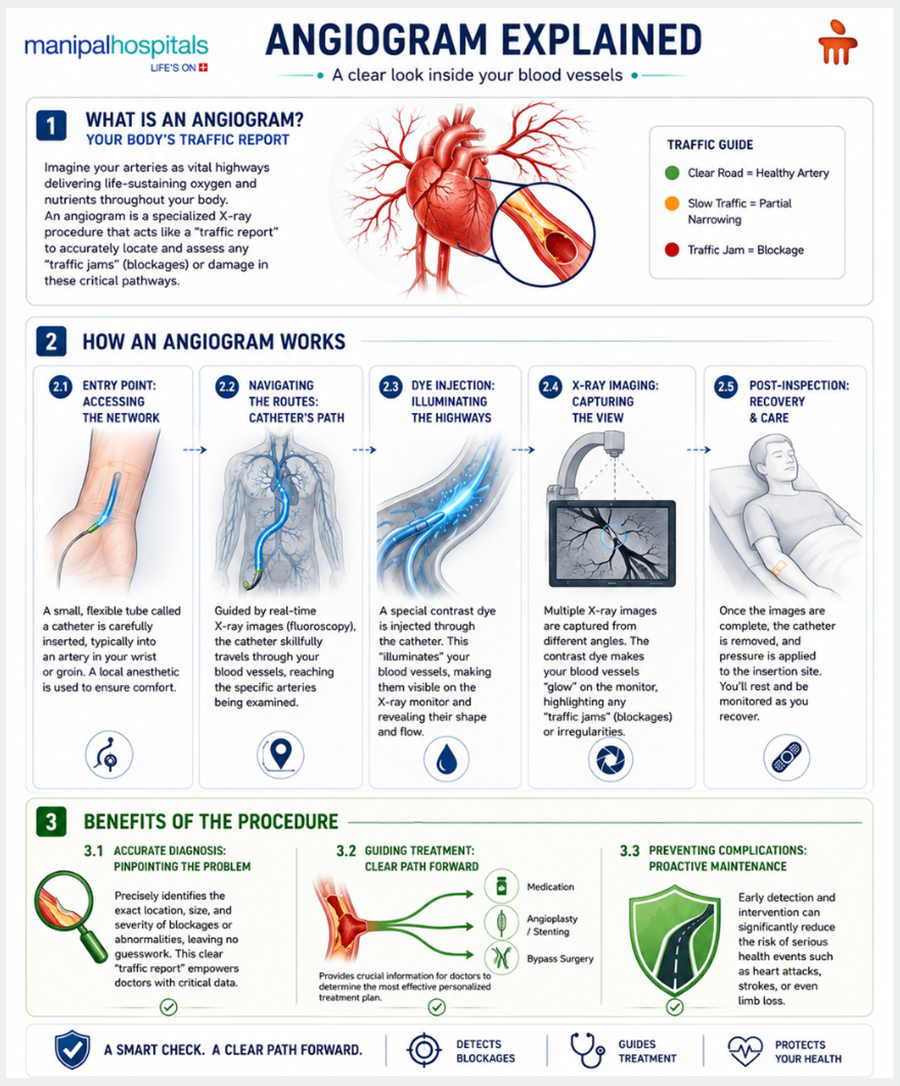
The Angiogram Procedure: A Step-by-Step Guide
Knowing what to expect can significantly ease any anxieties surrounding a medical procedure. Our skilled medical team at Manipal Hospitals meticulously follows the angiogram procedure steps to ensure your safety and comfort throughout. Here’s a breakdown of what typically happens:
-
Preparation: Before the procedure, you'll receive detailed instructions from our team. This usually involves fasting for a few hours and discussing your medical history, allergies (especially to iodine or shellfish), and current medications. Our nurses will check your vital signs and ensure you’re comfortable.
-
Local Anaesthesia: Once in the sterile catheterisation lab, the area where the catheter will be inserted (most commonly the wrist or groin) will be cleaned and numbed with a local anesthetic. You will be awake but should not feel pain at the insertion site. Many patients also receive a mild sedative to help them relax.
-
Catheter Insertion: A thin, flexible tube called a catheter is carefully inserted into an artery or vein through a small incision. Using advanced imaging guidance, the cardiologist or radiologist gently threads the catheter through your blood vessels until it reaches the area of interest – for example, the coronary arteries around the heart or vessels in the legs.
-
Contrast Dye Injection: A special iodine-based contrast dye is then injected through the catheter. This dye makes your blood vessels visible on the X-ray images. You might feel a brief warm flush as the dye circulates, which is a normal sensation.
-
X-ray Imaging: As the dye flows, a series of rapid X-ray images (angiograms) is taken from different angles. These images provide a clear, real-time view of your blood vessels, highlighting any blockages, narrowing, aneurysms, or other abnormalities.
-
Catheter Removal: Once sufficient images are captured, the catheter is carefully withdrawn. Pressure is applied to the insertion site to prevent bleeding, and a dressing is applied.
The entire angiogram procedure typically takes between 30 minutes and 2 hours, depending on the complexity. Patient comfort is paramount, and our experienced team ensures a smooth and safe experience. In our facilities, we complete over 98% of angiogram procedures without major patient discomfort, allowing for accurate diagnosis.
What Conditions Can an Angiogram Diagnose?
The versatility of an angiogram makes it an invaluable diagnostic tool for a wide array of vascular conditions. Understanding why an angiogram is done often boils down to accurately identifying these issues:
-
Coronary Artery Disease (CAD): This is one of the most common reasons, where the angiogram helps identify narrowed or blocked arteries supplying blood to the heart muscle, a leading cause of heart attacks.
-
Peripheral Artery Disease (PAD): Diagnoses blockages in arteries supplying blood to the limbs, often causing pain, numbness, and cramping, especially in the legs.
-
Cerebrovascular Disease: Detects narrowing or blockages in the arteries leading to the brain, which can cause strokes or transient ischemic attacks (TIAs).
-
Aneurysms: Identifies weakened, bulging areas in artery walls that could rupture if left untreated.
-
Arteriovenous Malformations (AVMs): Reveals abnormal connections between arteries and veins.
-
Kidney Artery Stenosis: Detects narrowing of the arteries supplying blood to the kidneys, which can cause high blood pressure or kidney dysfunction.
-
Blood Clots: Helps pinpoint the location and size of blood clots within vessels.
The detailed images from an angiogram empower our specialists to make precise diagnoses, guiding crucial decisions about whether medication, a minimally invasive procedure like angioplasty, or surgery is the most appropriate course of action for your unique condition.
Benefits of Angiography
An angiogram offers numerous significant advantages that underscore its importance in modern medicine:
-
Precise Diagnosis: It provides highly detailed, real-time images of blood vessels that other imaging tests cannot capture, allowing for exact identification of blockages, narrowing, or other abnormalities. This precision is critical for effective treatment planning.
-
Guiding Treatment: Often, an angiogram is not just diagnostic but also therapeutic. During the procedure, if a blockage is found, our doctors may immediately proceed with an angioplasty (widening the artery with a balloon) and stent placement (inserting a small mesh tube to keep the artery open), potentially saving you from a separate procedure.
-
Minimally Invasive: Compared to traditional open surgery for diagnosis, an angiogram is a minimally invasive procedure, typically involving only a small puncture site. This leads to less pain, smaller scars, and a faster recovery.
-
Reduced Risk of Major Events: By detecting and addressing vascular issues early, angiograms play a crucial role in preventing severe health events like heart attacks, strokes, or limb loss. Early intervention following an angiogram has been shown to reduce the risk of major adverse cardiovascular events by up to 70% in high-risk patients.
-
Comprehensive Assessment: It allows for a comprehensive assessment of the entire vascular system in a targeted area, helping identify multiple problem spots simultaneously.
The ability of angiography to provide both diagnostic clarity and a pathway to immediate intervention makes it a highly beneficial procedure for many patients facing potential vascular health challenges.
Angiogram Recovery and Post-Procedure Care
After your angiogram, our team will monitor you closely to ensure a smooth angiogram recovery time. Here’s what you can generally expect:
-
Immediate Post-Procedure: You will be moved to a recovery area where nurses will monitor your vital signs and the insertion site. You'll typically need to lie flat for several hours (often 2-6 hours, depending on the access site) to prevent bleeding, especially if the groin was used.
-
Hydration: You will be encouraged to drink plenty of fluids to help flush the contrast dye from your system and prevent kidney issues.
-
Pain Management: You might experience some mild discomfort or soreness at the insertion site. Over-the-counter pain relievers can usually manage this.
-
Discharge: Most patients can go home the same day, typically within 6-8 hours after the procedure, provided there are no complications. You will need someone to drive you home.
-
Angiogram Recovery Time at Home: Full recovery usually takes a few days. You should avoid strenuous activities, heavy lifting, and intense exercise for about 24-48 hours. Keep the insertion site clean and dry. It's normal to have a small bruise, which will fade over a week or two.
Do's and Don'ts of Angiogram
To ensure a smooth recovery and avoid complications after your angiogram, please follow these guidelines:
|
Do’s |
Don’ts |
|
Keep the insertion site clean and dry. |
Don’t lift heavy objects or engage in strenuous activities for 24-48 hours. |
|
Drink plenty of fluids to flush the dye from your system. |
Avoid taking a bath or immersing the insertion site in water for the first 24-48 hours (showering is usually fine). |
|
Get adequate rest for the first 24-48 hours. |
Don't drive for at least 24 hours after the procedure, especially if you received sedation. |
|
Monitor the insertion site for signs of infection (redness, swelling, warmth, and pus). |
- |
|
Take prescribed medications as directed. |
Never ignore severe pain, swelling, new bleeding, or numbness in the limb; contact your doctor immediately. |
Conclusion
An angiogram is not just a diagnostic test; it is a highly precise, safe, and often life-saving tool that empowers our specialists to see exactly what your heart and blood vessels need. If you or a loved one has been advised to undergo an angiogram, or if you are experiencing symptoms of cardiovascular discomfort, do not delay your care. Early detection reduces the risk of major cardiac events by up to 70%.
At Manipal Hospitals Bangalore, we are with you every step of the way, from your initial preparation to your smooth recovery, to ensure your journey is safe, transparent, and comfortable.
Book an angiogram test in Bangalore and get your heart health evaluated today!
FAQ's
You might feel a sting from the local anaesthetic at the insertion site, but the procedure itself is generally not painful as the area is numbed. Many patients also receive a mild sedative to help them relax and remain comfortable.
The procedure itself takes between 30 minutes and 2 hours, depending on the complexity and what is being investigated. However, you should plan for several hours at the hospital, including preparation and recovery time.
Generally, you will be asked to fast for a few hours (typically 6-8 hours) before the procedure. Our team will provide specific instructions tailored to your appointment.
You will need to rest in bed for several hours after the procedure. You might experience some bruising or soreness at the insertion site. Most people can return to light activities within 1-2 days and full activities within a week.
Yes, Manipal Hospitals Bangalore offers advanced angiography services with state-of-the-art facilities and experienced specialists. You can easily schedule an angiogram procedure in Bangalore at one of our hospital branches in the city.
Share this article on: