9 Min Read
Finding out that something is wrong with your digestive system is often a quiet, personal struggle. You might notice a subtle change in your energy levels, a slight discomfort after eating, or a shift in your bathroom habits that you initially dismiss as stress or a reaction to a heavy meal. Because these changes often happen slowly, it is easy to wait and see if they disappear on their own. However, when these issues persist, they can cause significant anxiety. One of the most serious conditions that can cause these changes is colorectal cancer, a disease that affects the large intestine or the rectum. While the topic can feel heavy and frightening, the most important thing to know is that this disease is one of the most preventable and treatable types of cancer when caught early. Medical technology and surgical techniques have advanced significantly, providing many pathways back to health.
This blog will help you understand the core facts about the condition, from the earliest signs of colorectal cancer to the modern medical interventions available today. By learning about the risk factors and the specific ways the body signals for help, you can take control of your health with confidence and clarity.
Synopsis
What is Colorectal Cancer?
When doctors discuss digestive health, they often use terms that sound complex. To put it simply, colorectal cancer is a growth of abnormal cells that begins in the lining of the colon or the rectum. The colon is the primary part of your large intestine, responsible for absorbing water and salt from food waste before it leaves the body. The rectum is the final few inches of the digestive tract. Together, they form a continuous tube, which is why cancers in these areas are grouped under one name.
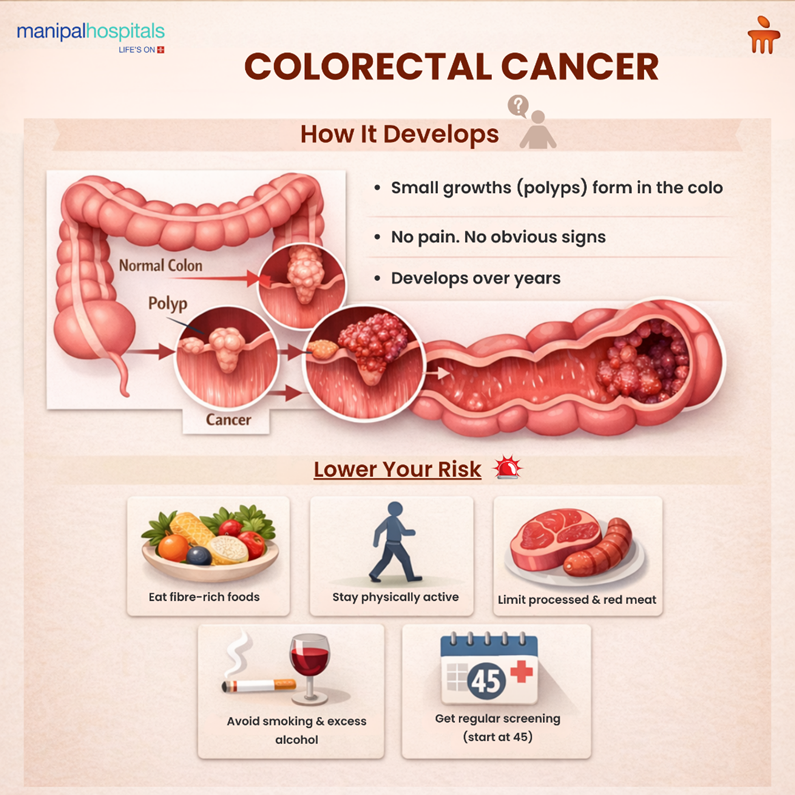
Most cases of colorectal cancer do not start as a large tumour. Instead, they usually begin as small, noncancerous clumps of cells called polyps. Over several years, some of these polyps can change and become malignant. Because polyps themselves often cause no symptoms, regular screening is the best way to find and remove them before they ever have the chance to develop into a serious problem. Understanding what is colorectal cancer at its earliest stage helps patients realise that a diagnosis is not always an emergency but rather a call to take specific, structured medical action.
Recognizing Initial Changes
Because the colon is a large organ, a small growth might not cause any pain or blockage for a long time. This phenomenon is why many people are surprised by a diagnosis. However, if you pay close attention to your body, you may notice signs of colorectal cancer that appear before the disease progresses. These signs are often related to how the colon functions.
Some of the most frequent colorectal cancer symptoms include:
-
Shifts in Digestion: You might experience a change in bowel habits, such as diarrhea, constipation, or a narrowing of the stool that lasts for more than a few days.
-
Abdominal Discomfort: Persistent gas, cramps, or a feeling of being bloated that does not seem related to specific foods can be a signal.
-
Unexplained Fatigue: Because tumours can sometimes bleed very slowly into the digestive tract, you might develop anaemia. This leads to feeling tired or weak even when you have rested well.
-
A Feeling of Incomplete Emptying: You may feel as though you need to have a bowel movement even after you have just had one.
If you notice these signs of colorectal cancer, it does not automatically mean you have the disease. Many other conditions, such as Irritable Bowel Syndrome (IBS) or haemorrhoids, can cause similar issues. However, checking these symptoms with a doctor is a necessary step to rule out serious concerns.
Screening Methods
Screening is the most powerful tool available for early detection. There are several ways doctors can look for abnormalities in the colon, each with its own set of benefits.
|
Screening Method |
How It Works |
Frequency |
Purpose |
|
Colonoscopy |
A long, flexible tube with a camera is used to view the entire colon. |
Every 10 years for average risk. |
To find and remove polyps and detect tumours. |
|
Stool DNA Test |
A sample is analysed in a lab for DNA changes or blood. |
Every 3 years. |
To detect signs of cancerous cells in the stool. |
|
CT Colonography |
A specialised X-ray (virtual colonoscopy) creates images of the colon. |
Every 5 years. |
To look for growths without an invasive procedure. |
|
Fecal Immunochemical Test (FIT) |
Tests for hidden blood in the stool. |
Every year. |
A simple, non-invasive first step in screening. |
Who is at Risk?
While anyone can develop cancer of the colorectal, certain factors make it more likely:
-
Age is one of the most common factors, as the risk increases significantly after the age of 45.
-
A diet high in processed meats and red meats, while being low in fibre from fruits and vegetables, has been linked to higher rates of the disease.
-
Sedentary behavior and obesity are also contributors.
-
People with a family history of the condition or those with inflammatory bowel diseases, like ulcerative colitis or Crohn’s disease, have a higher baseline risk.
While 45 is the standard age for the general population, those with Lynch Syndrome or Familial Adenomatous Polyposis (FAP) require much earlier and more frequent surveillance.
By understanding these risk factors, you can better grasp colorectal cancer prevention and how to implement it in your life through better habits and regular checkups.
Classification of Disease Progression
If a diagnosis is made, doctors will use various tests to determine the stages of colorectal cancer. This process is essential because it tells the medical team how far the cells have moved beyond the original site. Knowing the stage allows the doctor to choose the most effective intervention.
The stages of colorectal cancer generally follow a 0 to IV scale:
-
Stage 0: The cells are only in the innermost lining of the colon. This is the earliest possible stage.
-
Stage I: The cancer has grown into the wall of the colon but has not spread beyond it.
-
Stage II: The growth has extended through the wall of the colon but has not reached the lymph nodes.
-
Stage III: The cancer has spread to nearby lymph nodes but has not affected other organs.
-
Stage IV: This is the most advanced of the stages of colorectal cancer, where the disease has spread to distant organs like the liver or lungs.
The survival rate is extremely high for the early stages, which is why doctors emphasise the importance of early detection through regular screening.
Available Medical Interventions
Once the stage is identified, the focus shifts to colorectal cancer treatments. The plan is usually personalised based on the location of the tumour and the patient's overall health. Often, a combination of different methods is used to ensure the best possible outcome.
The primary colorectal cancer treatments include:
|
Surgery |
This procedure is the most common approach for early-stage cases. The surgeon removes the part of the colon containing the tumour along with a small margin of healthy tissue. |
|
Chemotherapy |
This procedure involves using medication to kill cancer cells or stop them from growing. It is often used after surgery to ensure any remaining microscopic cells are eliminated. |
|
Radiation Therapy |
High-energy beams are used to shrink tumours, often before surgery, especially in cases where the rectum is involved. |
|
Targeted Therapy |
These are newer colorectal cancer treatments that focus on specific proteins or genes that help cancer cells grow, sparing more of the healthy cells in the process. |
Modern medicine continues to refine these colorectal cancer treatments, making them more effective and reducing the side effects associated with recovery.
Prevention through Daily Habits
While you cannot change your genetics or your age, there are many things you can do to lower your risk. Diet is perhaps the most influential factor. Eating a variety of whole grains, fruits, and vegetables provides the fibre that keeps your digestive system moving and healthy. Reducing your intake of red meat and avoiding processed meats like sausages and deli meats can also make a significant difference in your long-term health.
Regular physical activity is another pillar of prevention. Aiming for at least 30 minutes of moderate exercise most days of the week helps maintain a healthy weight and balances the hormones that can influence cell growth. Additionally, avoiding tobacco and limiting alcohol consumption are well-known ways to protect the lining of your colon. These habits, combined with staying informed about what is colorectal cancer, form a strong defense against the disease.
Conclusion
A diagnosis involving the colon can feel like an overwhelming hurdle, but it is a challenge that can be met with advanced medical science and a proactive mindset. By staying informed about colorectal cancer symptoms and understanding the importance of early screening, you are already taking the most important steps toward a healthy future. If you have noticed any persistent changes in your body, do not hesitate to speak with our healthcare professional.
Manipal Hospitals offers the best colorectal cancer treatments in Bangalore, making the path back to a full, active life very much within reach.
FAQ's
Current guidelines recommend that most people start regular screening at age 45. However, if you have a family history of the disease or have noticed signs of colorectal cancer, your doctor may suggest starting much earlier.
While surgery is a primary component of many colorectal cancer treatments, it is often paired with chemotherapy or radiation, depending on the stage and location of the tumour. Every case is unique and requires a tailored approach.
While you cannot prevent them entirely, a high-fibre diet, maintaining a healthy weight, and staying active are proven ways to reduce the likelihood of polyp development. Regular screening is the only way to ensure they are found and removed.
Recovery varies depending on whether the surgery was traditional or minimally invasive (laparoscopic). Many patients who receive colorectal cancer treatments in Bangalore using advanced techniques find they can return to their normal activities within a few weeks, though full internal healing takes longer.
Yes. Sometimes a tumour located in a specific part of the colon may cause colorectal cancer symptoms like bleeding, even when it is still in the early stages. This is actually a positive thing, as it leads to earlier diagnosis and a higher chance of a total cure.
Share this article on: