7 Min Read
Medical emergencies do not follow a schedule. They often happen in the quietest hours of the night or in the middle of a busy workday, leaving families with very little time to process what is happening. When a sudden stroke, a severe accident, or a life-threatening infection occurs, the environment changes from a normal daily routine to a high-stakes race against time. In these moments, the quality of medical intervention determines the outcome. In these moments, care is not limited to one department or one doctor. It is a coordinated system where emergency teams, intensivists, nurses, technicians, and specialists work together with focus and urgency.
The aim is simple, but never small: to stabilise the patient, prevent further decline, and support recovery with the right level of attention at the right time. For many families, critical care and life-saving services available 24×7 at Manipal Hospitals Bangalore offer reassurance during some of the most difficult hours they will ever face.
This blog explores the world of intensive medicine and the structural support provided by our top-tier critical care hospitals. We will look at how these units function, the technology used to keep patients stable, and the specific expertise required to manage the most complex health crises.
Synopsis
- What Is a Critical Care Unit?
- Why Does This Level of Support Matters?
- The Role of Emergency Medicine and Critical Care
- Conditions Managed in a Critical Care Setting
- Technology That Supports Life-Saving Care
- Why 24×7 Availability Matters
- Patient-Centred Approach in Critical Care
- Transition from Critical Care to Recovery
- Conclusion
What Is a Critical Care Unit?
A critical care unit is a specialised area in a hospital where patients with life-threatening conditions receive continuous monitoring and intensive treatment. These units are designed for patients who need close observation, advanced equipment, and immediate medical intervention.
Unlike general wards, a critical care unit is equipped with:
-
Continuous heart and vital monitoring systems
-
Ventilators to support breathing
-
Advanced life-support equipment
-
Dedicated nursing staff trained in intensive care
Patients admitted here are often dealing with severe conditions such as organ failure, major trauma, or post-surgical complications. The goal is to stabilise the patient and prevent further deterioration.
Why Does This Level of Support Matters?
Critical illness often changes quickly, sometimes over the course of minutes rather than hours. Breathing may become difficult, blood pressure may drop, oxygen levels may fall, or an infection may begin to spread before the body has time to compensate. In those situations, regular ward care may not be enough. A critical care unit is designed to watch the patient continuously and allow the team to act the moment something begins to shift.
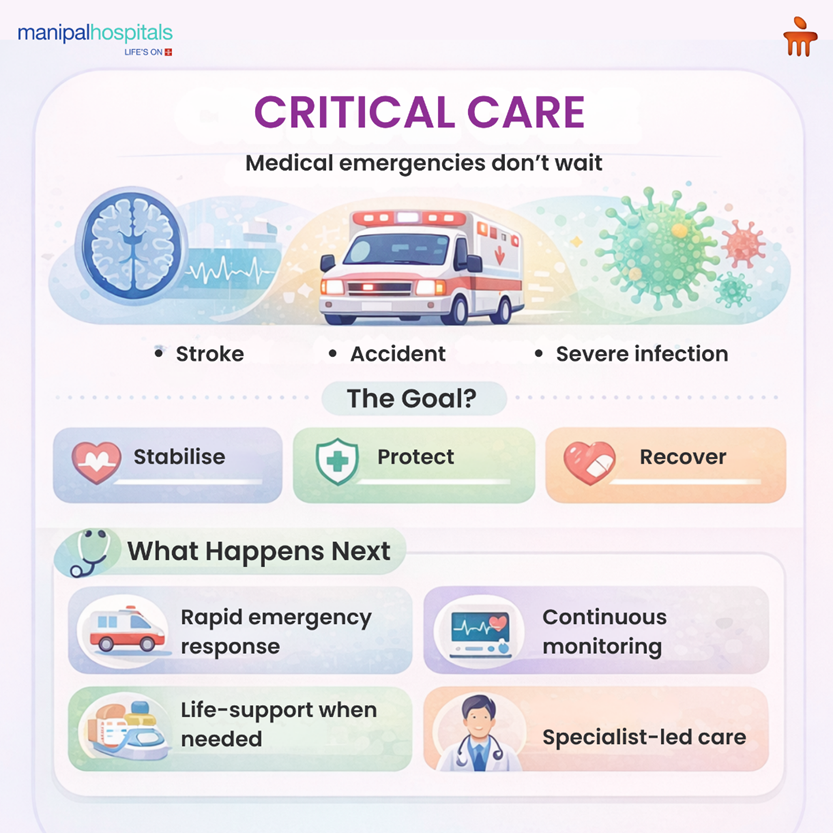
That level of readiness changes the way treatment unfolds. Instead of waiting for a problem to become obvious, clinicians can see subtle changes early and respond before those changes grow into a larger crisis. This is one of the main reasons critical care and life-saving services available 24×7 at Manipal Hospitals are so important. The availability of care around the clock means there is no gap in vigilance, no pause in monitoring, and no delay when a patient needs immediate support.
The Role of Emergency Medicine and Critical Care
When a patient arrives in a serious condition, care begins even before they reach the ICU. This is where emergency medicine and critical care work together seamlessly.
Emergency teams handle the first phase:
-
Rapid assessment of symptoms
-
Immediate stabilisation
-
Initial diagnosis and urgent interventions
Once stabilised, patients who need close monitoring are moved to the ICU, where critical care teams take over. This smooth transition ensures there is no delay in treatment. The integration of emergency medicine and critical care ensures continuity. From arrival to recovery, every step is connected and carefully managed.
Conditions Managed in a Critical Care Setting
A critical care hospital manages a wide range of serious medical conditions. These are situations where the body’s essential functions are at risk, and close monitoring is necessary.
Common conditions include:
-
Severe infections such as sepsis
-
Heart attacks and related cardiac complications
-
Stroke and neurological emergencies
-
Respiratory failure requiring ventilator support
-
Major trauma from accidents
-
Complications after surgery
Every case is different. Some patients need breathing support, while others require medication adjustments, dialysis, or neurological monitoring. In all of these situations, the presence of a skilled critical care specialist is central to decision-making and ongoing care.
Technology That Supports Life-Saving Care
Modern intensive care depends heavily on technology. Equipment in the ICU helps the team monitor the patient closely and support the body when one or more systems are failing.
Key technologies include:
-
Multi-parameter monitors for real-time tracking
-
Ventilators for respiratory support
-
Infusion pumps for accurate medication delivery
-
Dialysis machines for kidney support
-
Imaging support for rapid diagnosis
These tools give the critical care specialist the information needed to act quickly. In an ICU, reliable technology can directly impact outcomes, as decisions often require quick action within minutes.
The support available in this setting is broad because critically ill patients may need more than one type of intervention at the same time. The goal is always to match the level of care to the patient rather than forcing the patient to fit a fixed routine:
|
Services |
What It Supports |
Why It Matters for the Patient |
|
Continuous monitoring |
Heart rate, oxygen level, blood pressure, and other vital signs |
Helps the team notice changes early and act before the condition worsens |
|
Breathing support |
Patients with severe respiratory distress or respiratory failure |
Protects oxygen delivery when the lungs are not working well enough on their own |
|
Medication and infusion management |
Antibiotics, pain control, fluids, and emergency drugs |
Keeps treatment precise and responsive to changing needs |
|
Post-surgical observation |
Recovery after major or high-risk procedures |
Reduces the chance of sudden complications during the early recovery period |
|
Multi-specialty coordination |
Input from surgeons, physicians, neurologists, cardiologists, and others |
Ensures the patient receives the right expert support without delay |
Why 24×7 Availability Matters
Serious emergencies can happen at any time. A patient may deteriorate in the middle of the night, or a new complication may appear during a holiday or weekend. That is why 24×7 readiness is such an important part of any critical care hospital in Bangalore.
Round-the-clock availability means:
-
Immediate medical attention without waiting
-
Continuous monitoring without gaps
-
Faster response to sudden changes
-
Better support during unstable periods
Even short delays can have a major impact on critical illness. A fully functioning critical care unit that is available at all hours offers reassurance that trained help is always present when needed
Patient-Centred Approach in Critical Care
Although critical care relies on machines, monitors, and procedures, it also needs to remain deeply human. Being in an ICU is overwhelming for patients and families alike, and excellent care includes honest communication as much as technical skill.
Hospitals often focus on:
-
Clear explanations of the patient’s condition
-
Regular updates for family members
-
Emotional support during uncertain periods
-
Respectful, compassionate communication
This patient-centred approach helps families feel informed and included. It also supports trust during a time that is often stressful and frightening.
Transition from Critical Care to Recovery
Leaving the intensive care unit is a major victory, but it is not the end of the journey. The recovery process involves:
-
Physical Therapy: Starting even before the patient leaves the ICU to maintain joint mobility and muscle strength.
-
Respiratory Therapy: Helping patients wean off oxygen support and regain full lung capacity.
-
Nutritional Support: Gradually moving from IV nutrition back to a standard diet to rebuild energy stores.
-
Psychological Support: Helping both the patient and the family process the stress of the medical emergency.
Conclusion
Critical care is about being prepared for the most serious moments in healthcare. It combines expertise, technology, and rapid decision-making to support patients when they need it the most. A well-equipped critical care unit (CCU), supported by experienced teams, ensures that patients receive timely and effective treatment. With the presence of a skilled critical care specialists, every aspect of care is closely monitored and adjusted based on the patient’s needs.
Manipal Hospitals Bangalore designs its Level 3B ICU services to provide immediate, reliable, and advanced life-saving interventions. In critical situations, the availability of expert help can significantly impact the outcome.
FAQ's
In most modern hospitals, the terms are used interchangeably. Both a critical care unit and an intensive care unit (ICU) provide the highest level of monitoring and life support for patients with life-threatening conditions. Some hospitals use the term "critical care" to emphasise the presence of specialised doctors and advanced organ support technology.
Yes, but the rules are usually stricter than in a general ward. Because patients in a critical care unit are highly susceptible to infection and need significant rest, visiting hours are often limited, and only a few close family members are allowed at a time. This procedure is done to maintain a sterile and quiet environment for recovery.
The decision is made by the critical care specialist when the patient’s vital signs are stable without the need for constant mechanical support. This means they are breathing on their own, their heart rate and blood pressure are stable, and they no longer need the ICU's intensive monitoring.
This is often done to allow the body to heal without the stress of pain or the discomfort of being on a ventilator. By using sedative medications, the critical care specialist can reduce the brain’s demand for oxygen and energy, which is especially important after a head injury or a severe cardiac event.
You should look for 24/7 availability of intensivists, a high nurse-to-patient ratio, advanced life-support equipment like ventilators and dialysis machines, and a seamless connection between the emergency room and the ICU. Accessibility to your location is also a major factor in an emergency.
Share this article on: