6 Min Read
What if a simple test could reveal hidden blockages in your heart before they lead to something life-threatening? Chest discomfort, breathlessness while climbing stairs, or unexplained fatigue are often dismissed as stress or ageing. Yet, in many individuals, these subtle symptoms may point toward underlying coronary artery disease. When doctors need a clear and detailed view of the heart’s blood vessels, a coronary angiogram becomes one of the most reliable tools available.
Coronary artery disease remains one of the leading causes of mortality worldwide. Early and accurate heart disease diagnosis not only prevents heart attacks but also allows timely intervention that can significantly improve quality of life. Through this blog, we explain how each test is performed, the risks involved, recovery expectations, and what to expect during angiography so that patients can feel informed rather than anxious when advised to undergo the procedure.
Synopsis
What is a Coronary Angiogram?
Your heart works tirelessly, pumping blood through arteries called the coronary arteries. Over time, these arteries can narrow due to plaque build-up. When that happens, the heart muscle may not receive enough oxygen-rich blood.
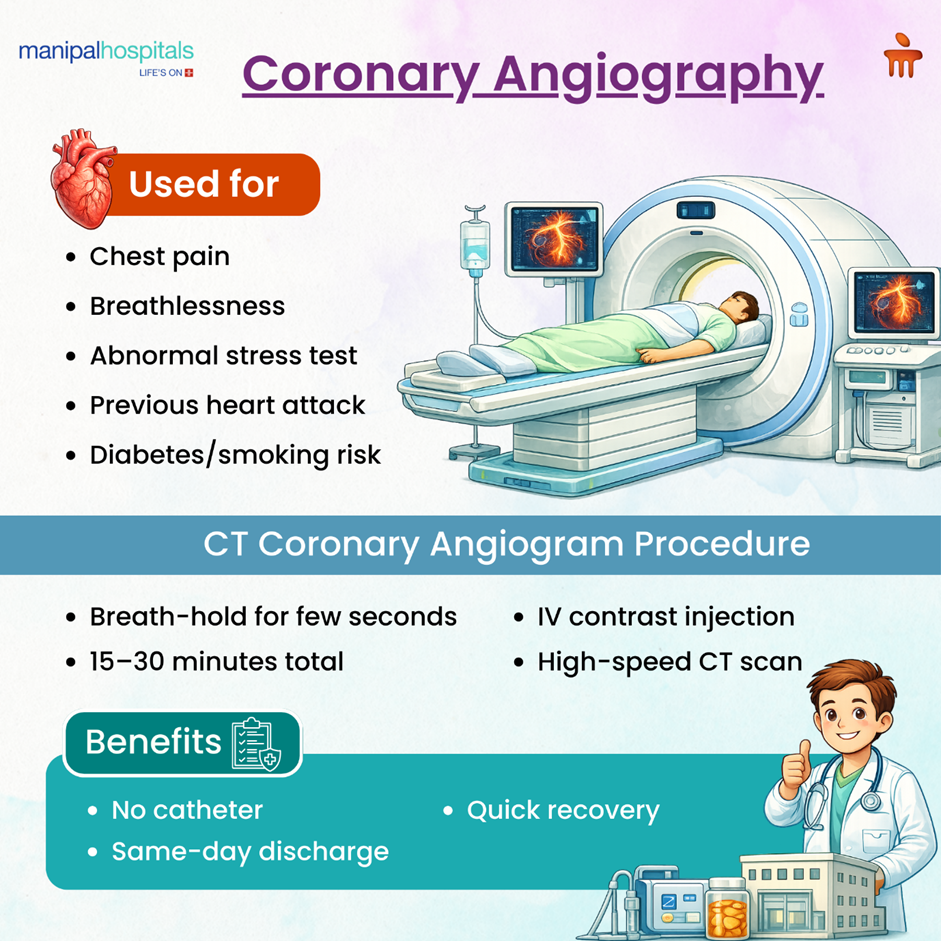
A coronary angiogram is a specialised imaging test that shows these arteries in detail. It plays a crucial role in heart disease diagnosis, especially when someone has:
-
Abnormal stress test results
-
Shortness of breath during exercise
-
History of heart attack
-
Risk factors such as diabetes or smoking
The test will assist your cardiologist in determining if there are blockages, their severity, and the necessary treatment. There are two main types of procedures for a coronary angiogram:
-
CT Coronary Angiogram – A non-invasive test that utilizes modern CT scanning technology and contrast dye.
-
Invasive Coronary Angiography – A catheter-based test that is conducted in a cardiac catheterization lab.
Both tests are used to evaluate blockages, but they are different in terms of procedure, recovery time, and usage.
Understanding the CT Coronary Angiogram
If your symptoms are mild to moderate and your doctor wants a non-invasive evaluation, a CT coronary angiogram may be recommended.
A CT coronary angiogram procedure uses a high-speed CT scanner along with contrast dye to produce detailed images of the heart arteries. Unlike traditional invasive coronary angiography, this method does not require inserting a catheter into the arteries of the heart.
Here is what usually happens:
-
You lie on a CT scanning table.
-
A small IV line is inserted into your arm to inject contrast dye.
-
The scanner takes rapid images of your heart while you hold your breath briefly.
-
The entire process typically takes 15 to 30 minutes.
Because it is non-invasive, recovery is almost immediate. Most people resume normal activities the same day.
A CT coronary angiogram is particularly helpful in ruling out significant coronary artery disease in patients with low to intermediate risk. However, if a major blockage is detected, you may still require invasive coronary angiography for confirmation and treatment.
What Happens During Invasive Coronary Angiography?
When symptoms are significant or when a heart attack is suspected, doctors usually recommend invasive coronary angiography. This remains the gold standard for detailed evaluation.
The procedure is done in a specialised cardiac catheterisation lab. This is why you may hear the terms coronary angiography and cardiac catheterization used together. Here is what to expect during angiography:
-
A local anaesthetic is given at the wrist or groin.
-
A thin tube called a catheter is gently inserted into an artery.
-
The catheter is guided to the coronary arteries using X-ray imaging.
-
Contrast dye is injected, making blockages visible on the screen.
You remain awake during the procedure, but do not feel pain inside the arteries. The test usually takes 20 to 40 minutes. If a significant blockage is identified, doctors may proceed immediately with coronary angiography and angioplasty, where a balloon and stent are used to open the narrowed artery. This avoids the need for a second procedure.
CT vs Invasive Coronary Angiogram: How do Doctors Choose?
A CT coronary angiogram is an excellent first test when the pre-test probability of coronary disease is low to moderate, when you cannot exercise for a stress test, or when your doctor wants a non-invasive map. Invasive coronary angiography is preferred if symptoms are high-risk (ongoing chest pain, positive stress test), or if there’s a likelihood you may need a stent or other coronary intervention during the same visit. Advances such as 3D CT modelling (used alongside CT) are reducing the number of invasive tests needed, but the invasive approach remains essential when immediate treatment is likely.
Risks and Safety Considerations
Hearing the word “angiogram” can understandably cause concern. The good news is that both procedures are routinely performed and generally safe when done in experienced centres.
With a CT coronary angiogram, risks are minimal and may include:
-
Mild allergic reaction to contrast dye
-
Temporary kidney strain in patients with pre-existing kidney disease
-
Exposure to a small amount of radiation
With invasive coronary angiography, risks are slightly higher but still uncommon. They may include:
-
Bleeding or bruising at the catheter site
-
Rare artery injury
-
Allergic reaction to dye
-
Irregular heart rhythm during the procedure
Your doctor will assess your overall health before recommending a coronary angiogram to ensure it is safe for you.
Recovery After Coronary Angiography
Recovery depends on the type of test performed. After a CT coronary angiogram, most people walk out of the hospital shortly after the scan. Hydration is encouraged to flush out the contrast dye.
Following invasive coronary angiography, you may need to lie flat for a few hours if the groin approach was used. If the wrist approach is used, recovery is often faster. Most patients go home the same day or the next day.
If coronary angiography and angioplasty were performed, recovery may involve:
-
Monitoring overnight
-
Taking prescribed blood-thinning medications
-
Avoiding heavy lifting for a few days
Your doctor will provide personalised instructions before discharge.
Preparing for the Procedure
Preparation is usually simple but important. Your doctor may advise:
-
Fasting for a few hours before the test
-
Stopping certain medications temporarily
-
Blood tests to check kidney function
-
Informing the team about allergies
Understanding what to expect during angiography often reduces anxiety. Most patients are surprised by how smooth and controlled the procedure feels.
Conclusion
A coronary angiogram is one of the most powerful tools available for accurate heart disease diagnosis. Knowing the difference between a non-invasive CT coronary angiogram procedure and traditional coronary angiography and cardiac catheterisation can help you feel more confident if the test is recommended. If you have symptoms or risk factors, do not ignore them; book an evaluation at Manipal Hospital Yelahanka today. Early evaluation, timely testing, and informed decisions can make all the difference to your heart health.
FAQ's
A coronary angiogram is usually not painful. During invasive coronary angiography, you may feel mild pressure at the insertion site but not inside the heart arteries.
A CT coronary angiogram procedure typically takes 15 to 30 minutes, and most patients return home the same day.
A CT coronary angiogram is non-invasive and mainly diagnostic. Invasive coronary angiography involves catheter insertion and allows immediate treatment if needed.
A coronary angiogram specifically detects blockages in the coronary arteries. Other heart conditions may require additional tests for a complete heart disease diagnosis.
After invasive coronary angiography, you may need short observation. After a CT coronary angiogram, recovery is almost immediate. Your doctor will guide you based on your individual case.
Share this article on: