8 Min Read
Transferring a medically unstable newborn requires careful planning and precision. In fact, the transfer of critically ill infants is often one of the most time-sensitive decisions clinicians make. There is minimal margin for error. What makes it more challenging is that these infants are already dependent on ongoing medical support. Interruptions, even brief ones, can lead to complications. That is why a dedicated ambulance service to shift critically ill infants is essential.
In areas with advanced healthcare access, services like infant ambulance transport in Old Airport Road, Bangalore, have made it possible to move babies with critical illnesses while still maintaining NICU-level care during transit. This blog explains how infants with critical ailments are transported from one point of care to another.
Synopsis
What Are Critically Ill Infants?
Critically ill infants are newborns who cannot maintain stable vital functions on their own. These babies usually need continuous observation and medical intervention. They could include:
-
Premature infants with underdeveloped lungs
-
Babies with severe infections that require urgent treatment
-
Babies with respiratory distress at birth
-
Infants with congenital abnormalities
-
Babies with neurological concerns following delivery complications
In such situations, even minor delays can be risky. A dedicated ambulance service to transfer critically ill infants helps ensure that treatment does not pause during movement.
Why Is Neonatal Transport Necessary?
Not all hospitals are equipped to handle complex neonatal cases. When advanced care is needed, transferring critically ill infants becomes necessary.
A specialised ambulance designed for critically ill infants is outfitted with equipment that:
-
Supports breathing
-
Monitors vital signs continuously
-
Enables rapid response to clinical changes
Infant ambulance services, like those found on Old Airport Road in Bangalore, facilitate and accelerate access to sophisticated NICU care. This can have a substantial impact on both survival rates and the overall recovery process.
Key Principles of Safe Infant Transfer
1. Pre-Transport Stabilisation
Before anything else, the infant must be stabilised. Transport usually begins after the infant is stabilised as much as possible, depending on urgency.
Doctors pay attention to:
-
Making sure the airway is safe
-
Giving enough oxygen or help with breathing
-
Keeping the body at the right temperature
-
Establishing IV access
If the baby’s condition is unstable, the risk remains high, even with a specialised ambulance.
2. Effective Communication
This part is often underestimated. Clear communication between teams can prevent critical errors. The following information is shared:
-
Current diagnosis
-
Treatments already given
-
Possible complications
When transferring critically ill infants, the receiving hospital prepares based on this information.
3. Specialised Transport Systems
A standard ambulance may not meet neonatal care requirements. A specialised ambulance service designed specifically for neonatal transport has equipment made just for taking care of newborns, like:
-
Incubators for transport
-
Ventilators that can be moved
-
Devices for monitoring
-
Infusion pumps for controlled medication delivery
These needs are the basis for services like infant ambulance transport on Old Airport Road in Bangalore, which make sure that care continues throughout the transit.
Role of Neonatal Transport Teams
Behind every safe transfer is a trained team. Managing critically ill infants during transport requires experience and quick decision-making. The team usually consists of:
-
A neonatologist or paediatric specialist, who is responsible for making critical decisions during the entire journey
-
NICU-trained nurses, who administer medications and handle medical equipment
-
Emergency paramedics ensure that all medical equipment functions properly during transit
They monitor, adjust treatment, and respond immediately if something changes. A dedicated ambulance service to transfer critically ill infants is only as effective as the team operating it.
Steps Involved in Transferring Critically Ill Infants
Moving critically ill infants requires careful planning and supervision along with a skilled medical team and specialised equipment.
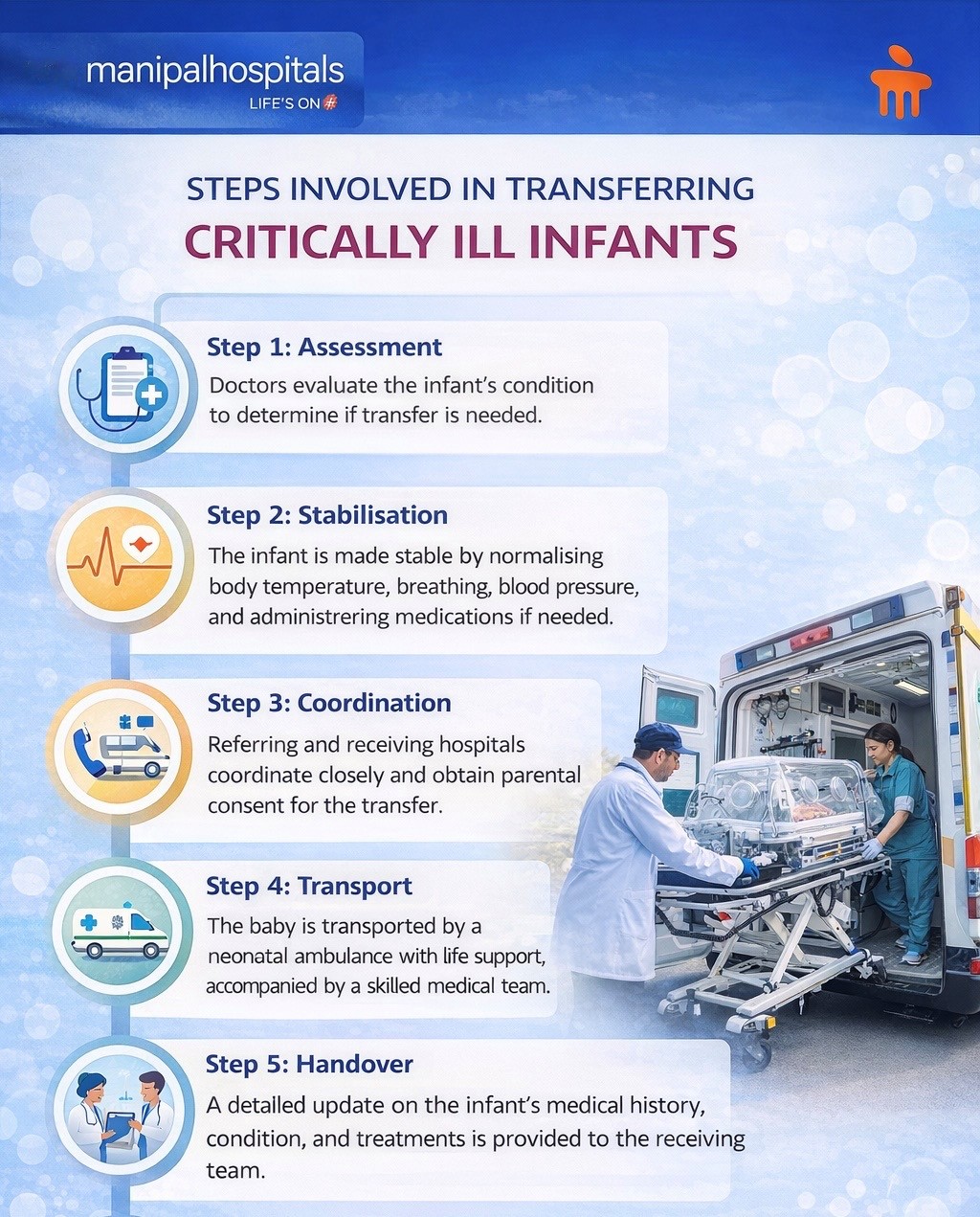
Step 1: Assessment
Doctors evaluate whether transfer is necessary based on the medical condition of the baby and the availability of the required care at the current facility. In this step, doctors review vital signs and potential risks during transport.
Step 2: Stabilisation
Before moving, the infant is made stable. This includes keeping body temperature normal, checking blood pressure, supporting breathing, and giving medicines if needed.
Step 3: Coordination
The referring and receiving hospitals coordinate closely. Transport arrangements are made, and parental consent is obtained.
Step 4: Transport
The baby is moved in a neonatal ambulance with life support. A trained team goes along, keeps checking vital signs, and acts quickly if anything changes.
Step 5: Handover
A detailed update is provided to the receiving medical team on arrival. This includes the infant’s medical history, current condition, treatments given, and any changes observed during transport.
Challenges in Neonatal Transport
Even with proper systems in place, challenges remain. Common ones include:
-
Difficulty maintaining body temperature: Newborns, especially premature infants, are prone to fluctuations in temperature. Although special incubators are used, maintaining a stable body temperature can be challenging.
-
Sudden breathing issues: Babies with critical illness may face respiratory distress during transit. Therefore, continuous monitoring and ventilator support are crucial.
-
Space constraints inside the ambulance: An ambulance to transport babies with critical illnesses is equipped with advanced machines. This can create space constraints and limit mobility and response time during emergencies.
-
Traffic delays: Traffic congestion, especially when transferring to a facility at a long distance, can affect the condition of the infant.
A dedicated ambulance service to shift critically ill infants is specifically designed to handle these situations more effectively than general emergency transport.
Importance of Location-Specific Services
Time plays a critical role in neonatal emergencies. Services such as infant ambulance transport on Old Airport Road, Bangalore, are positioned to reduce response time and connect babies quickly with advanced NICU facilities. For critically ill infants, faster access often means better outcomes.
Advancements in Neonatal Transport
Over time, neonatal transport has improved significantly. Today, transferring critically ill infants is safer due to:
-
Better transport incubators: Modern incubators keep the temperature, humidity, and oxygen levels consistent to minimise environmental stress during transport while they are being transported.
-
More reliable ventilators: Portable ventilators now provide precise respiratory support, almost like NICU-level care. They may change how they work based on how the baby is breathing in real time, which lowers the likelihood of problems.
-
Improved staff training: Neonatal transport crews have particular training in how to deal with high-risk scenarios, give emergency care, and manage equipment. Standardised protocols make sure that everything is done the same way and safely at every step.
-
Advanced monitoring systems: Modern monitoring systems keep an eye on body vitals, like heart rate, oxygen saturation, blood pressure, and temperature, all the time. These systems send alarms in real time, so action can be taken right away if necessary.
A dedicated ambulance service to shift critically ill infants now offers a level of care that closely mirrors what is available inside a NICU.
Conclusion
Transporting critically ill infants is more than just a medical procedure. It is a well-planned process that requires careful monitoring at every step. Each step, from stabilisation to transport to final handover, helps keep the baby healthy. A special ambulance service ensures that babies with critical illnesses are transferred between healthcare facilities safely.
With services like infant ambulance transport in Old Airport Road, Bangalore, families can access advanced neonatal care more efficiently and safely. For specialised neonatal care and reliable transport solutions, Manipal Hospital Old Airport Road, Bangalore, offers advanced NICU support along with expert-led neonatal transfer services tailored for critically ill newborns.
FAQ's
Critically ill infants need specialised transport because their condition can change quickly and they may need constant oxygen, temperature control, ventilation, and monitoring. A specialised system helps maintain stability during the journey and reduces the risk of complications.
A dedicated ambulance service to shift critically ill infants includes an incubator, ventilator support, monitoring equipment, oxygen supply, and emergency medicines. It is designed as a dedicated ambulance service to shift critically ill infants safely while keeping their medical needs under continuous care.
Safety is ensured through trained neonatal staff, continuous monitoring, and the right medical equipment inside the ambulance. A dedicated ambulance service to transfer critically ill infants also helps keep the baby stable and allows quick action if the condition changes suddenly.
Yes, there are always some risks when moving a critically ill infant, but those risks are much lower when the transfer is handled by a specialised team. Careful planning, monitoring, and the right equipment make the process far safer.
Services like infant ambulance transport in Old Airport Road, Bangalore, are usually arranged quickly because timing matters in neonatal emergencies. The sooner the transfer is organised, the sooner the infant can receive the right care at a suitable facility.
Share this article on: