8 Min Read
Consuming alcohol is widely considered a socially acceptable vice, often used to unwind or bond with friends and colleagues. Alcohol harms not only liver health but also several other organ systems. In fact, alcohol is classified under the group 1 cancer-causing agents, as it can lead to at least 7 types of cancers. When it comes to alcohol consumption, there is no safe amount that does not affect health.
Synopsis
Types of Alcoholic Drinks
Alcohol can be classified into three main types:
-
Beer: These beverages range from light to strong and are generally of many types, such as light beer with 4.3% alc/vol. or regular beer with 5% alc./vol. Beverages, such as craft beer and flavoured malt beverages, can also be stronger, with alcohol content anywhere between 6% and 9% alc/vol.
-
Wine: These are comparatively stronger, with typical table wines ranging from 5% to 16% alc/vol.
-
Hard Liquor (Spirits): These drinks are high-strength beverages that are made from distilled spirits; for example, vodka, whisky, brandy, rum, gin, etc., each generally containing from 24% to 40% alc/vol, or higher. Cocktails are often 2 or more spirits combined with a variety of other ingredients, with the total alcohol content being more than a couple of standard drinks.
How Much Alcohol is Safe?
Alcohol in any amount isn’t necessarily good for you, but the level at which it begins to turn toxic for the liver depends on a variety of factors, including your gender, age, underlying health conditions, and genetic predisposition. Moreover, beyond quantity, your drinking pattern, including how fast, how often, and the type of alcohol you drink, can also determine your risk of alcohol-associated liver disease (ALD).
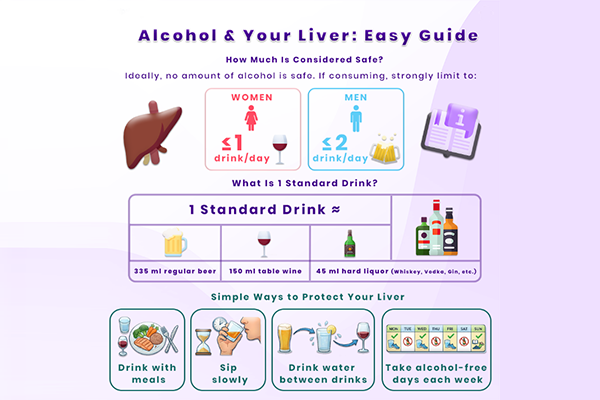
The World Health Organisation has now published a statement: when it comes to alcohol consumption, there is no safe amount that does not affect health.
While nearly 2.3 billion people consume alcohol globally, not all of them develop ALD. Recent research shows that binge drinking (5 or more drinks for men and 4 or more drinks for women in approximately 2 hours) can significantly increase the risk of liver disease.
On average, one drink or less per day for women and two drinks or less per day for men are less likely to cause alcohol-related health risks. One standard drink is typically 335 ml of regular beer, 150 ml of table wine, or 45 ml of hard liquor such as whiskey, vodka, or gin. Cirrhosis typically develops after 10 to 20 years of consistent drinking. Slowing down your intake and spacing out drinks over a longer duration can therefore help mitigate alcohol’s harmful effects on the liver.
Studies have also shown that the likelihood of developing ALD depends on the type of alcohol consumed. Distilled spirits are associated with the highest risk, while fermented beverages such as wine have lower risk when consumed in limited amounts. However, regardless of the type of alcoholic beverage, public health guidelines emphasize that no level of alcohol consumption is safe.
Common alcohol-related health issues
There are three main types of ALDs that heavy alcohol users generally progress through:
-
Alcoholic Fatty Liver Disease (AFLD): This is a condition that develops when inefficient fat metabolism causes excess fat to accumulate in liver cells. AFLD is most commonly seen in individuals with heavy alcohol use. Although often asymptomatic, some individuals complain about symptoms such as pain in the upper right abdomen, fatigue, and weight loss.
-
Alcohol-associated Hepatitis (AAH): This is a serious form of ALD that involves inflammation and damage to the liver cells resulting from excessive alcohol use over a prolonged period. Common symptoms of AAH include low-grade fever, fatigue, nausea and vomiting, jaundice, abdominal distension, upper right abdominal pain, and stomach tenderness.
-
Alcohol-associated cirrhosis (AAC): This condition is pretty much advanced scarring of the liver due to heavy alcohol use over time. "Cirrhosis" is a broad term that refers to the liver developing scar tissue during its attempt to repair itself after damage. As cirrhosis worsens, more scar tissue begins to develop, hampering normal liver function. The advanced stage of this disease is often life-threatening, as the damage caused by cirrhosis is mostly irreversible. Some of the classic symptoms of cirrhosis include jaundice, edema involving swelling in the legs, feet, and ankles, weight loss, nausea, drowsiness, extreme fatigue, and ascites involving fluid build-up in the stomach.
How are ALDs diagnosed and treated?
To diagnose ALDs, doctors analyse patients’ health history and perform a variety of screening tests, such as:
-
Blood tests: These tests measure liver enzyme levels to find out whether the liver is functioning optimally. In case of abnormalities, they help identify the type and stage of liver disease.
-
Ultrasound: These scans help doctors identify the cause of the disease by using high-frequency sound waves to create images of the internal organs, particularly the liver.
-
MRI scans: These tests involve the use of magnetic fields and radio frequency pulses to generate images of internal organs, which are displayed on a computer. A unique dye is injected into the vein of the patient to ensure these organs are clearly visible.
-
CT scans: X-rays are used to capture images of visceral organs that are viewed on a computer. A dye is injected intravenously to improve their visibility.
-
Liver biopsy: This test involves using a needle to extract a portion of the liver tissue, which is analysed under the microscope to determine the type of liver disease.
Most individuals struggling with an alcohol-associated liver disease may also be at an increased risk of having other conditions, like the hepatitis B or C virus. It is crucial to consult with a liver specialist at a reputed Bangalore liver hospital to get yourself tested and treated for both conditions. Those with acute hepatitis or cirrhosis related to alcohol use often develop issues with their kidney, with some also developing gastrointestinal bleeding, fluid build-up in their stomach, and, in severe cases, infections and liver cancer.
For treatment to be effective, individuals need to be completely truthful with doctors about their alcohol use. Before starting therapy, individuals should completely stop alcohol consumption. This procedure can be challenging, particularly for those with chronic long-term alcohol dependence. In such cases, enrolling in an alcohol treatment program can be highly beneficial.
Since the liver possesses the ability to repair and regenerate, it can heal itself to some extent from cirrhosis-related scarring and damage from alcohol. However, permanent damage may occur if the loss of liver tissue is severe enough to cause liver failure. Treatments may differ based on the type of complication. In most cases, dietary changes are recommended along with medicines and procedures to help bring swollen veins in the digestive tract to their normal size. Medicines to control confusion and inflammation are also prescribed. In cases of irreversible damage, individuals may be advised to undergo transplant surgery at a top liver transplant hospital in India.
Precautions while consuming alcohol
Research has shown that sipping on drinks during meals and keeping yourself adequately hydrated can significantly reduce your risk of developing alcohol-related hepatic issues. Drinking during meals has a protective effect due to the reduced blood-alcohol concentration rather than drinking on an empty stomach, which can be extremely harmful both to your liver and stomach. Sipping on water during your drinks can prevent dehydration and reduce your chances of experiencing hangovers the following day.
In case you already have an ALD and want to halt its progression, abstaining from alcohol can considerably reverse some liver damage, while also improving lipid metabolism and cirrhosis-related complications. Studies have found that the survival rate of individuals who abstained from alcohol was significantly higher, with liver-related mortality showing a 57.2% reduction. If you have ALD or related symptoms, consult a doctor promptly for evaluation and guidance.
FAQ's
Yes, alcohol is a major contributor to liver disorders such as fatty liver, cirrhosis and hepatitis, even in the absence of other risk factors like obesity. This is particularly the case for people who drink large amounts frequently and over longer durations.
While all types of alcohol are harmful for the liver, people who consume distilled spirits generally have a greater chance of developing liver diseases compared to those who drink fermented beverages. However, no amount of alcohol consumption is considered safe.
The World Health Organization has now published a statement: when it comes to alcohol consumption, there is no safe amount that does not affect health. One drink or less per day for women and two drinks or less per day for men are often considered less likely to cause liver damage. In addition, sipping your drink slowly, consuming in moderation, and taking breaks between each drink are effective ways to minimize the negative impacts of alcohol on the liver.
The first, most important step in treatment is to stop alcohol consumption completely. For those who have already developed the habit, enrolling in an alcohol treatment program is helpful. Doctors generally recommend changes in diet and prescribe diuretics and medicines to control swelling and confusion. In severe cases, liver transplant may be considered an option.
Since alcohol is naturally dehydrating, regularly sipping on water during a drinking session is key to preventing painful hangovers the next day. Additionally, consuming alcohol with meals slows down its absorption, thereby reducing its impact on the liver compared to drinking on an empty stomach.
Share this article on: