5 Min Read
At Manipal Hospitals, Old Airport Road, we believe every patient deserves a fast, accurate diagnosis. That is why we partnered with Harrison.ai to bring comprehensive radiology AI into our imaging workflow — giving our clinicians a trusted second pair of eyes.
For anxious patients seated in the waiting area, each passing minute can feel like an hour as they hope for positive results. Traditional imaging technologies have long been reliable diagnostic tools for a wide range of conditions. Yet, despite their precision, humans are not infallible, and therefore subtle errors and misinterpretations remain a possibility.
A missed diagnosis can be a significant clinical risk for patients, sometimes allowing critical conditions to go unnoticed. This is especially true with chest X-rays, as they heavily rely on human interpretation. Small abnormalities such as early-stage lung nodules, a tiny pneumothorax (air leak), or hairline rib fractures can sometimes be so subtle that they go undetected even by highly experienced radiologists.
Synopsis
How AI Is Helping Manipal Clinicians See More and Miss Less
With the continuous advancement of radiology AI solutions, this scenario has gradually started to take a positive turn.
Manipal Hospitals has introduced Harrison.ai Chest X-ray (CXR), a comprehensive decision-support solution developed by Harrison.ai that acts as a trusted second pair of eyes for our clinicians, enabling them to review radiology scans with greater confidence and improve patient outcomes.
Harrison.ai CXR is a CDSCO-licensed, CE-marked, clinically validated medical device trained by over 145 consultant radiologists who manually annotated more than 782,000 chest X-ray studies. The comprehensive AI model can be used across a range of clinical radiology cases, designed to improve patient care.
In addition to radiology departments, Harrison.ai CXR has been widely used in emergency departments to help quickly identify critical injuries like fractures and pneumothorax, as well as unexpected lung nodules and chronic illnesses. In the Intensive Care Unit (ICU), it helps in assisting staff with managing and monitoring patients, in turn saving crucial time and reducing their burden.
What Sets Harrison.ai CXR Apart?
Harrison.ai CXR aims to address some of the most pressing concerns faced by clinicians, foremost among them being accuracy. By analysing up to three X-ray images from various angles simultaneously, it can detect acute, chronic, and technical findings on a chest X-ray. In one of the largest multi-reader multi-case studies in AI radiology, Harrison.ai CXR significantly improved radiologist diagnostic accuracy across 102 chest X-ray findings (Seah et al. Lancet Digital Health 2021).
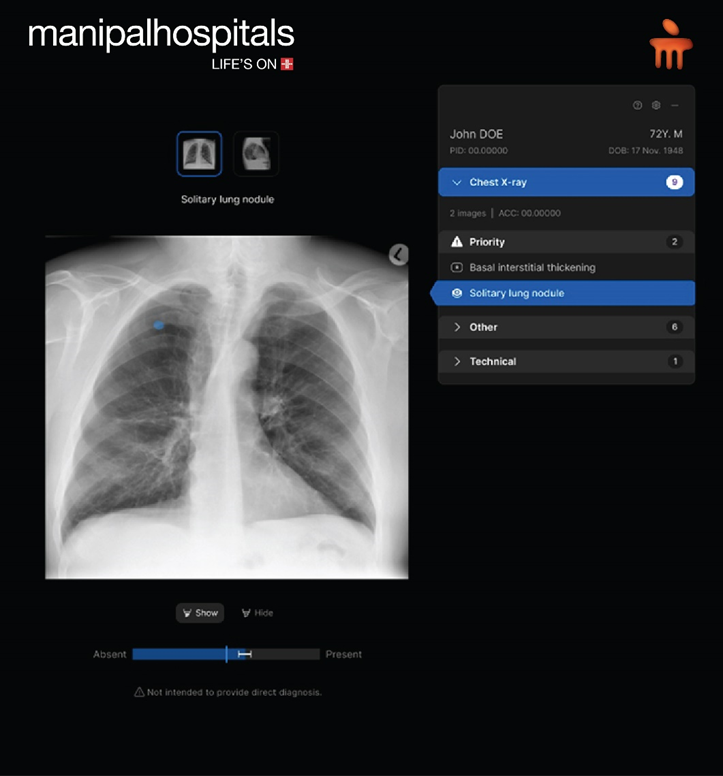
Harrison.ai CXR enables clinicians to customise the platform to align with the needs and workflows of the hospital. For example, they can decide which findings they want the AI to display and adjust threshold or sensitivity levels accordingly.
Waiting time is another major challenge for patients, as it can significantly delay treatment. Harrison.ai CXR fits effortlessly into existing hospital workflows without disrupting the radiologist’s work, with an intuitive image viewer allows clinicians to efficiently review X-ray images.
When something abnormal is detected, the solution uses coloured overlays to highlight the exact areas on the chest X-ray. By highlighting these suspicious findings, the platform helps identify suspected cases of diseases such as tuberculosis and lung cancer, which remain major causes of death around the world. Chronic conditions such as osteoporosis, COPD, and congestive heart failure can also be detected. Harrison.ai CXR categorises cases into priority groups and rapidly generates draft reports, easing the reporting process while ensuring that critical cases receive urgent care without delay.
To save time, the platform generates AI-assisted draft reports that radiologists review and finalise reducing the time spent on routine cases and freeing clinicians to focus on complex pathology. For a high-volume operation like Manipal Hospitals, where chest X-rays represent more than half of all imaging studies, this translates directly into measurable gains in reporting throughput and departmental efficiency. As Dr. Sudarshan Rawat notes: “Turnaround time and report quality are critical metrics for any large radiology operation” and AI-assisted reporting is how we are strengthening our ability to deliver on both at scale.
When illness or injury strikes, patients and their families need reassurance that they will receive comprehensive care — and knowing every chest X-ray is effectively reviewed twice provides exactly that peace of mind. At Old Airport Road, this approach ensures that patients benefit from advanced technology combined with expert clinical judgment. For clinicians, Harrison.ai CXR aims to ease cognitive load by surfacing critical findings quickly, so they can focus on clinical decision-making rather than diagnostic uncertainty. The outcome for hospital leaders is equally promising: measurable gains in reporting capacity and diagnostic accuracy with their existing headcount.
FAQ's
When something unusual is detected, the system highlights the exact area on the image. This helps radiologists carefully review those areas before finalising your report.
The AI does not replace your doctor. A qualified radiologist always reviews and confirms the findings. Your images are effectively checked twice, helping reduce the chance of missed abnormalities. This added layer of review helps improve accuracy and gives patients greater peace of mind.
Yes, one of the major benefits of AI support is faster reporting. The AI works seamlessly within the hospital’s existing systems. It can analyse scans in seconds, prioritise urgent cases such as fractures or lung complications, and generate draft reports for radiologists to review.
Since critical cases are flagged quickly, patients who need urgent care can be attended to sooner. At the same time, the overall reporting process becomes more efficient, which helps reduce waiting times for everyone.
For patients, this means faster access to reports, quicker next steps in treatment, and reduced anxiety while waiting. Our goal is to combine advanced technology with expert medical care to ensure you receive accurate, timely, and personalised diagnosis and treatment.
Share this article on:


.webp "Breast Cancer Treatment Hospital")