8 Min Read
What if your child’s blood or immune system could get a fresh start? A bone marrow transplant may offer that new beginning. While the term “bone marrow transplant” can sound overwhelming to parents, this advanced medical procedure has helped save the lives of many children with serious blood and immune disorders—giving them a renewed chance at health and healing. In India, over 2,000 paediatric bone marrow transplants are performed annually, with success rates often exceeding 80% in specialised centres. In this blog, we explain about a bone marrow transplant, when it is required, how the process works, the risks involved, what donors should know, and the current costs in India.
Synopsis
- What is a Bone Marrow Transplant?
- Why Do Kids Need a Bone Marrow Transplant?
- What to Expect During a Bone Marrow Transplant
- Types of Bone Marrow Transplant Donors
- Bone Marrow Transplant Risks and Side Effects
- Risks for Bone Marrow Transplant Donors
- How Much Does a Bone Marrow Transplant Cost in India?
- Final Thoughts
What is a Bone Marrow Transplant?
A bone marrow transplant (BMT), also known as a haematopoietic stem cell transplant (HSCT), is a treatment that replaces unhealthy or damaged bone marrow with healthy stem cells. Bone marrow is the soft, spongy tissue found inside bones that produces blood cells, including red blood cells, white blood cells, and platelets. These cells help fight infections, carry oxygen, and prevent bleeding. If a child’s bone marrow cannot make these cells properly due to illness or damage, a bone marrow transplant can help restore normal function.
Why Do Kids Need a Bone Marrow Transplant?
A child may need a bone marrow transplant to replace damaged or diseased marrow with healthier marrow. Common reasons include:
-
Cancers in Children (Leukaemias/Lymphomas): Some high-risk or relapsed cancers require a bone marrow transplant to replace marrow that has been destroyed by strong chemotherapy or radiation treatments.
-
Problems with Blood: Severe aplastic anaemia, haemoglobin disorders like thalassemia, and sickle cell disease
-
Immune Deficiencies: Severe combined immune deficiency (SCID) and chronic granulomatous disease (CGD), affecting the immune system.
-
Metabolic and Bone Marrow Failure Syndromes: Rare inherited conditions that affect blood cell production.
A bone marrow transplant in children becomes the best option when standard treatment options like medications, radiation, or even chemotherapy fail to work.
This specialised bone marrow transplant procedure is thus a life-saving treatment.
What to Expect During a Bone Marrow Transplant
The bone marrow transplant involves a longer series of procedures:
-
Evaluation Before the Transplant: Includes blood tests and functioning tests for the heart, lungs, kidneys, and teeth.
-
Procedure Explanation: The team of experts will discuss how to prepare your child for the transplant.
-
Therapy for conditioning: High-dose chemotherapy and radiation are used to destroy the diseased marrow and create space for the new cells to develop.
-
Day Zero: This is the day healthy stem cells are infused into the child, whether from the child or a donor.
-
Transplantation Begins: Healthy stem cells are transferred intravenously, which is a painless procedure.
-
Recovery Period: Once transplanted, the stem cells travel to the bone marrow and produce healthy blood cells.
-
Getting better: Post-transplant, children typically stay in the hospital for several weeks and are closely monitored.
Types of Bone Marrow Transplant Donors
The type of donor affects how well the transplant works, the risks involved, and the overall outcome:
-
Autologous donor: the child’s own cells (used for some cancers).
-
Allogeneic matched sibling: often the best choice because the genetic match is closer.
-
Unrelated matched donor (MUD): found through national or international registries.
-
Haploidentical donor (half-match): a family member who is a partial match.
-
Umbilical cord blood donor: useful when a perfect match cannot be found.
-
Syngeneic Donor: a perfect genetic match, like identical twins.
Finding a suitable donor is crucial. A closer match usually means better results and fewer complications.
Finding a suitable donor is crucial, and consulting experienced specialists, paediatric and child care doctors, can help guide families through the process—since a closer match usually means better results and fewer complications.
Bone Marrow Transplant Risks and Side Effects
BMT can save lives, but it also has risks, both in the short and long term. These depend on the type of transplant, the person's age, and their overall health.
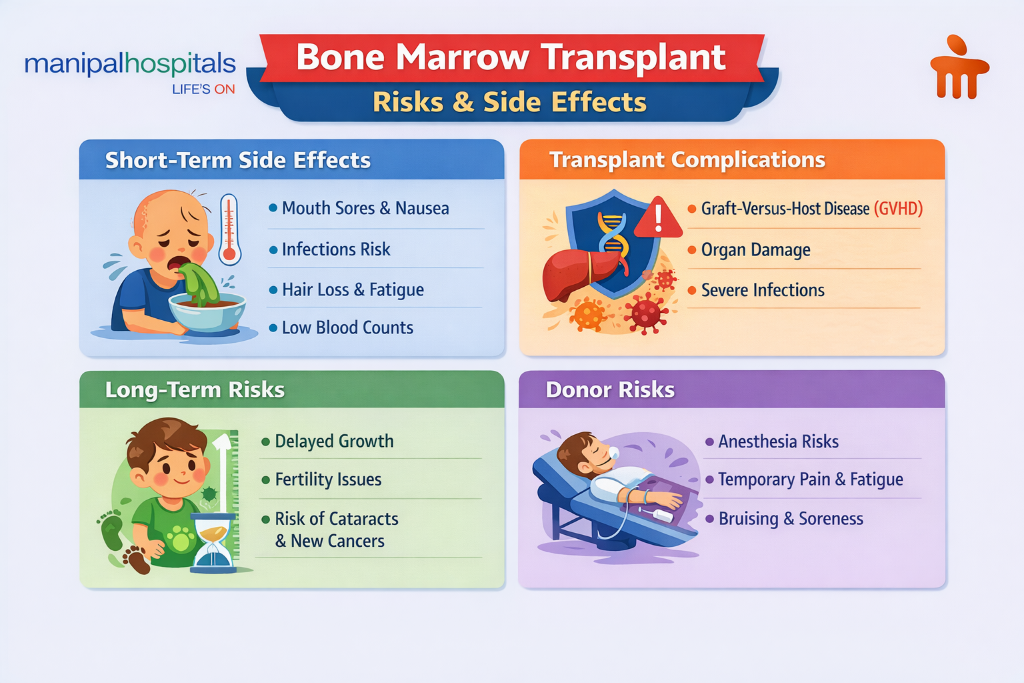
Short-Term Bone Marrow Transplant Side Effects
-
Mouth sores, nausea, vomiting, and diarrhoea
-
Low blood counts can increase the risk of infections
-
Fatigue and hair loss
-
Reactions related to infusion
Transplant-Specific Complications
-
Graft-versus-host disease (GVHD) can happen when donor cells attack the child’s tissues, mainly in allogeneic transplants.
-
Infections caused by a weak immune system
-
Damage to the liver, lungs, kidneys, or heart
-
Graft failure means the transplant does not succeed
Risks over the long term
-
Delayed growth in children
-
Possible fertility problems later in life
-
Cataracts or, in rare cases, new cancers
With better supportive care and improved technology, many risks of bone marrow transplants in children have been reduced. Outcomes continue to improve, and over the past few decades, survival rates for children have increased significantly. Some studies report hospital survival rates as high as 90–96%, depending on the condition and type of transplant.
Risks for Bone Marrow Transplant Donors
The process of collecting bone marrow or peripheral stem cells is usually safe for both family and unrelated donors.
-
Donating peripheral stem cells is generally low risk in the long term. The most common side effects are mild pain, fatigue, or bruising.
-
Bone marrow collection under anaesthesia may cause temporary pain or carry some risks related to anaesthesia.
-
Bone marrow transplant donor risks are rare, and most people recover and return to normal activities within a few days to a few weeks.
How Much Does a Bone Marrow Transplant Cost in India?
Cost is a major concern for many families considering a bone marrow transplant in India. While the cost is lower than in many Western countries, it is still a significant expense.
Common Price Ranges
-
The average cost ranges from ₹1,000,000 to ₹4,000,000.
-
Matched sibling transplants or simpler cases tend to be at the lower end of this range.
-
Unrelated or haploidentical transplants that require more care are usually more expensive.
These prices usually include the transplant procedure, hospital stay, medications, and follow-up care. However, the exact cost can vary depending on the hospital, city, and your child’s specific health needs. Many families choose India’s established transplant centres because they offer high-quality care at lower prices.
Final Thoughts
With compassionate care, careful planning, and informed decisions, your child has the best chance for a healthy future. If your child needs a bone marrow transplant, consulting a paediatric haematologist at Manipal Hospitals, Old Airport Road can help you understand what to expect and how to plan, including managing costs and exploring donor options.
FAQ's
A bone marrow transplant is a specialised treatment that replaces damaged bone marrow with healthy stem cells. In children, doctors use this procedure to treat serious blood cancers, inherited blood disorders, immune system problems, or bone marrow failure when other treatments stop working.
A bone marrow transplant can be done for newborns or children of any age, as long as the child is healthy enough for the procedure. The main factors are the child’s health, diagnosis, and how serious the disease is, not just their age.
hanks to better donor matching, infection control, and supportive care, bone marrow transplants in children are much safer now than before. Survival rates are high for many conditions, especially when the transplant is done early at a specialised centre with experienced doctors.
Usually, the best donor is a fully matched brother or sister. If that’s not possible, a parent, another family member, an unrelated donor from a registry, or umbilical cord blood can be used. Doctors carefully check each option to lower risks and help the transplant succeed.
Short-term side effects may include infections, mouth sores, fatigue, nausea, hair loss, and low blood counts. Some children may develop graft-versus-host disease (GVHD) in donor transplants. Most side effects are manageable with close medical monitoring and supportive care.
Share this article on: