Have you ever experienced a sudden, sharp pain in your back that makes it difficult to even stand or breathe deeply? For many people, especially as we get older or if our bones become a bit thinner, a simple, everyday movement like reaching for a high shelf or a minor slip can lead to what is known as a compression fracture in the spine. Unlike a typical backache that might fade away with a little rest, these fractures can cause a deep, constant pain that stops you from living your normal life. When things like rest or standard pain relief don't seem to help, a specialist might talk to you about vertebroplasty surgery.
It is completely normal to feel a bit nervous when someone mentions surgery, especially when it involves your back. However, vertebroplasty is actually quite different from the major, open-back operations you might be imagining. It is a minimally invasive way to stabilise the bone and get you some relief. You can think of it as a way to put a "cast" on the bone from the inside, giving it the support it needs so you can move around without that constant fear of pain.
This blog is here to help you understand the whole process in simple, everyday language. We will talk about what actually happens during the treatment, why it works so well for certain types of back pain, and what your recovery will look like. By learning more about vertebroplasty surgery and the steps involved, you can feel more confident about your care and focus on getting back to the things you enjoy doing.


What Is Vertebroplasty?
To get a clear picture of how the procedure works, we have to look at what is happening inside the spine. Your spine is made of small bones called vertebrae. When these bones become weak or porous, often due to age or health conditions, they can lose their ability to support the weight of your body. When that happens, the bone can essentially collapse in on itself. This is the "compression fracture" that causes so much trouble.
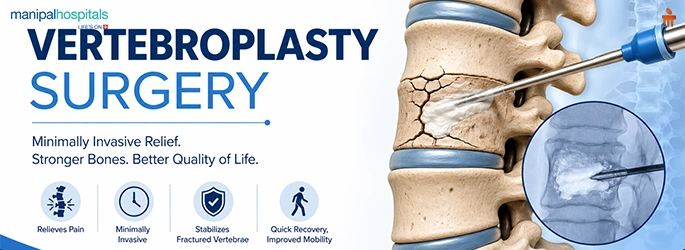
During a vertebroplasty, a doctor works to reinforce that specific weakened bone. The procedure involves injecting a specialised, medical-grade bone cement directly into the area where the fracture occurred. This cement is designed to harden rapidly. Once it sets, it acts as a permanent support that keeps the bone from shifting around or collapsing any further. While the thought of having "cement" in your back might sound a little strange at first, it is a very well-established clinical method. It allows doctors to resolve the problem at the source without having to make large incisions or keep you in the hospital for a long time.
When Is Vertebroplasty Surgery Needed?
Not every back injury requires a trip to the operating room. In most cases, doctors will want to try conservative treatments first, such as using a back brace, going to physical therapy, or just giving the body time to heal on its own. However, a vertebroplasty becomes a very important option when the pain is simply too much to handle or if it isn't getting better.
You and your doctor might decide a vertebroplasty is the right path if:
-
The pain is taking over your life: You find that you can’t walk, sleep comfortably, or do basic things around the house because the discomfort is so intense.
-
The injury is still fresh: This procedure usually works best when it is done on a relatively new fracture, often within a few weeks of the initial injury.
-
Standard treatments aren't working: You have tried resting and taking medication for several weeks, but your mobility hasn't improved at all.
-
Staying in bed is a health risk: For some patients, being forced to stay in bed for long periods can lead to other serious problems like pneumonia or blood clots, so getting back on your feet quickly is a medical priority.
Understanding the Procedure Step-by-Step
A lot of the stress surrounding surgery comes from not knowing what is actually going to happen once you go through those doors. A vertebroplasty is usually done in a specialised room with high-tech X-ray equipment so the doctor can see everything in real time.
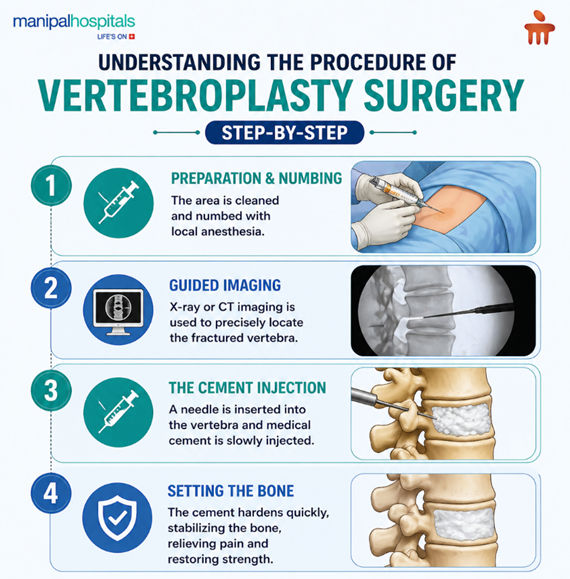
Here is how the process generally unfolds:
-
Preparation and Numbing: You will lie on your stomach, and the staff will ensure your comfort. You will usually receive a sedative through an IV to help you feel relaxed, and a local anaesthetic will be used to numb the skin and the area around the spine so you won't feel the procedure.
-
Guided Imaging: The doctor uses a special type of live X-ray called a fluoroscope. This allows them to see your spine clearly on a monitor, ensuring the needle is placed exactly where the fracture is located.
-
The Cement Injection: A small needle is carefully guided through the skin and into the fractured vertebra. The medical cement is then injected. It starts off as a thick liquid so it can flow into the small cracks in the bone, and then it begins to harden.
-
Setting the Bone: The cement usually reaches its full strength in about twenty minutes. Once the doctor is satisfied that the bone is stable, the needle is removed. There are no stitches needed; a simple bandage is placed over the small puncture site.
The whole thing usually takes less than an hour for each vertebra being treated. Because the entry point is so small, the physical impact on your body is kept to a minimum.
The Primary Benefits of Vertebroplasty Surgery
The biggest reason people choose this procedure is the speed of the results. For many, the relief from that deep, stabbing bone pain is almost instant.
A successful vertebroplasty can offer several practical benefits:
-
Rapid Pain Relief: Most patients notice a very significant drop in their pain levels within just a day or two of the procedure.
-
Getting Your Movement Back: Because the bone is no longer shifting, you can usually stand up and walk much sooner than if you were waiting for the bone to knit back together on its own.
-
Keeping Your Stature: By filling the bone and stabilising it, the procedure helps prevent the spine from curving forward, which is what causes the "hunching" often seen with untreated fractures.
-
Lower Risk Factors: Since it is a needle-based procedure rather than a major surgery, there is much less risk of things like heavy bleeding or serious infection.
For most people, the best part is simply being able to return to their normal daily routine without constant pain holding them back.
What to Expect During Recovery
Recovery from a vertebroplasty is generally much faster and simpler than recovery from traditional back surgery. Most of the time, you are able to head home the very same day.
-
The First Few Hours: After the procedure, you will stay in a recovery area for a couple of hours. This gives the medical team a chance to check your vitals and make sure the cement has fully hardened. You will likely be encouraged to get up and take a short walk before you leave.
-
At-Home Care: You might feel a little bit of soreness at the site where the needle went in, which is to be expected. Usually, an ice pack or a basic over-the-counter pain reliever is all you need to manage that.
-
Getting Back to Life: You can often return to light activities within twenty-four to forty-eight hours. Your doctor will probably ask you to avoid lifting heavy groceries or doing any strenuous exercise for a few weeks just to be safe.
-
Looking Ahead: You will have a follow-up appointment to see how you are doing. At this point, your doctor might also want to talk about bone health or osteoporosis treatments to help make sure you don't have to deal with another fracture down the line.
Potential Risks and Safety
Even though a vertebroplasty is considered a very safe procedure, no medical intervention is completely without risk. It is important to have an honest conversation with your surgeon about these possibilities.
A few things they might mention include:
-
Cement Leakage: In a very small number of cases, some of the cement can leak out of the bone. Most of the time, this complication doesn't cause any symptoms, but doctors use live imaging during the injection to watch for this and prevent it.
-
Infection or Bleeding: These are risks with any procedure that involves a needle, though they are quite rare in this setting.
-
Future Fractures: Because the treated bone is now very solid, it can sometimes put a bit more pressure on the bones directly above or below it. If those bones are also weak, they could be at risk for a fracture, which is why managing your overall bone density is so important.
The vast majority of people find that the chance to live without debilitating pain far outweighs these potential risks.
Conclusion
Dealing with a compression fracture can be a real blow to your quality of life, but a vertebroplasty is a very effective way to resolve the issue and get back on your feet. By focusing on stabilising the bone through a minimally invasive approach, it provides the structural support your spine needs without a long, difficult recovery. With the right medical support from experts at Manipal Institute of Robotic Spine Surgery (MIRSS) and a focus on long-term bone health, you can move past the pain and get back to the things you enjoy doing.