As people get older, the body changes in many ways. While mild postural changes can occur with age, a major shift in spinal alignment is not considered a normal part of ageing. Adult spinal deformity happens when the spine’s natural curves shift out of place. This leads to clear changes in how you stand and a nagging ache that many people just try to live with. While scoliosis in adolescents is often identified during routine health evaluations, adult cases tend to creep up slowly over several decades, usually caused by the everyday wear and tear of spinal joints and discs.
Many people overlook the early signs, like a slight lean to one side or a back that feels tired after short walks, thinking they are just tired. Recognising these symptoms early is very important. While mild cases can be managed with better habits and physical therapy, a deformity that is left to progress can eventually press on nerves and make it hard to walk. This blog looks at the common signs of adult spine deformity, why it happens, and what the treatment options look like today.

Understanding Adult Spine Deformity
The human spine is naturally curved to help you keep your balance and move around without discomfort. An adult spinal deformity occurs when these curves shift too far out of their healthy alignment. This usually shows up in two ways: scoliosis, which is a sideways curve, or kyphosis, which is a rounded "hunch" in the upper back.
Most cases in adults are "degenerative." This means the discs that act as cushions between the bones in your back begin to dry out, shrink, or shift. When these cushions degenerate, the spine can start to tilt or twist. Once the spine is out of balance, the back muscles must work overtime to keep you standing. This phenomenon is why many people with this condition feel exhausted by the end of the day.
Key Adult Spine Deformity Symptoms to Watch For
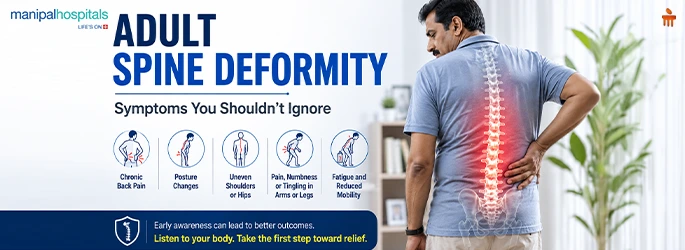
The symptoms of a spinal deformity are different for everyone. Some people see the change in the mirror first, while others feel it as discomfort, numbness, heaviness, or pain travelling into the legs.
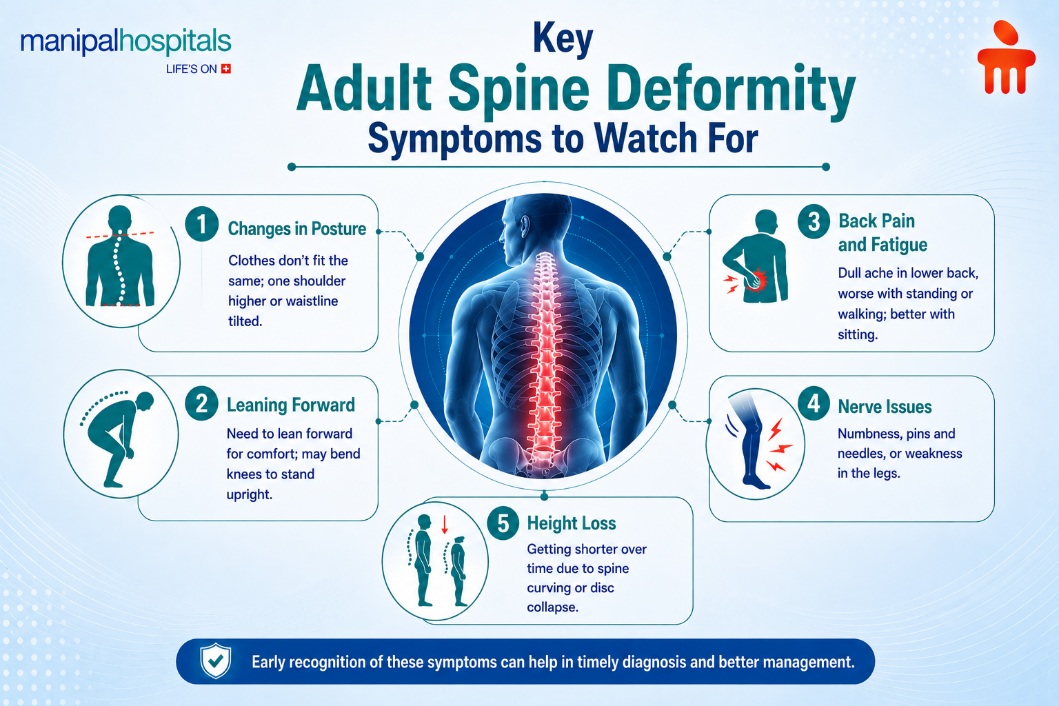
Look out for the following symptoms:
-
Changes in Posture: You might notice your clothes don't sit the way they used to. It is common to see one shoulder sitting higher than the other or a waistline that looks tilted.
-
Leaning Forward: A very common sign is the need to lean forward to feel comfortable. You might also find yourself bending your knees slightly just to stand up straight.
-
Back Pain and Fatigue: Most people feel a heavy, dull ache in the lower back. It usually gets worse if you’ve been standing or walking for a long time, but it tends to ease up once you sit down.
-
Nerve Issues: If the shift in the spine is large enough, it can pinch the nerves. This leads to adult spine deformity symptoms like numbness, a "pins and needles" feeling, or weakness in the legs.
-
Height Loss: If you find you are getting shorter over a period of a few years, it could be because the spine is curving or the discs are collapsing.
Daily Habits and Causes
Spinal issues in adults rarely happen because of a single event. It is usually a slow build-up of several factors:
|
Cause |
How it Happens |
Effect on the Spine |
|
Wear & Tear |
Decades of everyday moving and lifting wear down joints unevenly. |
Can gradually contribute to abnormal spinal alignment. |
|
Osteoporosis |
Brittle bones develop tiny cracks and collapse in the front. |
Causes the back to hunch forward. |
|
Old Curves |
A small curve from your teens grows as the supporting tissues weaken. |
The spine bends further in your 50s or 60s. |
|
Weak Core |
Weak stomach and back muscles fail to support your trunk. |
Reduced muscular support may worsen spinal instability and posture. |
How Doctors Diagnose the Condition
Diagnosis focuses on evaluating overall spinal alignment and body balance. The common diagnostic tests include:
-
Physical Exam: A specialist will look at how you walk and stand. They will check if your hips and shoulders are level. They might also test your leg strength and reflexes to see if nerves are involved.
-
Full-Spine X-rays: This is the most important tool. These are standing X-rays that show the spine from the neck all the way down to the pelvis. It allows the doctor to measure the angles of the curves.
-
MRI Scans: If you have leg pain or numbness, an MRI helps look at soft tissues like discs and nerves. It shows exactly where the pressure is coming from.
Adult Spinal Deformity Treatment
The goal of treatment is to reduce your pain and help you move better. It isn't always about making the spine perfectly straight; it’s about making life easier.
-
Activity and Lifestyle Changes - Small changes can have a significant impact. Avoiding heavy lifting and learning how to sit and stand with better support can stop a mild curve from getting worse. Keeping your weight at a healthy level also takes a lot of pressure off the joints in your back.
-
Physical Therapy - This is a very common starting point. A therapist will give you specific exercises to strengthen your "core"- the muscles in your stomach and back. A stronger core acts like a natural corset for your spine.
-
Pain Management - Sometimes, medications are needed to handle the pain. In some cases, targeted spinal injections may provide temporary pain relief and improve mobility, though they do not correct the deformity itself.
-
Bracing - While braces don't fix the curve in adults, they can support the back during long periods on your feet. It is usually used as a short-term way to manage pain.
Adult Spinal Deformity Surgery in India
Surgery will only be considered when there is rapid progression of the curve and severe back pain that prevents you from performing your normal tasks. The main aim of having adult spinal deformity surgery in India is to improve spinal alignment, stabilise the spine, and decrease pressure on affected nerves.
During the operation, surgeons use metal rods and screws to hold the spine in the correct place. Over time, the bones grow together; this is called fusion. Improvements in technology and surgical methods have made these operations more precise and the recovery process more structured.
Recovery and Healing
The time it takes to get better depends on the treatment path you take.
-
Non-surgical recovery: A lot of people notice gradual improvement over several weeks to months with consistent therapy and healthy lifestyle changes.
-
Surgical recovery: This is a longer process. Many patients are encouraged to begin assisted walking within a few hours to a few days after surgery, depending on the procedure and overall health.
Conclusion
An adult spinal deformity is more than just "slouching." It is a physical change in the spine that can cause real pain and limit your life. If you notice that you are leaning to one side, losing height, or dealing with leg weakness, it is worth getting a check-up. Catching it early gives you the best chance of managing it with exercise and simple changes. For people who need more help, adult spinal deformity surgery in India offers a way to regain balance and stop the progression of the curve. Dealing with the problem now can prevent much bigger mobility issues in the future.
An adult spinal deformity is more than just "slouching." It is a physical change in the spine that can cause real pain and limit your life. If you notice that you are leaning to one side, losing height, or dealing with leg weakness, it is worth getting a check-up with the expert team at the Manipal Institute of Robotic Spine Surgery (MIRSS). Catching it early gives you the best chance of managing it with exercise and simple changes. For people who need more help, adult spinal deformity surgery in India offers a way to regain balance and stop the progression of the curve. Dealing with the problem now can prevent much bigger mobility issues in the future.