
There is a specific kind of frustration that comes with a "crick" in the neck that simply won’t go away. You might wake up feeling like your neck is made of concrete, or perhaps you notice a sharp, electric sensation shooting down your arm every time you tilt your head to look at your phone. When the simple act of turning your head to observe your blind spot while driving becomes an ordeal, it is a sign that your body is sending an urgent message. Often, that message points toward a cervical disc bulge. While the term might sound intimidating, it is a remarkably common condition in our modern, screen-heavy world. When the protective discs between your vertebrae begin to shift out of place, the result is a cervical disc bulge.
Most people find significant relief through targeted cervical disc bulge treatment, lifestyle modifications, and a deeper understanding of how to support their spinal health. This guide will explore why this condition happens, the red flags to watch for, and the comprehensive options available, from physical therapy to cervical bulging disc surgery, to help you reclaim your mobility and comfort.


Understanding the Mechanics: What is a Cervical Disc Bulge?
To understand a cervical disc bulge, we first have to look at the "shock absorbers" of your spine. Between each vertebra in your neck sits a spinal disc. These discs have a tough, outer layer (the annulus fibrosus) and a soft, jelly-like centre (the nucleus pulposus). Think of them as small, pressurised cushions that prevent your bones from grinding together.
A cervical disc bulge occurs when the outer layer of the disc weakens, and the disc itself pushes or "bulges" outward into the spinal canal. Unlike a herniated disc, where the inner jelly actually leaks out through a tear, a bulge is more like a tire that has lost some structural integrity and is protruding past its normal boundary.
Even though the disc hasn't "leaked," a cervical disc bulge can still cause immense trouble. The space inside the spinal canal is limited. When a disc occupies space, it shouldn't; it can press against sensitive nerve roots or even the spinal cord itself. This pressure is what triggers the cascade of discomfort that patients often describe.
Identifying the Red Flags: Cervical Disc Bulge Symptoms
One of the trickiest aspects of this condition is that it doesn't always stay in the neck. Because the nerves in your cervical spine travel down to your shoulders, arms, and fingers, a problem in the neck often "refers" pain elsewhere.
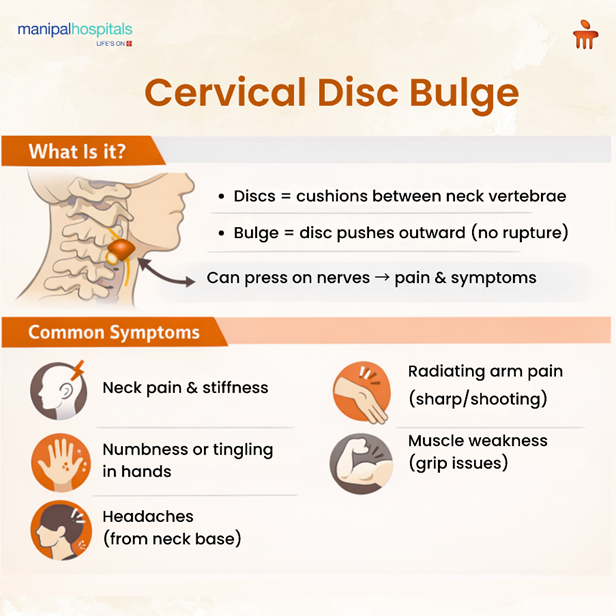
The most common cervical disc bulge symptoms include:
-
Radiating Arm Pain: You might feel a dull ache or a sharp, searing pain that travels from the neck down through the shoulder and into the arm.
-
Numbness and Tingling: Often described as a "pins and needles" sensation in the hands or fingers.
-
Muscle Weakness: You might find yourself suddenly dropping objects or struggling with fine motor tasks, like buttoning a shirt, because the nerve signals to your muscles are being interrupted.
-
Localised Neck Stiffness: A persistent "heavy" feeling in the neck and a reduced ability to look over your shoulder.
-
Headaches: Specifically, "cervicogenic" headaches, which start at the base of the skull and radiate forward.
It is important to note that cervical disc bulge symptoms can fluctuate. They might feel manageable in the morning, but they intensify after a long day of sitting at a desk or after a period of high stress.
Common Triggers and Causes
A cervical disc bulge rarely happens overnight. Usually, it is the result of long-term "micro-traumas" that finally reach a breaking point. Understanding the cause is the first step in a successful cervical disc bulge treatment plan.
The "Tech Neck" Phenomenon: Looking down at laptops and smartphones for hours puts incredible pressure on the cervical discs. Your head weighs roughly 5kg; when tilted at 60 degrees, that weight on your neck increases to nearly 27kg.
-
Age-Related Wear and Tear: As we get older, our spinal discs naturally lose water content and become less elastic. This makes a cervical disc bulge more likely, even with normal daily activity.
-
Sudden Trauma: Whiplash from a car accident or a fall can cause an acute shift in the disc position.
-
Poor Sleeping Habits: Using pillows that are too high or sleeping on your stomach can force the neck into unnatural angles, straining the discs over time.
The Diagnostic Journey: Finding the Root Cause
Before starting any cervical disc bulge treatment, a doctor must confirm exactly which disc is involved and how much pressure is being applied to the nerves. This is a multi-step process that ensures you aren't treating a muscular strain when the issue is actually structural.
-
Physical Examination: A specialist will check your range of motion, muscle strength, and reflexes. They might perform a "Spurling test," where they gently tilt your head to see if it reproduces your symptoms.
-
MRI Scans: This is the gold standard for identifying a cervical disc bulge. It provides a clear picture of the soft tissues, including the discs and nerves, which X-rays cannot see.
-
CT Scans: Occasionally used if an MRI isn't possible, often combined with a myelogram to visualise the spinal canal.
-
EMG (Electromyography): If you have significant weakness, this test measures the electrical activity in your muscles to see if a nerve is being severely compressed by a cervical disc bulge.
Comparing Treatment Paths: Conservative vs. Surgical
Most patients are relieved to hear that surgery is not the automatic first choice. In fact, roughly 90% of people with a cervical disc bulge recover using non-invasive methods.
|
Approach |
Cervical Disc Bulge Treatment (Conservative) |
Cervical Bulging Disc Surgery (Interventional) |
|
Primary Goal |
Reduce inflammation and improve posture |
Remove the bulge and stabilise the spine |
|
Methods |
Physiotherapy, medications, lifestyle changes |
Discectomy, fusion, or disc replacement |
|
Recovery Time |
4 to 8 weeks for significant improvement |
2 to 6 months for full structural healing |
|
Invasiveness |
Non-invasive |
Inpatient surgical procedure |
|
When to Use |
Mild to moderate pain with no severe weakness |
Persistent pain or progressive nerve damage |
Non-Invasive Cervical Disc Bulge Treatment Options
If your symptoms are still manageable, your doctor will usually suggest a combination of treatments that give the body time and support to heal. At this stage, the aim of cervical disc bulge treatment is to calm the inflammation so the disc has a chance to settle and, in some cases, improve on its own.
-
Targeted Physical Therapy: A physiotherapist may guide you through McKenzie exercises or posture-based corrections. These movements help shift pain away from the arm and back toward the neck, where it is usually easier to manage.
-
Medication Management: Anti-inflammatory medicines, such as NSAIDs, help reduce swelling around the nerve. In some cases, muscle relaxants may also be prescribed to ease painful spasms and break the cycle of tightness.
-
Cervical Traction: This treatment gently stretches the neck using a special device. The slight separation between the vertebrae can reduce pressure and allow the cervical disc bulge to move away from the nerve.
-
Epidural Steroid Injections: If tablets do not bring enough relief, a doctor may inject a strong anti-inflammatory medicine close to the affected disc to reduce pain and irritation more directly.
Practical Steps That Support Day-to-Day Relief
Living with a cervical disc bulge can be tiring, especially when it starts interfering with normal routines. Even so, a few simple habits can ease strain and support recovery.
Helpful daily steps include:
-
Keep screens at eye level instead of looking down for long periods
-
Take short breaks during desk work to stretch and reset your posture
-
Avoid carrying heavy bags on one shoulder
-
Use a supportive pillow that keeps the neck aligned
-
Stay consistent with the exercises your doctor or physiotherapist recommends
These small changes may not feel dramatic, but when combined with proper cervical disc bulge treatment, they often make a meaningful difference.
Conclusion
Living with a cervical disc bulge can feel like carrying a problem that no one else can see. It can affect your work, your movement, and even the simplest parts of your day. It can affect how you work, how you play, and even how you sleep. But by becoming familiar with the cervical disc bulge symptoms and sticking to a cervical disc bulge treatment plan, you can go a long way in alleviating your pain and ensuring that your spine remains healthy. Remember, the purpose of a cervical disc bulge treatment plan is not merely to halt your pain but to give you the liberty of movement that allows you to live your life to the fullest.
If you are living with a cervical disc bulge, you don’t have to go through the pain alone. Getting a Spine treatment from a specialist at Manipal Hospitals can provide you with access to state-of-the-art facilities.