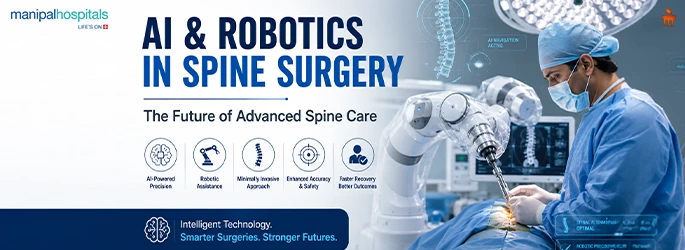
Spine surgery has changed dramatically over the last two decades. Earlier procedures depended largely on conventional imaging, surgical judgment, and manual precision. While surgical skill remains essential to patient care, technology now plays an increasingly important role within the operating room. New tools like artificial intelligence, robotics, and advanced navigation systems help surgeons perform complex procedures with greater accuracy and better preparation.
These technological innovations are not just futuristic gadgets; they offer real benefits, including less invasive procedures, reduced blood loss, quicker recovery times, and more predictable results. Consequently, many hospitals have integrated this advanced technology into the routine diagnosis and management of spinal conditions. This blog explains how these modern advancements are transforming complex spinal procedures, improving patient outcomes, and reshaping the approach to revision surgeries.
What Does Artificial Intelligence Mean in Spine Surgery?
The term "artificial intelligence" describes the computer algorithms that perform analysis on data, recognise patterns, and aid decision-making processes. Computer algorithms can be used for data analysis at an accelerated rate compared to conventional approaches in the health sector.
Some of the artificial intelligence applications in spinal surgeries include imaging, predicting complications, surgical planning, and enhancing precision while performing the procedure. These algorithms have undergone training using databases of images of the spine and the outcomes of surgeries.
Examples of tasks in which computers may help include:
-
Detection of spinal malformations
-
Assessing spinal alignment
-
Determination of the implant's position
-
Evaluation of probabilities of complications
-
Investigation of recovery patterns
It should be highlighted that artificial intelligence does not substitute a surgeon’s skills but provides additional data, which contributes to the successful performance of surgeries.
In connection with technological advancements, surgeons have started increasingly relying on artificial intelligence in spinal surgery.
How Robotics Supports Spine Procedures
Surgeons now widely use robotic-assisted systems in advanced spinal surgery. These platforms help surgeons guide instruments and implants with greater stability and accuracy.
Before performing any surgery, the surgical team enters the patient’s CT or MRI scan information into the robotic system. Based on this information, the surgeon develops a surgical strategy. The robot assists in guiding the tools during surgery.
The robot does not perform surgery on its own. Surgery is performed by the surgeon. Artificial intelligence and robotics in spine surgery are especially useful during procedures involving:
-
Spinal deformity correction
-
Spinal fusion
-
Revision surgery
-
Multi-level instability
-
Complex implant placement
These systems may help reduce positioning errors and improve consistency during technically demanding procedures.
Why Precision Matters in Spine Surgery
Considering that the spine comprises nerves, blood vessels, and other components that must be carefully manoeuvred when undertaking surgical operations, any mistakes may affect the spine or the nervous system.
Advanced technologies have enabled surgeons to observe internal organs with a higher level of precision. In addition, the adoption of imaging and navigation techniques has provided instant feedback in real time.
The table below outlines some of the key technologies commonly used in modern spine surgery:
|
Technology |
Role in Spine Surgery |
|
AI-assisted planning |
Helps analyse anatomy and surgical strategy |
|
Robotic guidance |
Improves implant positioning accuracy and bony procedures |
|
3D navigation systems |
Provides radiation-free surgical mapping |
|
Intraoperative imaging |
Confirms alignment and implant placement during surgery |
|
Neuromonitoring |
Monitors nerve function continuously |
These tools have become increasingly important in difficult spinal procedures, where degeneration or previous surgery may have already distorted the anatomy.
Benefits of AI in Spine Surgery
The application of AI in spine surgery is continuously increasing owing to several advantages that it offers.
The most significant benefit relates to enhanced surgical planning, where an AI system can quickly analyse the imaging data and determine anatomical features that require further investigation before a surgery takes place.
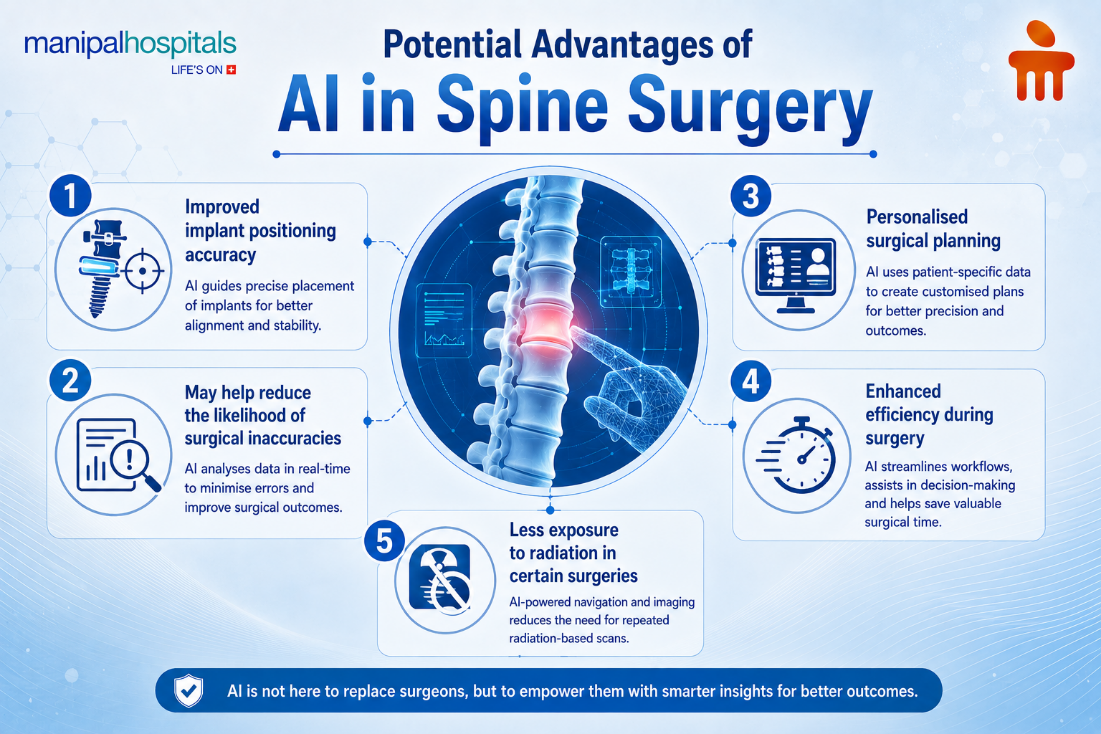
Some of the potential advantages include:
-
Improved implant positioning accuracy
-
May help reduce the likelihood of surgical inaccuracies
-
Personalised surgical planning
-
Enhanced efficiency during surgery
-
Less exposure to radiation in certain surgeries
Some AI systems could be used to forecast the possibility of postoperative complications by analysing a patient’s medical history and imaging patterns.
Though it is impossible to avoid all the risks involved, AI can contribute to more consistent results in complicated procedures such as spine surgery.
Artificial Intelligence and Robotics in Spine Surgery for Complex Cases
Complex spinal disorders often involve severe deformity, instability, or previous surgical changes. These situations can be technically demanding even for experienced surgeons.
Artificial intelligence and robotics are incredibly helpful here because they give the surgeon a much clearer view and extra guidance during the operation.
On other occasions, there may be the presence of scarred tissues because of past operations. The incorporation of robotic instruments and navigational technology will help the surgeon locate important anatomical landmarks.
In yet another situation, the correction of scoliosis is dependent upon careful surgical planning from various perspectives. The involvement of artificial intelligence in imaging technology is necessary to optimise spinal alignment.
Minimally Invasive Spine Surgery and Technology
Minimally invasive spine surgery is becoming increasingly popular due to advancements in technology such as imaging, navigation, and robots.
The traditional method of performing surgeries usually involved a large cut along with muscle damage. MIS procedures help in minimising the size of the cuts and the use of specialised instruments and cameras to conduct the surgery.
Benefits may include:
-
Smaller scars
-
Reduced blood loss
-
Less postoperative pain
-
Faster mobilisation
-
Shorter hospital stays
Challenges and Limitations of AI in Spine Surgery & Robotics
Despite the excitement surrounding technology, artificial intelligence still has limitations in clinical practice.
Artificial Intelligence (AI) is highly dependent on data quality. Bad imaging and insufficient medical data may affect the efficiency of AI. It should be understood that Artificial Intelligence technology cannot replace surgical skills, patient communication, and clinical expertise. Whereas robotics is accurate but also operator- and planning-dependent.
Some problems that hospitals may face include:
-
High costs of machinery
-
Technical training
-
Machine maintenance
The patients should also understand that robotic surgery does not ensure successful outcomes in all cases. A successful operation depends on proper patient selection, surgery, rehabilitation, and post-operative care.
Artificial intelligence in spine surgery and robotics should be regarded as an enhanced technology aid rather than a substitute for decision-making in medicine.
Artificial Intelligence in Spine Surgery in India
The use of artificial intelligence in spine surgery in India has increased steadily in recent years. Several advanced hospitals now use robotic platforms, navigation systems, and AI-assisted planning tools during complex spinal procedures.
Artificial intelligence in spine surgery in India is being applied in areas such as:
-
Spinal deformity correction
-
Minimally invasive procedures
-
Revision surgery
-
Implant placement guidance
-
Surgical planning
Growing investment in healthcare technology has improved access to advanced spinal care in major Indian cities. Many hospitals now combine modern surgical systems with multidisciplinary rehabilitation programmes designed to support long-term recovery.
As awareness increases, more patients are discussing technology-assisted surgery with specialists before making treatment decisions.
Recovery After Technology-Assisted Spine Surgery
Recovery after spine surgery still requires patience and rehabilitation, even when advanced technology is used.
Patients are usually encouraged to begin gradual movement under medical supervision soon after surgery. Physiotherapy remains an important part of restoring mobility, strength, and posture.
-
Recovery plans may include:
-
Walking exercises
-
Stretching programmes
-
Core strengthening
-
Pain management
-
Lifestyle modification
Technology may help reduce tissue damage during surgery, but healing still depends on overall health, nutrition, and rehabilitation commitment.
Patients recovering from spinal surgery are also advised to avoid smoking, as it affects circulation and bone healing.
Conclusion
Modern spinal care is evolving rapidly, driven by the integration of AI in spine surgery and robotic-assisted technologies. While these technological advancements do not replace the indispensable judgment of an experienced surgeon, they provide an invaluable layer of safety and efficiency that directly benefits post-operative recovery. The adoption of artificial intelligence in spine surgery in India continues to grow across leading medical institutions, making state-of-the-art spinal treatment more accessible than ever.
For those exploring advanced treatment options or seeking a specialised opinion on complex spinal conditions, consulting an experienced and dedicated spine care team in India is the best next step. Contact Manipal Hospital to learn more about our technology-assisted surgical options and comprehensive spine care programmes.