7 Min Read
A little ulcer that won't heal, a new patch of skin that looks different, or even a bump under the foreskin could all be signs of trouble. At first, these changes may seem minor, but sometimes they can be early warning signs of penile cancer. This rare cancer usually begins in the skin covering the penis, most often on the glans (head of the penis) or foreskin.
It is important to look at persistent symptoms, as the earliest changes are often visible. But skin changes are not always cancerous. Infections, irritation, and inflammatory conditions can cause similar symptoms, so medical evaluation is needed when abnormalities don’t improve. Being aware of the causes and warning signs of penile cancer can help with earlier diagnosis and prompt treatment when necessary. In this blog, we look at penile cancer causes, the symptoms to look out for, and treatment.
Synopsis
Early Warning Signs of Penile Cancer
The initial changes related to penile cancer often manifest as skin changes on the penis. These changes can be slow and sometimes are mistaken for common skin problems, infections, or inflammation. Identifying penile cancer early symptoms is useful for men to recognise changes that do not go away or continue to develop over time.
-
The most common symptoms reported are a painless lump or sore on the penis. The lesion may initially remain small or may gradually increase in size.
-
A growth, ulcer, or non-healing wound may develop on the glans, foreskin, or shaft of the penis.
-
Bleeding may be from the surface of the lesion or underneath the foreskin.
-
Some men notice a rash that lasts for an extended period.
-
The skin may thicken in a localised area, creating a patch that feels different from the surrounding tissue.
-
The skin colour may change. It may seem like red, white, brown, or darkened patches of skin.
-
On the surface of the penis, you might see little crusty bumps.
-
There may be flat bluish-brown patches, especially on the glans.
-
A smelly discharge may collect under the foreskin.
-
The glans may swell, become red, or be constantly irritated.
-
Difficulty retracting the foreskin may occur, particularly when disease affects the foreskin or glans.
Symptoms the Disease Is Progressing
As penile cancer progresses, the present symptoms may worsen, and other changes may develop outside the penis. Progression is often associated with an increase in size of the lesions and infiltration of neighbouring lymph nodes, but the pattern differs from one individual to another.
-
A lesion, ulcer, or growth may continue to grow larger and involve more tissue.
-
Bleeding may be more frequent or may occur from larger surface lesions.
-
There may be continuing discharge under the foreskin, which can become more obvious.
-
The lymph nodes nearby may become enlarged and cause swelling in the groin.
-
One or more lymph nodes in the groin may become swollen and feel firm or hard.
-
Difficulty retracting the foreskin can become progressively worse, particularly if there is ongoing tissue involvement under the foreskin.
-
Irritation, redness, or swelling of the glans becomes more noticeable as the disease progresses.
-
Enlarged lymph nodes in the groin are particularly important because they may indicate that cancer cells have spread beyond the primary site.
Understanding the Main Risk Factors
There is no single explanation for why one person develops penile cancer while another does not. In many cases, doctors cannot identify an exact cause. However, several well-established factors are known to increase risk. Understanding these penile cancer reasons can help men become more aware of conditions and exposures associated with the disease:
|
Risk Factor |
Why It Matters |
|
HPV infection |
HPV infection is associated with a significant proportion of penile cancer cases, particularly those caused by certain high-risk HPV strains. |
|
Phimosis |
Can make cleaning beneath the foreskin difficult and may contribute to irritation and inflammation. |
|
Chronic inflammation |
Long-term inflammation may promote abnormal changes in penile cells over time. |
|
Exposes tissues to cancer-causing chemicals that increase the risk of cellular damage. |
|
|
HIV infection |
Associated with a higher risk of penile cancer, partly due to its effects on the immune system. |
|
Older age |
The likelihood of developing penile cancer increases with advancing age. |
|
UV treatment for psoriasis |
Certain ultraviolet light treatments used for psoriasis have been linked to an increased risk in some individuals. |
When Should You See a Doctor?
Infections, inflammatory conditions, and skin disorders can sometimes cause symptoms that look similar to penile cancer early symptoms.
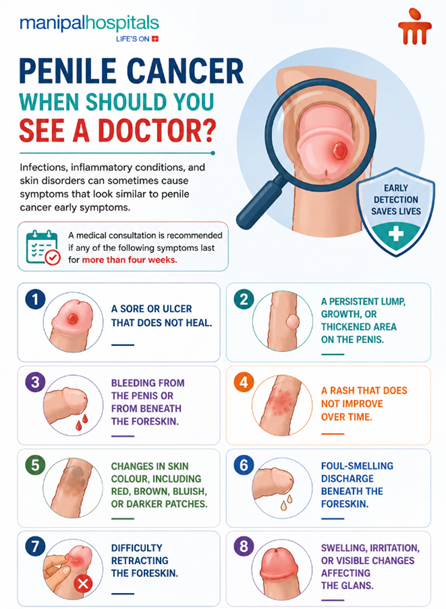
A medical consultation is recommended if any of the following symptoms last for more than four weeks:
-
A sore or ulcer that does not heal.
-
A persistent lump, growth, or thickened area on the penis.
-
Bleeding from the penis or from beneath the foreskin.
-
A rash that does not improve over time.
-
Changes in skin colour, including red, brown, bluish, or darker patches.
-
Foul-smelling discharge beneath the foreskin.
-
Difficulty retracting the foreskin.
-
Swelling, irritation, or visible changes affecting the glans.
Penile Cancer Treatment
Treatment options for penile cancer are determined by the stage of the cancer, the size and location of the tumour, and whether the disease has spread to nearby lymph nodes. A major goal of treatment is to remove the cancer while preserving as much normal penile tissue and function as possible.
Treatment may consist of:
-
Topical treatments for certain very early cancers of the outer layers of skin.
-
In some instances, laser treatment is used to destroy abnormal tissue.
-
Radiation therapy that targets cancer cells and spares surrounding structures.
-
Chemotherapy for advanced cancers.
-
Surgery for penile cancer is still one of the most common forms of treatment. Depending on the extent of disease, surgery can involve removal of only the affected tissue, a portion of the penis, or more extensive procedures in advanced cases.
-
Surgery or additional treatment may be required when cancer has spread to lymph nodes in the groin.
Conclusion
Penile cancer is often preceded by visible changes that may seem minor at first, such as a persistent sore, lump, rash, discharge, or skin discoloration. Early identification of these symptoms and knowledge about the factors associated with the disease can help in early diagnosis and intervention. If the changes do not improve or they get worse, medical evaluation is needed. Many non-cancerous conditions can cause similar symptoms, which is why proper medical evaluation is important. Early detection can increase the success of penile cancer treatment and may allow for less invasive procedures. Visit the experienced urology team at Manipal Hospitals, Millers Road, for expert opinions and Penile cancer treatment in Millers Road, Bangalore.
FAQ's
Early signs include a visible change in the skin of the penis. It may look like a sore, lump, growth, rash, thickened patch of skin, or an area that has changed colour. In many instances, these changes are gradual rather than abrupt.
No. Most penile cancers are painless in the early stages. There can be a lesion, ulcer, or lump for some time before discomfort or pain develops, and the presence of these can sometimes delay diagnosis.
No. Foul-smelling discharge can result from infections, inflammation, or other non-cancerous conditions. However, if the discharge persists or is accompanied by other symptoms, evaluation by a doctor is necessary.
Important risk factors include HPV infection, phimosis, chronic inflammation, balanitis, HIV infection, smoking history, poor genital hygiene, and increasing age.
Yes. Early-stage penile cancer often has more treatment options. Early diagnosis may allow less aggressive treatment and improve the chance of saving more normal tissue and function.
Share this article on: