


.webp "Dr. Bhaskar Mallaiah | Expert General Surgeon in Malleshwaram Bangalore | Manipal Hospitals")
 7 Min Read
An inguinal hernia is something doctors see regularly, but not every case is as straightforward as it sounds. In many people, the hernia sac contains fat or a simple loop of intestine, and the repair is relatively routine. However, there are situations where things are not that simple. When the contents include structures like the caecum (the first portion of the colon located in the lower right abdomen), along with dilated bowel loops and adhesions, the surgery becomes more complex and needs a more thoughtful approach. In these cases, the focus is not just on repairing the defect but on safely handling what is inside the hernia and protecting the surrounding structures. Choosing the right surgical method becomes important here. While open surgery is still a reliable option, laparoscopic repair can offer better visual clarity and more controlled dissection, especially when dealing with adhesions or unusual findings.
In this blog, a top general surgeon in Malleshwaram, Bengaluru, helps you understand how inguinal hernias develop and the usual ways they are treated and walks you through a real case of a right inguinal hernia where the caecum was part of the hernia contents. This case shows how careful planning and the right surgical technique can make a significant difference in achieving a safe and successful outcome.
Synopsis
What Is an Inguinal Hernia?
An inguinal hernia occurs when tissue pushes through a weak area in the groin region. It may appear as a swelling and may or may not cause pain. Some hernias stay small for a long time, while others enlarge or become more complex over time. In certain cases, abdominal contents can enter the hernia sac, which makes surgical repair more demanding.
The main goal of hernia surgery is to return the contents to their proper place and reinforce the weak area so the hernia does not recur. Hernia repair with mesh is commonly used because it provides support to the abdominal wall and helps reduce the risk of recurrence. In this case, the laparoscopic hernia repair offered a minimally invasive way to handle a hernia with unusual intraoperative findings.
The Case Study
The patient was a 46-year-old male with no significant past medical history. He presented with a swelling in the right groin region for a few days, and there was no associated pain. On evaluation, he was conscious, stable, and vitally normal. No other systemic abnormalities were noted.
He was diagnosed with a right inguinal hernia and taken up for surgery. What made this case notable was the intraoperative finding. The hernia was a complete indirect inguinal hernia, and its contents included the caecum, dilated small bowel loops, and adhesions. This added complexity because the hernia contents had to be reduced carefully without injury to the bowel or surrounding structures.
Causes of an Inguinal Hernia
Inguinal hernias usually develop because of weakness in the abdominal wall. This weakness may be present from birth or may develop over time. Increased pressure inside the abdomen can also contribute.
Common contributing factors include:
-
Strain on the abdominal wall
-
Heavy lifting
-
Chronic coughing
-
Constipation with repeated straining
-
Weakness in the groin area
In this case, the exact cause was not stated, but the hernia developed in the right groin and became clinically visible as swelling.
Treatment Options
Not all hernias are managed the same way. Small or minimally symptomatic hernias may sometimes be observed for a time, but surgical repair is the definitive treatment.
Treatment options may include:
-
Observation in selected mild cases
-
Open hernia repair
-
Laparoscopic hernia repair
-
Mesh reinforcement during repair
In this case, laparoscopic hernia repair with mesh was chosen. Since the hernia contained the caecum, bowel loops, and adhesions, operative repair was the correct approach to safely reduce the contents and close the defect.
Treatment Decision
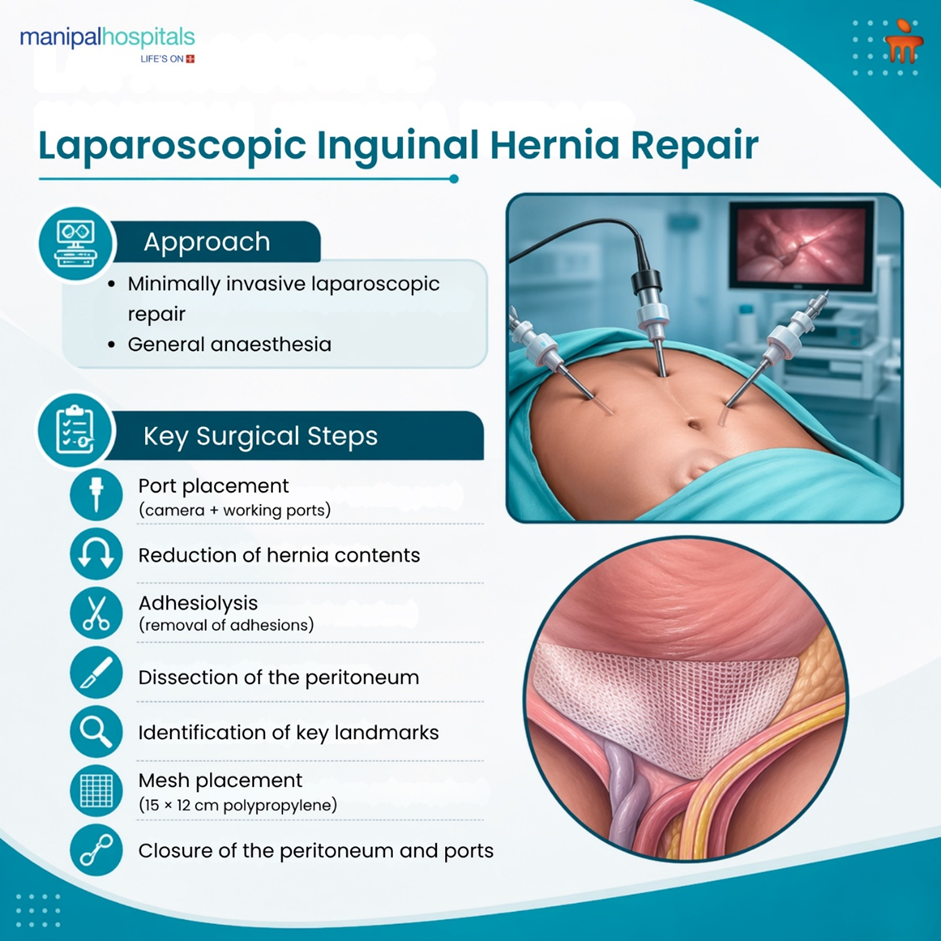
The team proceeded with laparoscopic right inguinal hernia repair under general anaesthesia. A 10 mm supraumbilical camera port was inserted, and pneumoperitoneum was established. Two 5 mm working ports were placed at the umbilical level lateral to the epigastric vessels. Intraoperatively, a complete indirect inguinal hernia with caecum as content and associated adhesions was identified. The surgical team performed:
-
Reduction of hernia contents
-
Adhesiolysis
-
Incision and dissection of the peritoneum
-
Exposure of the myopectineal orifice
-
Identification of key landmarks such as the pubic symphysis, Cooper’s ligament, epigastric vessels, iliopubic tract, and cord structures
-
Placement of a 15 × 12 cm polypropylene mesh
-
Closure of the peritoneum with absorbable sutures
-
Release of pneumoperitoneum and layered port closure
This procedure was a well-planned repair because it addressed both the hernia defect and the unusual intraoperative findings.
Outcome of the Treatment
The surgery was completed without complications. The patient tolerated the procedure well and had an uneventful recovery. Post-operatively, he remained hemodynamically stable and was managed with IV fluids, antibiotics, and analgesics.
He was discharged in a stable condition with advice to:
-
Gradually resume daily activities
-
Avoid strenuous activity and heavy lifting for three months
-
Follow breathing exercises
-
Maintain proper wound care
-
Attend scheduled follow-up
The overall outcome was favourable, with successful repair and stable postoperative recovery.
What Laparoscopic Hernia Repair Involves
Laparoscopic hernia repair is a minimally invasive technique that uses small incisions, a camera, and working ports to access the hernia from inside the abdomen. It allows the surgeon to inspect the defect, reduce hernia contents, and reinforce the area with mesh.
Why it Helped in This Case
This approach offered several advantages:
-
Smaller incisions
-
Clear visualisation of internal structures
-
Careful adhesiolysis under direct vision
-
Accurate mesh placement
-
Better handling of a complex hernia with bowel content
Because the hernia contained the caecum and adhesions, the laparoscopic view helped the surgeon identify landmarks and reduce the contents safely.
Comparison: Surgical Approach & Case Complexity
|
Open Surgery for Hernia Repair |
Laparoscopic Surgery for Hernia Repair |
|
Open hernia repair is a widely used and dependable technique |
Laparoscopic repair offers a minimally invasive alternative with enhanced precision |
|
Involves a larger incision and more extensive tissue dissection |
Requires smaller incisions with reduced tissue handling |
|
Suitable in many standard situations, including some complex cases |
Particularly advantageous in complex cases due to superior internal visualisation |
|
Provides limited internal view compared to laparoscopy |
Enables better visualisation of intra-abdominal structures for safer intervention |
|
Routine hernia cases are generally straightforward to manage |
This case was more demanding due to bowel contents and adhesions |
|
Standard procedures usually require less intricate dissection |
Required careful reduction and meticulous adhesiolysis |
|
Considered a typical inguinal hernia repair approach |
Stands out as a complex case needing advanced surgical planning and execution |
Key Takeaways for Readers
-
An inguinal hernia may present as painless groin swelling.
-
The contents of a hernia can sometimes be unusual, as in this case where the caecum was involved.
-
Adhesions can complicate surgery and require careful dissection.
-
Mesh repair helps reinforce the abdominal wall and lower recurrence risk.
-
Laparoscopic repair can be an effective option in selected cases, even when the hernia is technically challenging.
-
Good recovery depends on following postoperative advice, especially avoiding heavy lifting.
Conclusion
This case shows how a right inguinal hernia can occasionally present with unexpected findings that influence the surgical plan. Although the patient initially came in with painless right groin swelling, surgery revealed a complete indirect hernia containing the caecum, dilated small bowel loops, and adhesions—adding to the complexity of the procedure.
This case is a good example of how careful planning, good anatomical identification, and the right surgical technique can lead to a successful outcome even in a more complex hernia case. For those seeking hernia repair surgery near Malleshwaram, the expertise of experienced general surgeons at Manipal Hospital Malleshwaram plays a crucial role in managing such complex presentations effectively.
FAQ's
An inguinal hernia is a bulge in the groin that happens when tissue pushes through a weak area in the abdominal wall. It may cause swelling, discomfort, or no symptoms at all.
This case was more complex because the hernia contained the caecum, dilated small bowel loops, and adhesions. That made reduction and repair more technically demanding.
Mesh is used to reinforce the weak area of the abdominal wall. It helps support the repair and lowers the chance of the hernia coming back.
Laparoscopy allowed the surgeon to see the anatomy clearly, reduce the hernia contents carefully, perform adhesiolysis, and place the mesh through a minimally invasive approach.
The patient was advised to resume daily activity gradually, avoid strenuous work and heavy lifting for three months, follow breathing exercises, care for the wound properly, and attend follow-up appointments.
Share this article on:


