8 Min Read
Most people do not think much about their spine until everyday movements start hurting. One day you may be bending down to pick something up or getting out of bed as usual, and the next, you are dealing with back pain that shoots into your leg or makes walking uncomfortable. This is often how the journey with a spine disc injury begins. It does not always start with a major trauma but through gradual wear and tear within the spinal discs that makes simple daily tasks feel completely exhausting.
The reassuring fact is that a slipped disc is not permanently debilitating. Instead, it occurs when one of the discs in your spine becomes damaged and begins pressing on nearby nerves. Although the symptoms can feel alarming, many people recover successfully with the right diagnosis, activity modifications, and treatment plan. Modern treatments have come a long way from the limited options used in the past. In this blog, we explain the risk factors, symptoms, diagnosis, treatment options, and what you can expect during the healing process.
Synopsis
What is a Slipped Disc?
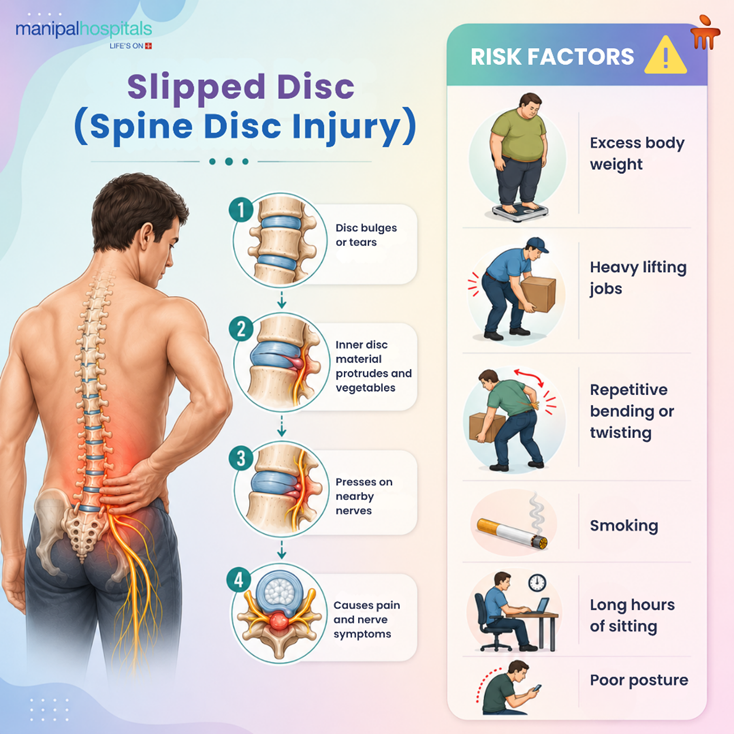
A spine disc injury occurs when part of a spinal disc bulges or pushes through a tear in its outer layer, sometimes pressing on nearby nerves. The damaged disc can irritate nearby nerves and cause pain, numbness, or weakness.
-
Disc Annulus: This is the tough outer layer of the spinal disc that helps keep the disc in place. Daily strain or sudden twisting can cause this outer layer to develop small tears or structural weak spots.
-
Nucleus Pulposus: This is the soft inner portion of the disc that acts as a shock absorber. When the outer wall breaks down, this gel-like material bulges outward into the narrow spaces of the spinal canal.
When this inner material forces its way past its normal boundary, it creates a compressed nerve root. Nerve irritation can cause pain, numbness, or tingling that radiates into the arms or legs.
Key Risk Factors
Recognising the lifestyle choices and physical habits that weaken the back early can be the difference between a simple exercise routine and long-term medical care. Several common elements significantly elevate your baseline risk.
-
Weight Accumulation: Carrying excess body weight places continuous mechanical stress on the lower cushions. This accelerated load forces the inner gel to push against the outer walls even during basic movements.
-
Occupational Exposure: Jobs that require repetitive heavy lifting, continuous twisting, or sitting for long hours on machinery that vibrates can slowly wear down the protective outer boundaries.
-
Nicotine Use: Smoking reduces the overall oxygen and nutrient supply to the spinal column. Because these discs lack a direct blood supply, nutrient deprivation leaves them brittle and far more fragile.
-
Long Hours of Sitting: Slouching over a computer desk increases pressure on the lower back and can weaken the muscles that support the spine over time, weakening your spine's natural support network.
Slip Disk Symptoms to Watch For
The symptoms of a spine disc injury depend entirely on where the damage is along your spine and which specific nerve pathway is feeling the squeeze.
-
Radiating Shooting Pain: If the issue sits in your lower back, it can cause sciatica, which is a sharp, hot pain that travels through your hip and down the back of one leg. This severe discomfort is a primary indicator that you need a targeted slipped disc treatment plan.
-
Pins and Needles: A constant tingling, prickling, or numbness often develops in the exact areas of skin connected to the irritated nerve root.
-
Muscle weakness: Squeezed nerves struggle to carry clear signals from your brain to your limbs, making your leg feel heavy or causing you to trip over your feet.
Depending on which disc is affected, slip disk symptoms may also occur in the neck, shoulders, arms, or hands. If these symptoms persist or begin affecting your daily activities, consult experienced spine specialists in Kanakapura Road, Bangalore, for a comprehensive evaluation and timely treatment.
Diagnosis of Spine Disc Injury
If you suspect a problem, the diagnostic process is straightforward but thorough. Specialists use a combination of physical assessment and advanced imaging to map out the mechanical damage before recommending a path for slipped disc treatment.
|
Method |
What the Doctor Does |
What it Reveals |
|
Clinical Evaluation |
Checks physical reflexes, tests muscle strength, and raises your leg straight up while you lie flat on your back. |
Identifies the specific nerve pathway that is compressed or irritated by a suspected spine disc injury. |
|
MRI Scan |
Uses powerful magnets to take clear, highly detailed pictures of the soft tissues inside your back. |
Shows the precise shape and size of the disc bulge and confirms whether the bulging disc is compressing nearby nerves. |
|
CT Scan |
Takes a series of detailed X-ray images from different angles to provide a sharp view of your back anatomy. |
Helps your care team rule out other bone conditions, like arthritic bone spurs or small fractures. |
Imaging is usually recommended when symptoms persist, neurological deficits are present, or surgery is being considered.
Modern Options for Slipped Disc Treatment
The philosophy of spinal care has shifted dramatically. Most patients are initially managed with non-surgical treatment approaches to relieve nerve pressure and allow the affected disc and surrounding tissues time to recover.
Conservative Care: The First Line of Defence
For many, the problem can be managed successfully without ever stepping into an operating theatre, making simple therapies the primary goal of modern slipped disc treatment.
-
Core Stabilisation: This isn't about general fitness; it is about strengthening the muscles that support and stabilise the spine. A stronger core acts like an internal brace, holding the spine in a better position and lifting the physical burden off your healing tissues.
-
Posture and Movement Adjustments: Through specialised physical therapy, patients learn how to sit, walk, and lift safely to keep the spine in a safe, neutral alignment.
-
Medication Plans: Doctors frequently recommend anti-inflammatory medicines or muscle relaxants to dull the sharp initial ache, making it easier for you to move around and complete your exercises.
-
Targeted Cortisone Injections: If standard pills fail to give enough relief, a specialist can use an injection to place powerful anti-inflammatory medicine directly around the irritated nerve root to reduce inflammation around the affected nerve and improve symptoms.
Advanced Surgical Intervention
If severe nerve pain persists after therapy, or if nerve damage threatens your mobility, surgery becomes necessary. Modern techniques are highly precise and minimally invasive to speed up your recovery.
The primary goal is removing nerve pressure. This usually involves a microdiscectomy, where a surgeon removes only the tiny piece of protruding disc gel pinching the nerve, leaving the healthy cushion intact. In rare cases where bones are unstable, a spinal fusion joins the vertebrae together into a single, secure bone.
Recovery: What to Expect?
Whether you choose a conservative path or a surgical one, rebuilding your spinal health is a steady marathon that requires patience.
-
Non-Surgical Path: Many patients experience significant symptom improvement and a major return of mobility within four to six weeks of starting a dedicated physical therapy and slipped-disc treatment plan. Once the initial swelling drops, in many cases, the body gradually reduces the size of the disc bulge over time, leading to symptom improvement.
-
Surgical Path: If you undergo a microdiscectomy, you will generally be encouraged to begin assisted walking within a day or two after surgery. However, it takes about six weeks to three months for the deep tissues to heal securely and for the spinal structures to completely stabilise.
Conclusion
Living with a spinal disc injury can certainly disrupt your daily life, but it is a highly manageable condition with a very positive outlook. From noticing a loss of strength to choosing a personalised physical recovery plan, there are clear ways to feel better.
If you are noticing changes in your posture, persistent back fatigue, or progressive weakness in one side of your body, do not dismiss it as a normal part of getting older. Early intervention is the most powerful tool we have. Seeking professional slipped disc treatment in Kanakapura Road, Bangalore, ensures you get a clear diagnosis and access to world-class medical help. With the guidance of the spine specialist at Manipal Hospital Kanakapura Road, you can regain your balance, reduce your pain, and return to a comfortable, active lifestyle.
FAQ's
No. A slipped disc is a localised problem involving one specific cushion between your bones, bulging out of place. A spinal deformity involves a much larger, structural change in the actual alignment and natural curvature of your entire back.
Exercise cannot physically reposition a herniated disc, but strengthening deep core muscles stabilises the spine. This relieves nerve pressure, significantly reduces pain, and acts as an effective non-surgical treatment.
You must go to an emergency room right away if you experience sudden weakness in one side of body, total numbness in your groin area, or a sudden loss of bowel or bladder control. These are signs of dangerous nerve compression.
The vast majority of cases are successfully managed without surgery using physical therapy, core stabilisation, anti-inflammatory medicines, and lifestyle adjustments. Surgery is reserved for patients who do not find relief through conservative means.
Most people see a major improvement within four to six weeks of starting a dedicated, non-surgical plan. In some cases, symptoms improve as inflammation settles and the disc protrusion reduces over time. This protects your posture and helps you avoid movements that re-injure the back.
Share this article on: