8 Min Read

A stroke is one of those medical emergencies that usually strikes without any obvious warning. Unlike a broken arm, a deep cut, or a heart attack, it rarely comes with intense chest pain to alert you that something is seriously wrong. Someone might just feel suddenly dizzy, notice their vision blurring, or find that their speech sounds a bit thick and clumsy. Because there is often no physical pain, many people make the mistake of waiting it out. They sit down on the sofa, drink a glass of water, or hope a short nap will clear their head.
With a stroke, waiting to see if things improve is the worst thing you can do. A stroke happens in the brain, and every minute that passes without blood flow causes millions of brain cells to be starved of oxygen. Recognising the problem straight away and getting to an emergency room immediately can completely change the outcome.
In this guide, we will look at what a stroke is, break down the BE FAST acronym, explain the stroke symptoms and warning signs you should never ignore, and discuss why acting during the first hour is so vital.
Synopsis
- What Is a Stroke?
- What Is BE FAST in Stroke and How Does It Help Identify a Stroke?
- BE FAST Stroke Symptoms, Early Signs and Other Warning Signs
- Importance of Early Stroke Treatment
- Treatment Options for Stroke
- Golden Hour in Stroke Treatment
- What to Do (and What Not to Do) in an Emergency
- Local Preparedness and Awareness
- Conclusion
What Is a Stroke?
A stroke is essentially a sudden interruption of the blood supply to part of your brain. Your brain depends on a steady network of blood vessels to deliver oxygen and essential nutrients. If that flow gets interrupted, the brain tissue in that specific area stops functioning, and cells begin to die off very rapidly.
There are two primary types of stroke:
-
Ischaemic Stroke: This is by far the most common type, making up around 85% of all cases. It occurs when a blood clot blocks an artery that leads to or sits inside the brain. These clots often form because of fatty cholesterol plaques that build up in blood vessels over time.
-
Haemorrhagic Stroke: This happens when a weakened blood vessel bursts open and bleeds directly into or around the brain tissue. Untreated high blood pressure and aneurysms are the most frequent causes. The leaked blood creates pressure inside the skull, which damages nearby brain cells.
There is also something called a Transient Ischaemic Attack (TIA), often referred to as a "mini-stroke". A TIA happens when a clot blocks blood flow for just a few minutes before clearing away on its own. While the symptoms disappear quickly, a TIA is a major warning that a full, disabling stroke could happen in the near future.
What Is BE FAST in Stroke and How Does It Help Identify a Stroke?
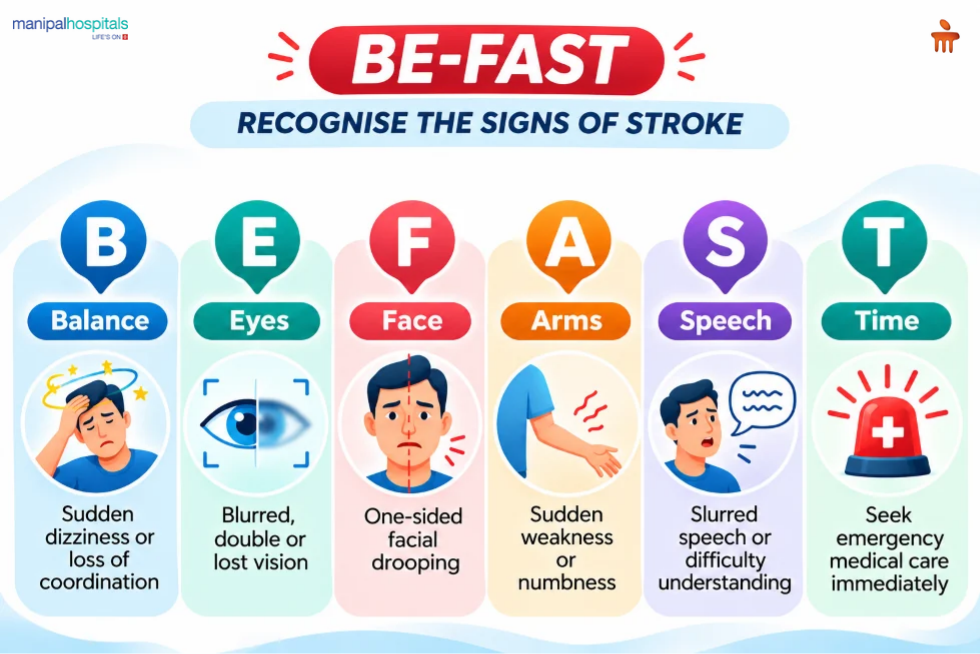
When someone has a stroke, the symptoms may appear suddenly. But how do you recognise them? This is where BE FAST in stroke can help. It is a simple way to remember the warning signs and understand when a person needs medical attention.
Each letter in BE FAST points to a symptom you should look out for.
-
B – Balance: Sudden dizziness, loss of balance or difficulty walking.
-
E – Eyes: Sudden blurred vision, double vision or loss of vision in one or both eyes.
-
F – Face: One side of the face may droop, especially when the person tries to smile.
-
A – Arms: Sudden weakness or numbness in one arm. The person may find it difficult to raise both arms.
-
S – Speech: Speech may become slurred. The person may also struggle to find words or understand what others are saying.
-
T – Time: Seek emergency medical attention immediately.
The traditional FAST method covers face, arms, speech and time. BEFAST adds balance and eye changes, which can also be early signs of a stroke. This makes BE FAST stroke recognition more useful in spotting symptoms that might otherwise go unnoticed.
Note: Not all these signs will appear together. Even one sudden symptom needs urgent medical attention.
BE FAST Stroke Symptoms, Early Signs and Other Warning Signs
Stroke symptoms usually appear suddenly. However, not everyone experiences them in the same way. It depends on which part of the brain is affected. Some people develop weakness on one side of the body, while others may have problems with speech, vision or coordination.
Apart from the signs covered under BE FAST, there are a few other early signs of stroke to watch for:
-
Sudden numbness or weakness on one side of the body, including the leg.
-
Confusion or difficulty understanding what someone is saying.
-
A sudden, severe headache without an apparent cause.
-
Difficulty swallowing.
-
Sudden loss of coordination or difficulty controlling body movements.
Importance of Early Stroke Treatment
When a person has a stroke, the brain starts losing its normal function as soon as the blood supply is interrupted. Doctors often use the phrase time is brain to explain this. The longer the brain goes without adequate blood flow, the greater the risk of permanent damage.
Early diagnosis helps doctors identify the type of stroke and decide on the right treatment. The approach differs depending on whether a blood clot or bleeding has caused the stroke.
Treatment Options for Stroke
-
Thrombolysis: In eligible patients with an ischaemic stroke, doctors give medication intravenously to dissolve the blood clot blocking the artery.
-
Mechanical thrombectomy: This procedure involves removing a clot using a specialised device. It is used in selected patients with a blockage in a large blood vessel.
-
Treatment for haemorrhagic stroke: Doctors may use medication, procedures or surgery to control bleeding and manage pressure inside the brain.
Golden Hour in Stroke Treatment
The first 60 minutes after stroke symptoms begin are commonly referred to as the golden hour. This period is particularly important for early assessment and treatment. However, the golden hour in stroke treatment is not a strict deadline. Some patients may still qualify for treatment several hours later.
For instance, selected patients may benefit from clot-dissolving medication within 4.5 hours or mechanical thrombectomy within 24 hours of symptom onset. Doctors consider the time symptoms began, brain scan findings and the patient's overall condition before deciding on treatment.
What to Do (and What Not to Do) in an Emergency
If you spot the Early Signs of Stroke in someone around you, taking the right practical steps keeps them safe while you get medical help:
What You Should Do:
-
Call an emergency ambulance immediately and state clearly that you suspect a stroke.
-
Note the exact time you first noticed the symptoms, or the last time the person was seen completely normal. Doctors need this time to decide on treatment.
-
Lay the person down on their side with their head slightly raised and supported. This keeps their airway clear if they vomit.
-
Loosen tight collars or belts to help them breathe comfortably.
What You Must Avoid:
-
Do not give them aspirin: If the stroke is caused by a burst blood vessel (haemorrhagic), taking aspirin will thin the blood and make the bleeding far worse. Never give aspirin until a hospital CT scan has ruled out bleeding.
-
Do not give food or water: A stroke often weakens the muscles in the throat. Trying to swallow pills or water can cause the person to choke or inhale fluid into their lungs.
-
Do not let them go to sleep: Sleeping delays emergency treatment and makes it impossible to know when the stroke progressed.
Local Preparedness and Awareness
Raising Stroke Awareness in Kanakapura Road, Bangalore, is an important part of community health. Knowing beforehand which nearby hospitals have 24/7 CT scanners, acute neurology coverage, and emergency stroke protocols means you do not have to guess where to go in the middle of a crisis. Having an emergency plan in place saves precious minutes on the road.
Conclusion
A stroke can happen without warning, and the time taken to recognise it can affect a person's recovery. Knowing the BEFAST signs gives you a simple way to identify possible symptoms, especially when someone close to you is affected. Do not wait for the symptoms to settle before seeking medical help. For Stroke Awareness in Kanakapura Road, Bangalore, Manipal Hospitals is committed to supporting timely stroke assessment and treatment. Visit the emergency room the moment you identify signs of a stroke.
FAQ's
BE FAST is an updated acronym that stands for Balance, Eyes, Face, Arms, Speech, and Time. It was updated from the older FAST checklist because doctors realised that FAST sometimes missed strokes that occur in the back of the brain. Adding Balance and Eyes helps catch symptoms like sudden dizziness, unsteadiness, and vision loss that might otherwise be overlooked.
The golden hour refers to the first 60 minutes after stroke symptoms appear. Reaching a hospital within this first hour gives doctors the time needed to perform emergency brain scans and administer clot-dissolving medicines while the maximum amount of brain tissue can still be saved.
Yes, most ischaemic strokes are completely painless. Because there are no pain receptors inside the brain tissue itself, a blocked blood vessel usually causes numbness, weakness, or confusion rather than a severe headache. A sudden, violent headache is more common in haemorrhagic strokes where a blood vessel bursts.
Yes, absolutely. If symptoms resolve on their own, the person has likely had a Transient Ischaemic Attack (TIA) or mini-stroke. A TIA means an artery was temporarily blocked. Without urgent medical evaluation and preventive treatment, there is a very high risk of having a major, permanent stroke in the days following a TIA.
You cannot tell whether a stroke is caused by a blocked blood vessel (ischaemic) or a ruptured blood vessel (haemorrhagic) without a hospital CT scan. If the stroke is caused by bleeding in the brain, giving aspirin will thin the blood and cause further, potentially fatal bleeding.
Share this article on: