8 Min Read
The terms Alzheimer's and dementia are often used interchangeably, leading to widespread confusion about these distinct conditions. While both involve cognitive decline, understanding the fundamentals of Alzheimer’s vs dementia is crucial for accurate diagnosis, effective management, and providing appropriate support. At Manipal Hospitals, our neurologists in Gurugram frequently encounter these questions and are dedicated to demystifying these complex neurological challenges for our patients and their families. This comprehensive guide aims to clarify what dementia is, what Alzheimer’s is, and how they relate to each other, shedding light on their unique symptoms and treatment approaches.
Synopsis
- Understanding Dementia: The Umbrella Term
- Common Symptoms of Dementia
- Types of Dementia
- Delving into Alzheimer’s Disease: A Specific Challenge
- Early Signs and Progression of Alzheimer’s
- The Core Difference: Alzheimer’s vs Dementia
- Diagnosis and Management: A Path Forward
- Treatment Approaches and Support
- Conclusion
Understanding Dementia: The Umbrella Term
What is Dementia?
Dementia is not a specific disease but rather a broad term that describes a collection of symptoms affecting cognitive functions such as memory, thinking, reasoning, language, and behaviour, severe enough to interfere with a person's daily life. It is a progressive condition, meaning symptoms gradually worsen over time. It's important to understand that dementia is not a natural part of ageing, though the risk increases with age. Globally, over 55 million people are living with dementia, a number projected to reach 78 million by 2030, underscoring the urgent need for awareness and support.
Common Symptoms of Dementia
The dementia symptoms can vary widely depending on the underlying cause and the areas of the brain affected. However, some common signs include:
-
Memory loss that disrupts daily life, especially recent events.
-
Difficulty with planning or solving problems.
-
Challenges in completing familiar tasks at home, at work, or at leisure.
-
Confusion with time or place.
-
Trouble understanding visual images and spatial relationships.
-
New problems with words in speaking or writing.
-
Misplacing things and losing the ability to retrace steps.
-
Decreased or poor judgment.
-
Withdrawal from work or social activities.
-
Changes in mood and personality.
Types of Dementia
Dementia can arise from various medical conditions, each presenting with its unique set of challenges. Understanding the different types of dementia is vital for targeted care. While Alzheimer's disease is the most prevalent, it is just one of many forms:
-
Alzheimer's Disease: Accounts for 60-80% of dementia cases, characterised by specific brain changes.
-
Vascular Dementia: Often occurs after a stroke or a series of mini-strokes, caused by reduced blood flow to the brain.
-
Lewy Body Dementia (LBD): Characterised by abnormal protein deposits (Lewy bodies) in the brain, leading to fluctuations in attention and alertness, visual hallucinations, and Parkinsonian motor symptoms.
-
Frontotemporal Dementia (FTD): Affects the frontal and temporal lobes of the brain, impacting personality, behaviour, and language more prominently than memory in the early stages.
-
Mixed Dementia: A combination of two or more types of dementia, most commonly Alzheimer's disease and vascular dementia.
-
Parkinson's Disease Dementia: Develops in some individuals with Parkinson's disease as it progresses.
-
Creutzfeldt-Jakob Disease: A rare, rapidly progressive, and fatal form of dementia.
-
Huntington's Disease: A genetic disorder that can lead to a decline in thinking and reasoning skills.
Delving into Alzheimer’s Disease: A Specific Challenge
What is Alzheimer’s Disease?
Alzheimer's disease is a specific, progressive neurodegenerative disease that accounts for the majority of dementia cases. It is characterised by specific changes in the brain, including the accumulation of abnormal protein plaques (beta-amyloid) and tangles (tau), which disrupt nerve cell function and ultimately lead to brain cell death. These changes begin years before symptoms appear and are unique to Alzheimer's, making it distinct from other types of dementia. The disease gradually destroys memory and thinking skills and, eventually, the ability to carry out the simplest tasks. With advancements in research, early diagnosis of Alzheimer's has been shown to improve long-term symptom management and quality of life by up to 25% for many patients.
Early Signs and Progression of Alzheimer’s
Recognising the early signs of Alzheimer’s is crucial for timely intervention. While the exact progression varies among individuals, typical Alzheimer’s disease symptoms often begin with subtle changes and gradually become more pronounced:
-
Mild Cognitive Impairment (MCI) due to Alzheimer’s: This is an early stage where a person has noticeable memory problems, but usually not severe enough to interfere with daily life. People may forget recent events or conversations more often.
-
Early Stage: Memory lapses become more frequent. Individuals may struggle with finding the right words, losing objects, or forgetting the names of familiar people. Planning and organising become challenging.
-
Middle Stage: This is typically the longest stage. Memory loss and confusion deepen. Individuals may forget personal history, struggle to perform multi-step tasks, and experience significant mood and personality changes. Wandering and repetitive behaviours can occur.
-
Late Stage: In the final stage, individuals lose the ability to respond to their environment, carry on a conversation, and eventually control movement. They require full-time assistance with daily personal care.
The Core Difference: Alzheimer’s vs Dementia
The primary factor of Alzheimer’s vs dementia lies in their relationship: dementia is an overarching term for a set of symptoms, while Alzheimer’s disease is a specific disease that causes those symptoms. Think of it this way: all Alzheimer’s is a form of dementia, but not all dementia is Alzheimer’s.
Just as "cancer" is a general term for uncontrolled cell growth, and "lung cancer" is a specific type of cancer, "dementia" is a general term, and "Alzheimer's disease" is a specific type of dementia. This distinction is vital because while the symptoms may overlap, the underlying brain pathology, diagnostic approaches, and specific management strategies can differ significantly based on the cause of dementia.
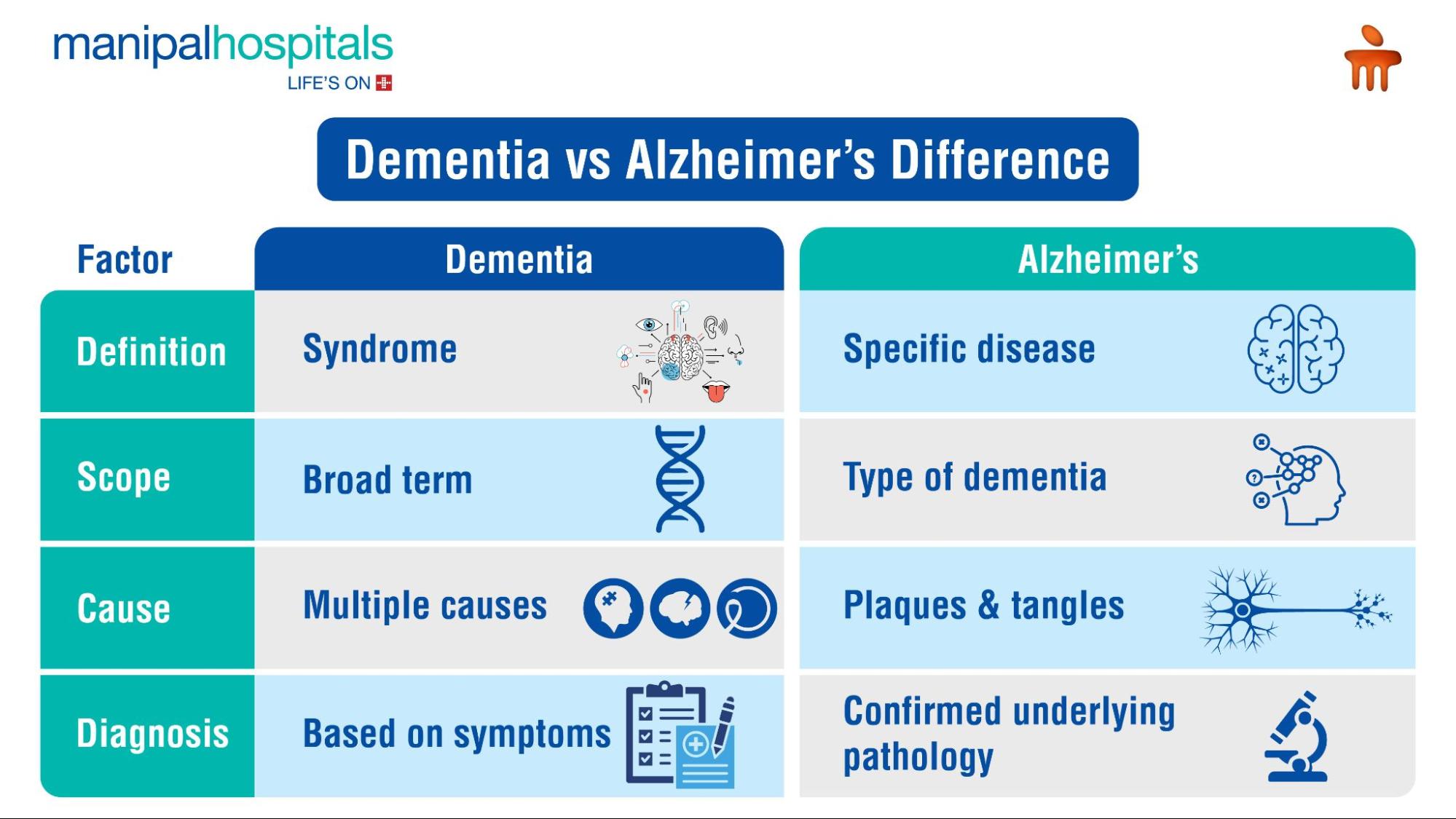
Key Distinctions Summarised
-
Definition: Dementia is a syndrome characterised by cognitive decline; Alzheimer’s is a specific neurodegenerative disease.
-
Scope: Dementia is an umbrella term; Alzheimer’s is the most common cause of dementia.
-
Causes: Dementia can be caused by various conditions (vascular disease, Lewy bodies, FTD, etc.); Alzheimer’s has specific pathological hallmarks (plaques and tangles).
-
Diagnosis: A diagnosis of dementia indicates symptoms of cognitive decline. A diagnosis of Alzheimer’s disease indicates these symptoms are due to the specific brain changes associated with Alzheimer’s.
-
Progression: While both are progressive, the specific patterns and timelines of cognitive decline can vary among different types of dementia.
Diagnosis and Management: A Path Forward
The Diagnostic Process
An accurate diagnosis is the first and most critical step. If you or a loved one is experiencing dementia symptoms or early signs of Alzheimer’s, seeking a professional medical evaluation is paramount. Diagnosis typically involves a comprehensive approach:
-
Medical History and Physical Exam: To rule out other conditions.
-
Neurological Evaluation: To assess reflexes, coordination, balance, and sensory response. Our neurologists in Gurugram are equipped with state-of-the-art facilities for this.
-
Cognitive and Neuropsychological Tests: To evaluate memory, problem-solving, attention, counting, and language skills.
-
Brain Imaging: MRI, CT, or PET scans can help identify brain changes, tumours, strokes, or other issues.
-
Blood Tests: To check for treatable causes of cognitive decline, such as vitamin deficiencies or thyroid problems.
Early and accurate diagnosis offers significant benefits, including the ability to manage symptoms more effectively, plan for the future, and potentially participate in clinical trials for new treatments. Studies indicate that early detection can lead to better patient outcomes and significantly enhance a patient's quality of life, allowing for crucial interventions to be implemented.
Treatment Approaches and Support
While there is currently no cure for Alzheimer's disease or most other forms of progressive dementia, treatments are available to manage symptoms, improve quality of life, and slow the progression in some cases. These include:
-
Medications: Certain medications can help manage cognitive and behavioural symptoms, particularly for Alzheimer's disease.
-
Cognitive Stimulation Therapy: Activities designed to stimulate memory and thinking skills.
-
Lifestyle Adjustments: A healthy diet, regular exercise, adequate sleep, and social engagement can support brain health.
-
Caregiver Support: Education and support groups for caregivers are vital for managing the challenges of caring for someone with dementia.
-
Environmental Modifications: Adapting the living environment to ensure safety and promote independence.
Conclusion
Manipal Hospitals offers a multidisciplinary approach, combining the expertise of neurologists, geriatric specialists, psychologists, and support staff to provide holistic care for individuals with dementia and their families. With dedicated care and support, many patients can maintain a good quality of life for an extended period, an encouraging outcome observed in over 70% of individuals who receive comprehensive management.
If you or a loved one is experiencing symptoms related to cognitive decline, it's crucial to seek timely medical advice. Book an appointment with our expert neurologist at Manipal Hospitals Gurugram today to understand the difference between Alzheimer’s and dementia and explore personalised care options.
FAQ's
No, Alzheimer's disease is not a normal part of ageing. While age is a primary risk factor, it is a specific disease characterised by pathological brain changes, distinct from typical age-related memory fluctuations.
For most progressive types of dementia, including Alzheimer's, there is currently no cure. However, treatments are available to manage symptoms, improve quality of life, and, in some cases, slow progression. Some forms of dementia caused by underlying conditions (e.g., vitamin deficiencies, thyroid issues) can be treatable or reversible.
The early signs of Alzheimer’s often include persistent memory loss that impacts daily life, difficulty solving problems, trouble with familiar tasks, confusion about time or place, and changes in mood or personality. It's more than just occasional forgetfulness.
Diagnosis involves a comprehensive assessment, including medical history, neurological exams, cognitive tests, brain imaging (MRI, CT, PET), and blood tests to rule out other conditions. This multidisciplinary approach helps differentiate Alzheimer’s from dementia caused by other factors.
While there’s no guaranteed way to prevent dementia, research suggests that a brain-healthy lifestyle can significantly reduce risk. This includes regular physical exercise, a balanced diet (like the Mediterranean diet), maintaining social engagement, managing cardiovascular health, and engaging in mentally stimulating activities.
Share this article on:


.webp "Dr. Salil Yadav | Robotic & Laparoscopic Surgery Specialist in Gurugram | Manipal Hospitals")