7 Min Read
A breast cancer diagnosis is a life-altering event, but rapid advancements in diagnosis and treatments are offering patients more hope and improved clinical outcomes than ever before. One such ground-breaking advancement capturing the attention of the global medical community is Robotic Breast Surgery. The purpose of this post is to explore a specific procedure known as Robotic Nipple-Sparing Mastectomy (RNSM), detailing how this new and upcoming technique offers unparalleled advantages, and why it is revolutionising the surgical management of breast cancer.
Synopsis
Understanding Robotic Nipple-Sparing Mastectomy
Robotic Nipple-Sparing Mastectomy is a minimally invasive procedure designed to meticulously remove breast tissue while carefully preserving the patient's skin, nipple, and areola complex as an envelope and reconstructing a new breast using a silicon implant or patient’s own tissue as filler. During this surgery, the medical team utilises a highly advanced robotic console to control surgical instruments with extraordinary precision.
Currently, this breast surgery technique has its application in a specific area of practice. It is predominantly recommended for patients diagnosed with early-stage breast cancer undergoing mastectomy, or individuals who carry a high-risk genetic mutation and are opting for a prophylactic (preventive) mastectomy. Because the incisions are small and typically hidden away near the armpit, the procedure successfully avoids the large, visible scarring typically associated with traditional open surgeries.
A New and Upcoming Technique
While traditional open breast cancer surgery and breast lump surgery have a long-standing history as the standard of care, the robotic approach is decidedly a new and upcoming technique in the realm of Breast Onco-surgery. At present, it requires highly specialised training and state-of-the-art equipment, meaning its availability is mostly limited to premier medical institutions. However, as the technology becomes more accessible and rigorous training programmes expand, it is fully expected that this procedure will slowly gain more popularity among both surgeons and patients seeking superior cosmetic outcomes.
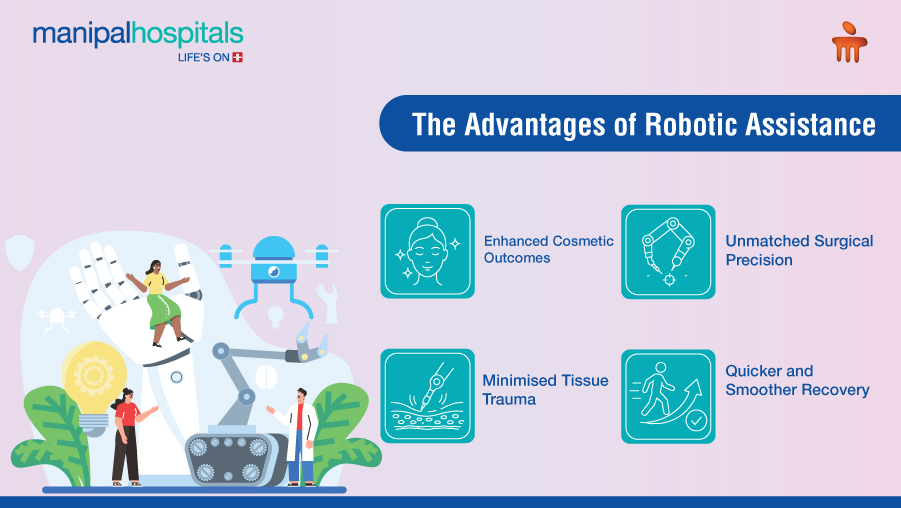
The Advantages of Robotic Assistance
The transition from traditional open breast surgery to robotic-assisted techniques brings a multitude of distinct advantages for patients. These benefits significantly enhance the overall treatment and recovery experience:
-
Enhanced Cosmetic Outcomes: By placing the incision in a discreet location and preserving the entire external envelope of the breast, the final cosmetic result following immediate reconstruction is incredibly natural-looking.
-
Unmatched Surgical Precision: The robotic system provides a high-definition, three-dimensional, magnified view of the internal anatomy, allowing the surgeon to navigate complex structures with absolute clarity.
-
Minimised Tissue Trauma: The robotic instruments possess a greater range of motion than the human hand, reducing the stress placed on the surrounding skin flaps and preserving a robust blood supply to the nipple.
-
Quicker and Smoother Recovery: As a minimally invasive treatment, patients typically endure less post-operative pain, require shorter hospital stays, and experience a much faster return to their daily routines.
Evaluating the Clinical Evidence
In the medical field, the widespread adoption of any new procedure relies heavily on robust scientific evidence. The current body of evidence supporting Robotic Nipple-Sparing Mastectomy is overwhelmingly positive. Clinical trials and comprehensive studies demonstrate that the oncological safety of the robotic approach is on par with a traditional open Mastectomy. This means it is equally effective at completely removing cancerous tissue and preventing recurrence. Furthermore, evidence indicates that patients undergoing RNSM experience a marked reduction in flap necrosis (tissue death) and report higher satisfaction rates regarding the preservation of nipple sensation. As more longitudinal data is published, the evidence will continue to solidify robotic surgery's role in modern Surgical Oncology.
Conclusion
In summary, Robotic Nipple-Sparing Mastectomy is a groundbreaking, minimally invasive procedure that is setting a new standard in Breast Oncosurgery. Although it is a new and upcoming technique with application in specific areas of breast cancer surgery or breast lump surgery, its profound advantages—from superior aesthetic results to quicker recovery times—ensure that it will slowly gain more popularity in the coming years. With a solid foundation of clinical evidence confirming its oncological safety, it presents an excellent option for eligible patients. At Manipal Hopsitals EM Bypass, patients who have undergone this revolutionary procedure have all seen superior results.If you or a loved one is seeking advanced breast oncology specialist, visit Manipal Hospitals EM Bypass today.
FAQ's
It is an advanced, minimally invasive procedure where breast tissue is removed using sophisticated robotic instruments, meticulously preserving the skin, nipple, and areola to ensure a better cosmetic reconstruction.
Yes, extensive clinical evidence shows that the robotic approach is relatively safe. It is just as effective at removing cancerous tissue as traditional open surgeries while offering a lower risk of certain physical complications.
The ideal candidates are generally women with early-stage breast cancer that is not located directly beneath the nipple-areola complex, or individuals who are undergoing a preventative Mastectomy due to a high genetic predisposition.
Because this robotic breast surgery procedure is minimally invasive and causes less tissue trauma, patients typically experience reduced pain, require a shorter hospital stay, and have a much faster overall recovery compared to conventional open surgeries.
While all surgical procedures result in some degree of scarring, the robotic technique enables the surgeon to place a small incision in a discreet area, such as near the armpit, meaning there are usually no visible scars on the breast itself.
Share this article on: