7 Min Read
Do you experience persistent lower back pain that makes bending, walking, or sitting uncomfortable?
While occasional back pain is quite common, ongoing stiffness and discomfort might be something serious, linked to age-related changes in the lower spine. One common cause is lumbar spondylosis, a gradual degeneration of the discs and joints in the lower back. Although it develops slowly over time, early recognition and proper management can significantly reduce pain and improve quality of life.
This blog delves into what lumbar spondylosis is, its causes, symptoms, diagnosis, and the best ways to manage it in the long run.
Synopsis
- What is Lumbar Spondylosis (Lower Spine Degeneration)?
- Causes of Lumbar Spondylosis
- Lumbar Spondylosis Symptoms
- How Degeneration Changes the Lower Spine
- How is Lumbar Spondylosis Diagnosed?
- Treatment Options for Lumbar Spondylosis
- Advanced and Surgical Treatment Options
- When to Seek Medical Attention
- Conclusion
What is Lumbar Spondylosis (Lower Spine Degeneration)?
Lumbar spondylosis refers to age-related wear and tear affecting the discs, vertebrae, and facet joints of the lower back. These gradual changes alter spinal stability, flexibility, and, in some cases, nerve function. Mild degeneration is common as people age. Symptoms typically arise when degenerative changes lead to inflammation, mechanical instability, or compression of spinal nerve roots.
More About Lumbar Spondylosis
As the condition progresses, several structural alterations may occur:
-
Intervertebral discs lose hydration, elasticity, and height, reducing their shock-absorbing capacity.
-
Facet joints may enlarge and develop arthritic changes.
-
Bone spurs, known as osteophytes, can form in response to chronic mechanical stress.
-
Narrowing of the spinal canal or nerve passages may develop.
-
These changes may cause symptoms like lower back pain, stiffness, numbness, or weakness that spreads into the legs.
Lumbar spondylosis includes a range of degenerative conditions, such as intervertebral disc degeneration, facet joint arthritis, and lumbar spinal stenosis.
Causes of Lumbar Spondylosis
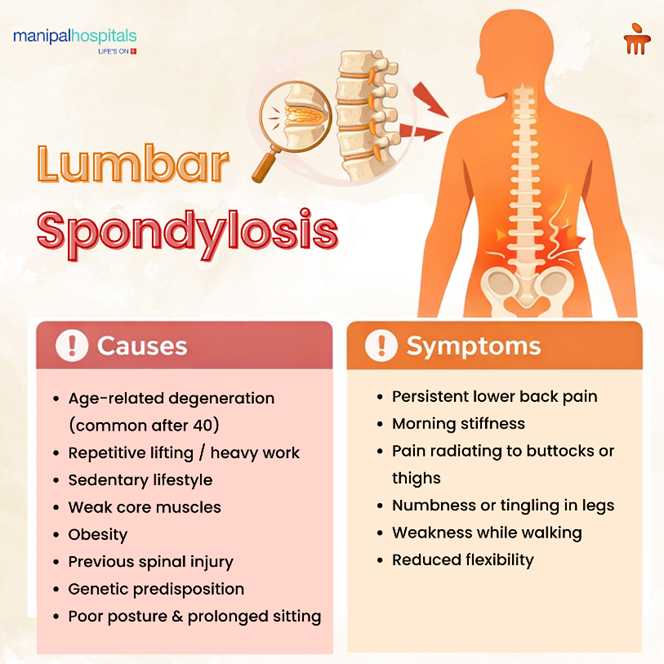
As we age, our spinal discs and joints gradually wear out. Repeated stress over the years dries out the discs and makes them lose height, which shifts the spine’s alignment and adds extra strain to the joints. Other things can cause lumbar spondylosis, such as:
|
Repetitive mechanical strain or occupational lifting |
Doing heavy physical work or lifting things over and over |
|
Age-related degenerative changes: |
After 40 years of age, the occurrence of natural wear and tear |
|
Lifestyle Factors: |
A sedentary lifestyle and weak core muscles |
|
Excess body weight: |
Obesity, which puts more stress on the spine |
|
Injury or Trauma: |
Prior spinal injuries or trauma |
|
Genetics: |
Genetic inclination towards premature degeneration |
Poor posture and sitting for long periods of time, especially at a desk job, can make it more likely that you will develop symptoms of lumbar spondylosis over time.
Lumbar Spondylosis Symptoms
Symptoms for lumbar spondylosis can differ from person to person. They usually depend on how much wear and tear has occurred in the spine and whether nearby nerves are affected.
-
Ongoing pain in the lower back that may worsen with movement.
-
Stiffness or reduced flexibility, often more noticeable in the morning.
-
Pain that may spread to the buttocks or thighs.
-
Numbness or tingling occurs when a nerve becomes compressed.
-
Difficulty standing or walking for long periods.
How Degeneration Changes the Lower Spine
Degenerative changes in the lumbar spine can involve several structures in the lower back. Over time, these changes may result in problems with stability, movement, and overall function. Some common spine effects are:
|
Spinal Effect |
What It Is |
Outcomes |
|
Disc Degeneration |
Intervertebral discs lose hydration and flexibility. |
Reduced shock absorption, altered load distribution, and increased mechanical stress on adjacent joints. |
|
Joint Strain |
Extra load on facet joints causes inflammation and arthritis-like changes. |
Leads to stiffness, localised pain, and reduced mobility. |
|
Bone Spur Formation |
Osteophytes (bony growths) develop to stabilise the spine. |
May press on nerves, causing discomfort or nerve irritation. |
|
Spinal Stenosis |
Narrowing of the spinal canal or nerve pathways. |
Causes leg pain, numbness, tingling, or difficulty walking. |
How is Lumbar Spondylosis Diagnosed?
Accurate identification of lumbar spondylosis begins with careful clinical evaluation and appropriate imaging.
-
Clinical assessment: Doctors assess symptoms, posture, gait, reflexes, and spinal movement to look for signs of mechanical strain or nerve involvement.
-
X-rays: Useful for detecting disc space narrowing, alignment changes, and bone spur formation.
-
MRI scan: Provides detailed visualisation of discs, nerves, and soft tissues, helping confirm compression or degeneration.
-
CT scan: May be recommended for better assessment of bony structures and canal narrowing.
Timely diagnosis of lumbar spondylosis allows specialists to grade severity, detect complications such as spinal stenosis, and design appropriate treatment strategies.
Treatment Options for Lumbar Spondylosis
Management depends on symptom severity, functional limitations, and imaging findings. Most patients respond well to conservative lumbar spondylosis treatment. However, advanced cases may need interventional procedures.
|
Treatment Approach |
What it is |
How it helps |
|
Physiotherapy |
Strengthening and flexibility exercises. |
Improves mobility and reduces pain. |
|
Pain Medications |
NSAIDs or analgesics |
Relieves pain and discomfort. |
|
Lifestyle Modification |
Weight control and posture correction. |
Reduces spinal stress. |
|
Heat/Cold Therapy |
Local application to the affected area. |
Provides symptomatic relief. |
Advanced and Surgical Treatment Options
When symptoms persist despite conservative therapy, more targeted interventions may be required. These approaches focus on relieving nerve compression, reducing pain, and improving spinal stability.
Interventional procedures
-
Epidural steroid injections: Help decrease inflammation around irritated nerves.
-
Radiofrequency ablation: Targets pain arising from facet joints by interrupting nerve signals.
Surgical procedures
-
Discectomy: A procedure where herniated or damaged disc material is removed to take pressure off the nerves.
-
Laminectomy: A decompression surgery where part of the vertebra is taken out to make more room for the nerves.
-
Spinal fusion: A surgery that joins two or more vertebrae to stabilise the spine.
Selecting the most appropriate lumbar spondylosis treatment requires careful evaluation of symptoms, neurological findings, imaging results, and the patient’s overall health.
When to Seek Medical Attention
Mild back pain or discomfort might get better with rest. However, pain with worsening symptoms should not be overlooked. Seeing a doctor immediately can lead to timely treatment. Consult a doctor promptly if you experience:
-
Lower back pain lasting more than a few weeks
-
Tingling or numbness in the legs
-
Weakness affecting walking or balance
-
Pain radiating down one or both legs
-
Loss of bladder or bowel control, which requires urgent attention
Timely diagnosis helps initiate appropriate management and protects nerves from permanent damage or disability.
Conclusion
Lumbar spondylosis commonly affects the lower spine, particularly with advancing age. Awareness of symptoms and timely evaluation are essential to reduce the risk of persistent pain and functional limitation. With early diagnosis and appropriate treatment at a leading hospital like Manipal Hospitals Bhubaneswar, many individuals can control symptoms and maintain an active lifestyle. Attention to posture, regular exercise, and healthy weight management further support long-term spinal wellbeing. Consult an expert today!
FAQ's
Lumbar spondylosis is a degenerative condition that affects the discs, joints, and vertebrae of the lower spine with age. It may cause pain, stiffness, and reduced mobility.
Common signs include ongoing lower back pain, stiffness, reduced flexibility, numbness or tingling, and pain that may spread to one or both legs.
Doctors check for lumbar spondylosis through physical exams and imaging tests such as X-rays, MRIs, or sometimes CT scans to find disc or nerve problems.
Treatment for lumbar spondylosis may include physiotherapy, medications, lifestyle modification, spinal injections, and, in more advanced cases, surgery to relieve nerve compression and improve function.
Share this article on:


_need_Surgery__Expert_Guide_.webp "Expert guide on gallbladder polyps and treatment options")