4 Min Read
Watching a child grow and learn is one of the most rewarding experiences for any parent. Every smile, first step, and new word feels like a milestone worth celebrating. While children develop at their pace, early childhood follows predictable developmental patterns. Recognizing when development is not progressing as expected is important; our goal is not to create fear, but to empower families with knowledge. Red flags in early childhood development are warning signs that indicate a child is not reaching expected developmental milestones.
Early identification of developmental concerns allows children to receive timely support, often making a profound difference in long-term outcomes.
In this blog, a top paediatric neurologist in Yeshwanthpur explains in detail what to look out for, how delays occur at different ages, and when to seek professional advice.
Synopsis
- Why Early Development Matters!
- Understanding Developmental Milestones in Children
- Red Flags in Early Development During Infancy (0–12 Months)
- Red Flags in Early Development in Toddlers (1–3 Years)
- Red Flags in Early Development During Preschool Years (3–5 Years)
- When Delays May Indicate a Serious Concern
- How Doctors Evaluate Developmental Concerns
- Why Early Intervention Matters
- Encouraging Healthy Development at Home
- Conclusion
Why Early Development Matters!
The early years of a child influence how they learn, communicate, move, and interact with others. This is a time when the child’s brain grows and develops in response to early stimulation. When milestones are missed or delayed, it could impact the child’s ability to learn, communicate, or move when they are older.
Not every delay indicates a serious condition, but persistent or multiple delays often point to early developmental delays that benefit from timely evaluation. Acting early can significantly improve outcomes and help your child reach their full potential.
Understanding Developmental Milestones in Children
Developmental milestones for children are skills most children achieve by a certain age. These milestones are grouped into four main areas:
-
Gross motor skills, such as sitting, walking, and running
-
Fine motor skills, like grasping objects or drawing
-
Speech and language development
-
Social and emotional interaction
Small variations are expected, but consistent delays across one or more areas may signal concerns about child development that require attention.
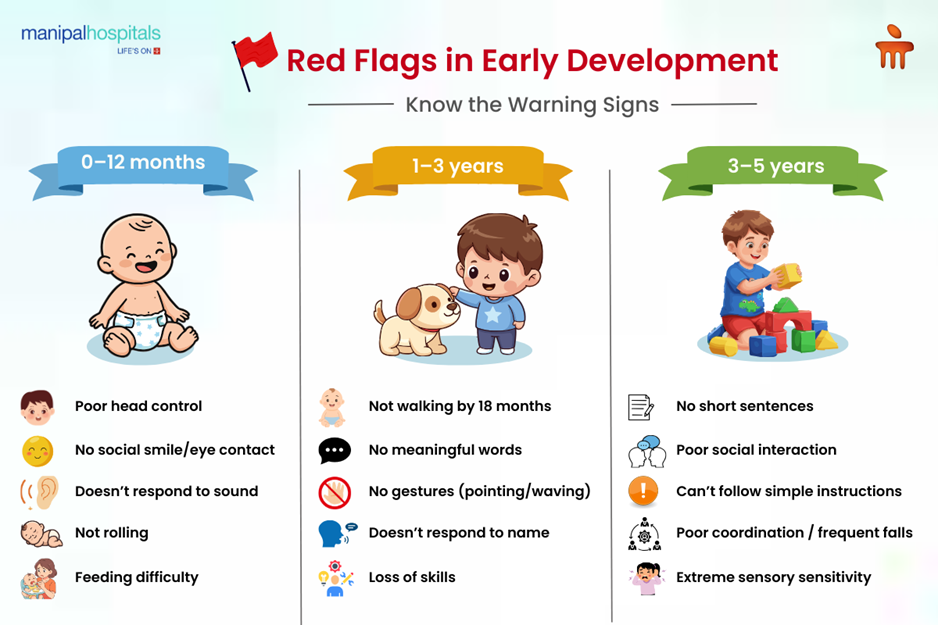
Red Flags in Early Development During Infancy (0–12 Months)
In the first year, development is centred on fundamental motor skills, sensory reactions, and early social interactions. Red flags in early development during this stage are usually subtle but significant.
If such symptoms occur, a medical evaluation is recommended:
-
Poor head control by 4 months
-
Not rolling over by 6 months
-
Stiff or floppy muscle tone
-
Limited eye contact or lack of social smile by 3 months
-
No response to loud sounds or visual stimuli
-
Difficulty feeding or swallowing
Any delay in these areas may indicate motor development delay or sensory processing problems that can be helped by early intervention.
Red Flags in Early Development in Toddlers (1–3 Years)
Toddlers exhibit tremendous growth in communication, motor, and social development. It is also during this stage that many children experience early developmental delays.
Warning signs include:
-
Not walking independently by 18 months
-
Few words or no meaningful words by 2 years
-
Loss of previously acquired skills
-
Difficulty using hands for simple tasks
-
Lack of interest in interactive games such as peek-a-boo
-
Limited response to name
Speech delay in children is one of the most common concerns at this stage. While some children talk later than others, the absence of gestures, sounds, or understanding words should be evaluated.
Red Flags in Early Development During Preschool Years (3–5 Years)
Preschool years focus on communication, social play, and independence. Red flags in early development at this stage often affect readiness for learning.
Look out for:
-
Inability to form short sentences by 3 years
-
Poor eye contact or minimal social interaction
-
Difficulty following simple instructions
-
Frequent falls or poor coordination
-
Extreme sensitivity to sounds, textures, or routines
Note: These signs may be red flags for social development. Speech and communication are key indicators of cognitive development.
When Delays May Indicate a Serious Concern
One delayed milestone alone may not be alarming. However, multiple delays or regressions, in which skills are lost, are more concerning.
You should seek medical advice when:
-
Developmental delays persist despite stimulation
-
Skills are lost at any age
-
Delays affect daily functioning or learning
-
There is a family history of developmental disorders
Understanding when to worry about child development helps prevent long-term difficulties.
How Doctors Evaluate Developmental Concerns
A developmental evaluation usually begins with a detailed history and observation. Doctors assess milestones, interaction, muscle tone, hearing, vision, and behaviour. Screening tools may be used to identify delays early.
If needed, referrals may be made for:
-
Speech and language therapy
-
Occupational therapy
-
Physiotherapy
-
Developmental paediatrics or neurology
Early diagnosis enables early intervention and positive developmental outcomes.
Why Early Intervention Matters
The developing brain is remarkably adaptable, a property known as neuroplasticity. During early childhood, neural pathways are rapidly forming and reorganizing.
Early intervention works because it:
-
Strengthens emerging brain networks
-
Prevents secondary behavioral and learning difficulties
-
Supports communication and social engagement
-
Improves motor coordination and independence
-
Reduces long-term disability in many conditions
Intervention does not require a final diagnosis. Therapy can begin based solely on developmental needs.
Encouraging Healthy Development at Home
Whereas medical assessment is necessary, regular activities also influence development. Everyday interactions can facilitate development:
-
Talk, read, and sing frequently
-
Encourage play that involves movement and problem-solving
-
Limit passive screen time
-
Maintain consistent routines
-
Use positive reinforcement and patience
These steps help reduce concerns about child development and promote overall growth.
Discover the early warning signs of developmental delays. Click here to learn more and take the first step toward timely support.
Conclusion
Recognising red flags in early development empowers you to act early and support your child’s growth. Early evaluation and timely therapy can significantly improve long-term outcomes and learning ability. Schedule a developmental assessment with an experienced Paediatric Neurologist or visit the department of Paediatric Neurology at Manipal Hospitals, Yeshwanthpur, Bangalore, for early clarity and expert guidance.
FAQ's
Some variation is normal, but missing multiple milestones or losing skills is concerning. If progress seems consistently behind peers, a medical review helps clarify the cause.
Not always. While some children may speak later, early speech therapy can be beneficial if it affects understanding or communication.
Yes. Early intervention improves brain adaptability and helps children gain skills faster and more effectively.
No. Earlier assessment leads to better outcomes. Waiting may allow delays to widen.
Share this article on: