7 Min Read
Have you noticed your child avoiding eye contact, not responding to their name, or fixating on toys in unusual ways? These behaviours warrant a closer look and possibly a doctor's check-up to rule out autism spectrum disorder (ASD). In India, autism spectrum disorder (ASD) affects approximately 1 in 68 to 100 children. This equates to about 1-1.5% prevalence with an estimated 18 million individuals nationwide, though underdiagnosis persists due to limited awareness.
Through this blog, a top paediatric neurologist in Yeshwanthpur explains clearly when to suspect autism in a child, what early signs to watch for at different ages, and the practical steps you can take next.
Synopsis
What is Autism?
Autism spectrum disorder (ASD) affects how a child communicates, interacts, and behaves. It’s called a “spectrum” because the type and intensity of differences vary widely between children. Diagnosis is based on patterns of social communication differences, plus restricted or repetitive behaviours. Clinical criteria are laid out in the DSM-5. Professionals use these criteria together with observations and developmental history to decide whether a child meets the threshold for an autism diagnosis.
Key Screening and Check-Up Ages You Should Know
Routine checks are set up so any early concerns don’t get missed. Health bodies recommend specific screening moments:
-
Paediatric guidelines advise autism-specific screening at 18 months and again at 24 months, alongside ongoing developmental surveillance. If a screening flags concern at any age, referral for diagnostic assessment and early intervention should be arranged without delay.
-
In India and many other places, routine developmental checks look for communication and social milestones across infancy and toddlerhood.
Remember: screening tools are quick checks; they don’t give a full diagnosis, but they do show when further assessment is needed.
Age-Based Red Flags: What to Watch For
Start with this simple approach: note the behaviours that are different from typical developmental expectations.
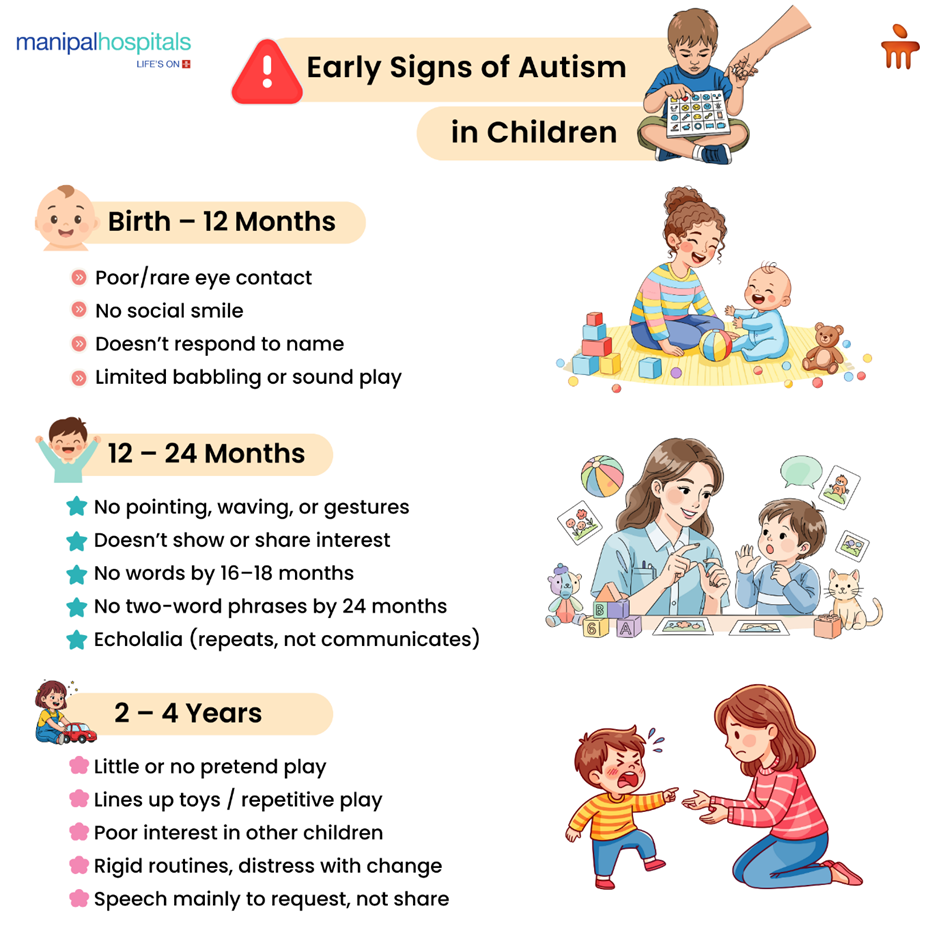
Birth to 12 months
During the first year, you expect a baby to make eye contact, smile responsively, babble, and react when their name is called. If these social responses are missing or reduced, it can be an early sign to watch.
-
Little or no eye contact.
-
Rarely smiles at you or doesn't respond to your smile.
-
Doesn’t respond to their name by about 9–12 months.
-
Limited babbling or back-and-forth sounds.
12 to 24 months
This is a time when language usually begins to take off, and social play becomes more obvious. If your toddler isn’t using gestures, pointing, or two-word combinations, you should seek advice.
-
Uses few or no gestures, such as waving or pointing.
-
Doesn’t show interest in sharing things with you (for example, bringing toys to show).
-
Limited or no words by 16–18 months; not combining words by 24 months.
-
Repeats phrases from TV or others without using them to communicate (echolalia).
2 to 4 years
Play becomes imaginative, and conversation skills grow. If you see ongoing difficulties with back-and-forth interaction, unusually repetitive play, or sensory reactions that interfere with daily life, make an appointment.
-
Struggles with pretend play or plays in a repetitive way (lining up toys, repeating the same motion).
-
Finds change distressing; strong, narrow interests.
-
Little interest in other children or difficulty joining in group play.
-
Speech might be delayed, unclear, or used mainly for requesting rather than sharing.
How to Tell a Late Talker from Possible Autism
Some children develop speech later but do not have autism. The difference often lies in social communication.
-
A late talker usually still uses eye contact and gestures and engages in social play even with limited words.
-
If your child has both a speech delay and reduced social communication (less eye contact, limited gestures, little interest in shared activities), this combination is a stronger reason to suspect autism and request assessment.
The AAP recommends referral for a diagnostic evaluation if screening or clinical concerns show increased risk, rather than waiting.
Practical Steps if You Suspect Autism
If you are asking when to suspect autism in a child, you likely want to know what to do next. Here’s a simple, ordered plan:
-
Make notes of what you see, when it started, examples, and how often it happens. Concrete observations make appointments more useful.
-
Speak to the doctor at your next appointment and mention specific behaviours and ages. If you are concerned about speech or social interaction, say so directly.
-
Ask for developmental screening (or a referral): many clinics use standard tools and can refer you to a specialist multi-disciplinary team for a formal assessment if needed. This helps map your child’s pattern of social communication and repetitive behaviours against diagnostic criteria (DSM-5 or, in India, ICD-11) and functional needs.
-
Access early intervention while diagnostic processes happen; therapies that support communication and behaviour do not need to wait for a final diagnosis.
Supporting Your Child While You Wait
Waiting for assessments or services can feel stressful, but there are practical ways to support your child now:
-
Keep routines predictable and break tasks into small steps.
-
Use simple, clear language and visual supports (pictures, first-then boards).
-
Build moments of shared attention, follow their interest, and label what they do.
-
Seek local parent groups and reliable information sources for practical tips and emotional support.
These are not treatments for autism, but they help communication and reduce day-to-day stress while you progress through assessment and services.
Conclusion
If you notice any patterns of social communication differences combined with repetitive or restricted behaviours in your child and are concerned if these are autistic traits, or if you can identify any clear red flag signs described here, it is recommended to consult an expert for further evaluation.
Consult our experienced paediatric neurologists at Manipal Hospital Yeshwanthpur, Bangalore, for a detailed assessment and early support plan.
FAQ's
Pointing and waving are early social gestures that show your child is sharing attention. If your toddler consistently avoids gestures by about 12–15 months or also has limited eye contact and few words, it’s reasonable to speak to your GP about developmental screening. Those combined signs are stronger reasons to seek assessment than any one behaviour on its own.
Many children receive a diagnosis in the preschool years because social communication differences are clearer then. Clinicians can diagnose autism reliably in some children by 2 years of age, but other children with subtler features may not be recognised until school age. Assessment teams use developmental history and standardised observations to reach a diagnosis.
Not necessarily. A child can be a late talker without autism. The difference often lies in social communication: late talkers typically still use eye contact, gestures, and social play. If speech delay exists alongside reduced social interaction, screening for autism is appropriate.
Bring simple, specific examples: the exact behaviours, when you first noticed them, how often they happen, and how they affect daily life. Notes, short video clips of typical behaviour, and any speech or school reports can be very helpful. Asking for formal developmental screening or a referral is a reasonable request.
Yes. If screening or clinical opinion shows developmental delays, early intervention should start rather than waiting for a diagnostic label. Therapy that supports communication, behaviour, and learning can reduce later difficulties and improve everyday functioning.
Share this article on: