6 Min Read
As a parent, witnessing your child experience sudden, involuntary muscle jerks can be a deeply alarming experience. These brief, shock-like movements might occur in a single muscle or group of muscles, often leading to immediate concern and questions about your child's health. While some jerks, like hypnic jerks during sleep, are normal, others can indicate an underlying neurological condition known as myoclonic seizures. Understanding these movements, their causes, symptoms, and available treatments is crucial for ensuring your child receives the best possible care.
Synopsis
What are Myoclonic Seizures?
Myoclonic seizures are characterised by sudden, brief, involuntary muscle jerks or spasms. These movements are often described as shock-like and can affect a single limb, a group of muscles, or even the entire body. Unlike other types of seizures, myoclonic seizures typically don't involve a loss of consciousness, though the child might be momentarily disoriented.
While often benign, especially in infancy, myoclonic seizures are a form of epilepsy. They are relatively common in children, affecting approximately 1-2% of all children diagnosed with epilepsy. These seizures result from abnormal electrical activity in the brain, causing muscles to contract rapidly. Recognising these movements is the first step towards understanding and managing your child's condition.
What Causes Myoclonic Seizures in Children?
The precise origin of myoclonic seizure causes can vary widely among children. These seizures arise from sudden, brief bursts of abnormal electrical activity in specific areas of the brain, particularly those controlling muscle movement. While some cases are idiopathic (meaning no identifiable cause), several factors are known to contribute:
-
Genetic Predisposition: In many instances, there's a genetic component, where a child inherits a predisposition to developing epilepsy. Specific gene mutations can disrupt brain cell function, leading to seizures.
-
Metabolic Disorders: Certain metabolic conditions can interfere with the brain's normal chemical balance, making it more susceptible to abnormal electrical activity.
-
Structural Brain Abnormalities: Though less common for isolated myoclonic seizures, conditions like brain malformations or injuries sustained before, during, or after birth can sometimes be underlying factors.
-
Infections: Past brain infections or inflammatory conditions can leave residual effects that increase seizure risk.
-
Syndromic Epilepsy: Myoclonic seizures are often a prominent feature of various epilepsy syndromes, such as Juvenile Myoclonic Epilepsy (JME) or Myoclonic Epilepsy of Infancy, which may also present with other seizure types.
Recognising the Signs: Myoclonic Seizure Symptoms
Observing the symptoms of myoclonic seizures can be subtle or quite pronounced, depending on the child and the severity of the seizure. Parents often describe these as sudden "jumps" or "jolts." It is important to differentiate these from typical startle reflexes or benign sleep myoclonus.
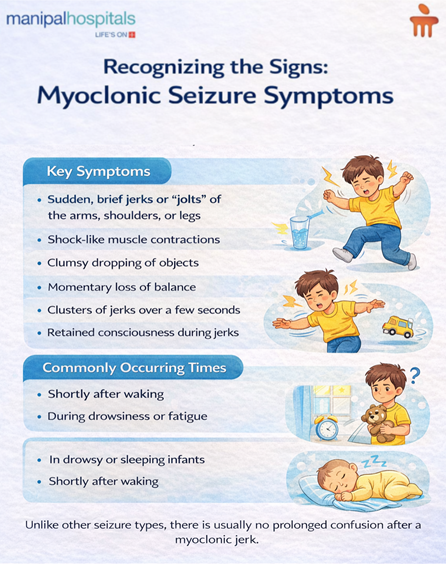
Key myoclonic seizure symptoms include sudden, brief jerks that include involuntary, shock-like contractions of muscles. These can be singular or occur in clusters over a few seconds. Jerks commonly affect the arms, shoulders, and sometimes the legs, causing the child to drop objects or briefly lose balance. In some cases, the entire body might jerk. The child usually remains conscious and aware during the jerk, although they might appear startled or momentarily confused. Jerks often occur shortly after waking up in the morning, during periods of drowsiness, or when the child is fatigued. In infants, these can manifest as head nods, shoulder shrugs, or brief arm/leg jerks. Parents might notice their baby's body suddenly stiffening or flopping, sometimes mistaken for colic or startle reflex. Unlike other seizure types, there is typically no prolonged period of confusion or drowsiness after a myoclonic jerk.
When to Seek Medical Attention
If you observe any of these sudden muscle jerks in your child, particularly if they are recurrent or seem out of the ordinary, it is essential to consult a paediatrician or a pediatric neurologist. Early diagnosis and intervention are vital for managing myoclonic seizures effectively and improving long-term outcomes.
Diagnosing Myoclonic Seizures
Diagnosing myoclonic seizures typically involves a comprehensive evaluation by a pediatric neurologist in Salem. This process includes evaluating the patient’s detailed medical history. To assess the child's overall health and neurological function, a physical and neurological examination is performed. This is the most crucial diagnostic test is the Electroencephalogram (EEG). An EEG records the brain's electrical activity and can detect the characteristic abnormal spike-and-wave patterns associated with myoclonic seizures. In some cases, MRI or CT scans may be performed to rule out any structural brain abnormalities or underlying conditions that could be contributing to the seizures. To check for metabolic disorders or other underlying health issues, blood tests are carried out.
Effective Myoclonic Seizures Treatment Options
The goal of myoclonic seizures treatment is to control or eliminate the seizures, improve the child's quality of life, and minimise any potential side effects. With appropriate diagnosis and treatment, over 70-80% of children with myoclonic seizures can achieve excellent seizure control, significantly improving their quality of life.
Treatment approaches may include:
-
Anti-Seizure Medications: The primary treatment involves specific medications that help stabilise brain activity and reduce the frequency and severity of seizures. The choice of medication depends on the child's age, specific seizure type, and overall health.
-
Lifestyle Modifications: Ensuring adequate sleep, managing stress, and avoiding triggers (if identified) can play a supportive role in seizure management.
-
Dietary Therapies: In certain cases, especially when medications are not fully effective or tolerated, special diets like the ketogenic diet may be recommended and supervised by a medical team.
-
Regular Follow-ups: Ongoing monitoring with the neurologist is essential to adjust medication dosages, track progress, and address any concerns. Regular EEG monitoring might also be part of the follow-up plan.
-
Support and Education: Providing support and education to parents and caregivers is crucial, empowering them to understand the condition and provide optimal care.
Conclusion
It's encouraging to note that many children, especially those with benign forms of myoclonic epilepsy of infancy, can outgrow the condition. With proper management, over 90% of children with benign myoclonic epilepsy of infancy outgrow the condition by 2-5 years of age with minimal long-term impact.
Concerned about sudden muscle jerks or seizures in your child? Early diagnosis can make a significant difference. Consult expert pediatric neurologists at Manipal Hospitals, Salem, for accurate evaluation and advanced care. Book your appointment today for trusted, compassionate treatment.
FAQ's
Myoclonic seizures are generally brief and not life-threatening on their own. However, if they lead to falls or cause a child to drop something, there's a risk of injury. The primary concern is their underlying cause and potential impact on development if left untreated.
Yes, many children, especially those diagnosed with benign myoclonic epilepsy at infancy, do outgrow myoclonic seizures by early childhood, often by 2-5 years of age, with appropriate treatment and management.
A startle reflex is a natural reaction to sudden noise or movement, typically brief and symmetrical. Myoclonic seizures are involuntary muscle jerks that occur spontaneously, can be asymmetrical, and are recurrent, often indicative of abnormal brain activity rather than a normal reflex.
While not a primary treatment for all, certain dietary therapies like the ketogenic diet can be effective for some children with epilepsy, including those with myoclonic seizures, especially when medications are not fully successful. This should always be supervised by a medical team.
The prognosis is generally good, especially with early diagnosis and consistent treatment. Many children achieve excellent seizure control, and a significant number may even outgrow the condition, leading to a normal quality of life.
Share this article on: