7 Min Read
While the term "urinary bladder wall thickening" might sound alarming, it's often a symptom of an underlying issue that can be effectively managed with proper diagnosis and treatment. This comprehensive guide is designed to help you understand what bladder wall thickening means for your health, its potential causes, symptoms, and the advanced treatment options available.
Synopsis
What is Bladder Wall Thickening?
The bladder is a muscular sac responsible for storing urine. Its wall is typically smooth and flexible, allowing it to expand and contract. Bladder wall thickening refers to an increase in the thickness of this muscular wall. This thickening is usually detected during imaging tests like an ultrasound, CT scan, or MRI, often performed for other reasons or to investigate urinary symptoms.
In many instances, what is observed might be a mild urinary bladder wall thickening. This subtle change can be a response to various factors, from temporary inflammation to more chronic conditions. It's a sign that the bladder is working harder or reacting to an irritation. Understanding the context of this finding is crucial. Recent data indicates that approximately 30% of all bladder imaging scans reveal some degree of wall thickening, highlighting its relatively common occurrence.
Understanding the Causes of Bladder Wall Thickening
The thickening of the bladder wall is not a disease in itself but rather a sign that the bladder is under stress or experiencing an abnormal condition, making identifying the root cause critical for effective treatment. Frequent causes of bladder wall thickening include recurrent or severe Urinary Tract Infections (UTIs), where inflammation of the bladder wall typically resolves post-treatment.
Bladder Outlet Obstruction (BOO) also commonly leads to thickening as the bladder muscle works harder against impeded urine flow; common BOO causes are Benign Prostatic Hyperplasia (BPH) in men (over 70% of men above 60 years with BPH show some bladder wall thickening due to an enlarged prostate pressing on the urethra), urethral stricture (narrowing of the urethra), and bladder stones that can obstruct the bladder neck.
Non-infectious inflammatory conditions such as interstitial cystitis (painful bladder syndrome) or radiation cystitis (due to previous radiation therapy) can cause chronic inflammation and subsequent thickening. Neurological conditions (e.g., stroke, spinal cord injury, and multiple sclerosis) can disrupt nerve signals to the bladder, leading to improper function and muscle thickening, known as neurogenic bladder. Less commonly, abnormal bladder growths or tumours within the bladder can cause localized or generalized thickening, requiring thorough evaluation. Lastly, chronic overdistension from consistently holding urine for prolonged periods can strain and thicken bladder walls over time. Our diagnostic teams are adept at pinpointing the precise cause, with a diagnostic accuracy rate exceeding 95% in complex cases, ensuring you receive the most appropriate care.
Recognizing Bladder Wall Thickening Symptoms
The bladder wall thickening symptoms you experience are typically related to the underlying cause rather than the thickening itself. However, they are crucial indicators that warrant medical attention.
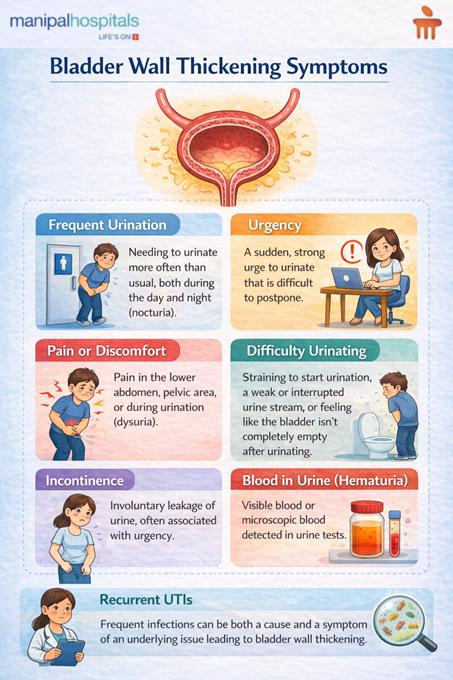
These symptoms can vary widely in severity and presentation:
-
Frequent Urination: Needing to urinate more often than usual, both during the day and night (nocturia).
-
Urgency: A sudden, strong urge to urinate that is difficult to postpone.
-
Pain or Discomfort: Pain in the lower abdomen, pelvic area, or during urination (dysuria).
-
Difficulty Urinating: Straining to start urination, a weak or interrupted urine stream, or feeling like the bladder isn't completely empty after urinating.
-
Incontinence: Involuntary leakage of urine, often associated with urgency.
-
Blood in Urine (Hematuria): Visible blood or microscopic blood detected in urine tests.
-
Recurrent UTIs: Frequent infections can be both a cause and a symptom of an underlying issue leading to bladder wall thickening.
If you are experiencing any of these symptoms, especially if they are persistent or worsening, it's vital to seek medical evaluation. Early detection and intervention can significantly improve outcomes, with studies showing that patients who address symptoms promptly experience a 75–80% faster resolution of discomfort and a higher success rate in managing underlying conditions.
Diagnosing Bladder Wall Thickening
Diagnosing the cause of urinary bladder wall thickening involves a systematic approach, combining advanced imaging with thorough clinical evaluation. This process typically begins with a comprehensive medical history and physical examination, where your doctor will inquire about your symptoms and medical background.
Urine tests, including urinalysis and urine culture, are crucial for detecting infections, blood, or other abnormalities, while blood tests may assess kidney function or inflammation markers. Imaging studies are pivotal: an ultrasound often serves as the initial test, providing a clear view of bladder wall thickness and any obstructions. For more detailed visualisation of the bladder and surrounding organs and for assessing tumours or other structural issues, a CT scan or MRI may be used.
A cystoscopy involves inserting a thin, flexible tube with a camera into the urethra to directly visualize the bladder's interior, allowing for detailed inspection of the bladder lining and facilitating potential biopsies if needed. Finally, urodynamic studies measure bladder pressure and urine flow to assess overall bladder function and identify problems with urine storage or emptying.
Effective Treatment Approaches for Bladder Wall Thickening
The treatment for thickening of the bladder wall is entirely dependent on the underlying cause. For infections, appropriate antibiotics typically resolve the thickening once the infection is completely eradicated. For obstruction, such as Benign Prostatic Hyperplasia (BPH), treatment options range from medications like alpha-blockers or 5-alpha-reductase inhibitors that relax prostate muscles or shrink the prostate to improve urine flow.
We also offer advanced minimally invasive procedures, which for many patients with BPH causing obstruction, provide excellent outcomes by removing or ablating prostatic tissue. In some instances, surgical intervention may also be necessary to remove the obstruction or correct structural issues. For inflammation, anti-inflammatory drugs or specific medications for conditions like interstitial cystitis help reduce inflammation and pain, complemented by lifestyle modifications such as dietary changes and stress management.
Neurogenic bladder treatment may involve medications to control bladder spasms, catheterization, or specific therapies to improve bladder control and emptying. If tumours or growths are present, treatment, depending on their nature and stage, could include surgical removal, chemotherapy, or radiation therapy.
If you notice troubling symptoms, it is advisable to get yourself diagnosed by urology experts who will offer cutting-edge treatments, including options for bladder wall thickening treatment in Salem, ensuring widespread access to exceptional care.
FAQ's
Not necessarily. Mild bladder wall thickening can often be a temporary response to irritation or inflammation, like a minor infection. However, it always warrants medical evaluation to rule out underlying serious conditions and ensure appropriate management.
It is a relatively common finding in imaging studies, affecting a significant portion of the population, especially as they age. For example, it's often seen in men with benign prostatic hyperplasia (BPH) or individuals experiencing recurrent urinary tract infections.
In cases where the thickening is due to a temporary cause like an acute infection, it can resolve once the underlying issue is treated. However, if it's due to chronic conditions or obstructions, it typically requires specific medical intervention to improve.
Maintaining good hydration, avoiding bladder irritants (like caffeine and alcohol), practicing good hygiene, and not holding urine for too long can support bladder health and may help manage symptoms, especially when combined with medical treatment.
Yes, if the underlying cause of urinary bladder wall thickening is left untreated, it can lead to complications such as recurrent infections, kidney damage due to urine backup, worsening of bladder function, or progression of an underlying condition like a tumour. Early diagnosis and treatment are vital.
Share this article on:


.webp "Early Signs of Kidney Disease You Shouldn’t Ignore")