
TAVR
TAVR in Mysore at Manipal Hospital offers a less invasive option for patients with severe aortic stenosis who may not be suitable for open-heart surgery. The procedure replaces the diseased valve using a catheter placed in a blood vessel, without opening the chest. Designed especially for elderly and high-risk patients, TAVR helps relieve symptoms, improves daily function, and supports faster recovery under expert cardiac care.
How It Works
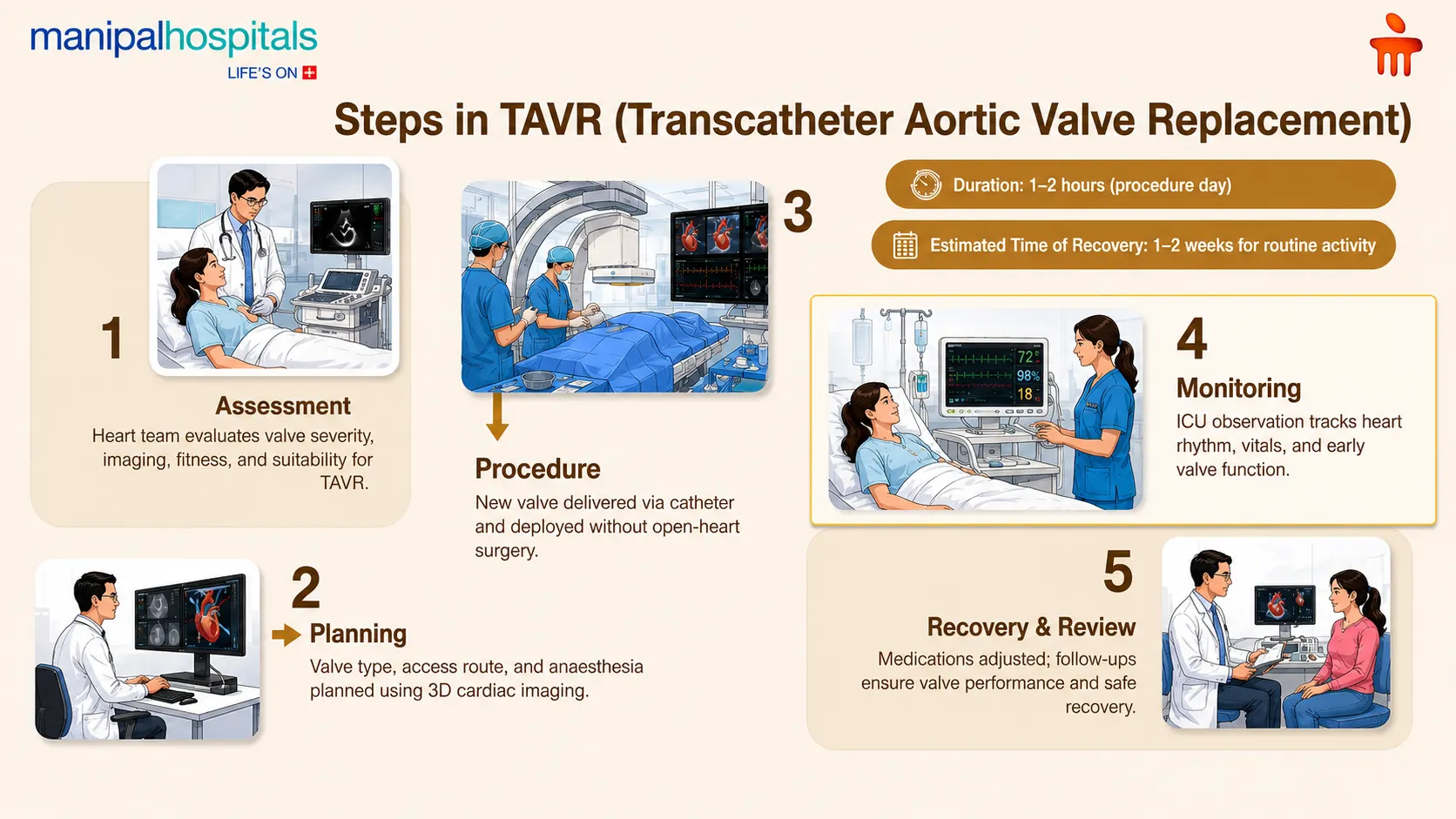
At Manipal Hospital Mysore, the TAVR journey begins with careful evaluation and planning. Detailed CT scans and echocardiography are used to measure the aortic valve accurately and assess blood vessels, ensuring the procedure is safe and tailored to the patient’s anatomy.
On the day of the procedure, TAVR is usually performed under general anaesthesia or conscious sedation. A small puncture is made in the femoral artery in the groin, allowing doctors to guide a catheter to the heart under live imaging. A temporary pacing wire may be used to control heart rhythm during key steps.
The new valve, compressed onto a catheter, is positioned inside the diseased valve and expanded. This pushes the old valve leaflets aside and allows the new valve to take over blood flow immediately. Doctors confirm correct placement and valve function using echocardiography before completing the procedure.
Patients are then shifted to a specialised cardiac recovery unit for close monitoring. The procedure itself typically takes around one to one and a half hours, with most patients resuming gentle activity within a day.
Didn’t find what you were looking for?
Request a CallbackBenefits
TAVR in Mysore offers meaningful relief for patients with severe aortic stenosis who need a safer alternative to surgery.
-
No chest incision or heart-lung machine required.
-
Shorter hospital stay and quicker recovery.
-
Rapid improvement in breathlessness and fatigue.
-
Well suited for elderly patients and those with medical complexity.
What to Expect
Consultation and Diagnosis
Your cardiology team reviews symptoms, scans, and overall health to confirm whether TAVR is the right option.
Pre-procedure Preparation
You receive simple instructions, medication guidance, and a clear explanation of the process so there are no surprises.
Procedure Day
The valve replacement is performed in a specialised hybrid cardiac suite using advanced imaging and monitoring throughout.
Immediate Monitoring
After the procedure, you are observed closely in the cardiac intensive care unit. Heart rhythm, blood pressure, and valve function are checked regularly.
Recovery and Discharge
Most patients begin walking within a day. Discharge usually happens within three to five days, depending on recovery progress.
Doctor Follow-up
Cardiologists review results, adjust medications if needed, and plan follow-up visits and echocardiograms to support long-term valve health.
Why Manipal Hospitals?
Manipal Hospital Mysore delivers TAVR through dedicated hybrid cardiac suites supported by experienced structural heart teams. Interventional cardiologists, cardiac surgeons, imaging specialists, and anaesthetists work together to plan each case in detail and manage every stage safely. Advanced imaging, intra-procedural echocardiography, and continuous haemodynamic monitoring help achieve reliable outcomes. Patients benefit from careful valve selection, precise placement, and structured follow-up care. With consistent clinical standards and outcomes aligned with global practices, Manipal Hospital Mysore offers a dependable local option for heart valve replacement in Mysore, especially for patients who need a less invasive approach.
-
Hybrid cardiac theatres with advanced imaging
-
Experienced multidisciplinary heart teams
-
Access to multiple valve technologies
-
Structured follow-up and rehabilitation support
Centre of Excellence
Manipal Hospital Mysore's Structural Heart Programme pioneers TAVR within comprehensive aortic stenosis management pathways, integrating advanced imaging, hybrid theatre capabilities, and multidisciplinary expertise for optimal transcatheter valve outcomes in high-risk patients.
Services Offered
Services include transfemoral and alternative access TAVR, valve-in-valve procedures, pre-TAVR CT planning, intra-procedural echocardiography, coronary intervention when required, and structured post-TAVR rehabilitation. TAVR in Mysore is delivered as part of a complete structural heart care programme.
Facilities & Services
Facilities include hybrid cardiac theatres, advanced fluoroscopy systems, intra-operative echocardiography, cardiac intensive care units, vascular closure devices, and dedicated recovery teams. These resources support every stage of the TAVR pathway at Manipal Hospital Mysore.
Frequently Asked Questions
Patients with severe, symptomatic aortic stenosis who are elderly, at increased surgical risk, or unsuitable for open-heart surgery may be considered after specialist evaluation.
Most TAVR procedures take between 60 and 90 minutes, although complex cases may take longer depending on additional treatments needed.
Hospital stay is usually three to five days. Patients spend the first day under close monitoring, followed by gradual mobilisation.
Most patients require antiplatelet medication for a period after the procedure. Your doctor will personalise this based on your condition.
Current bioprosthetic valves typically last 10 to 15 years. If needed in the future, valve-in-valve procedures are possible with newer technologies.
Consult our Experts



You’re on Our Indian Website
Visit the Global site for International patient services