
Peripheral Angioplasty and Stenting
Peripheral angioplasty in Mysore at Manipal Hospital Mysore treats lower limb arterial occlusions using balloon dilatation and stent deployment via endovascular access. Ideal for claudication, critical limb ischaemia, and restenosis prevention, it restores blood flow, minimising amputation risk. Performed under local anaesthesia through a femoral or pedal approach, angioplasty and stenting in Mysore offer rapid symptom relief and limb salvage through advanced cath lab facilities and vascular expertise.
How It Works
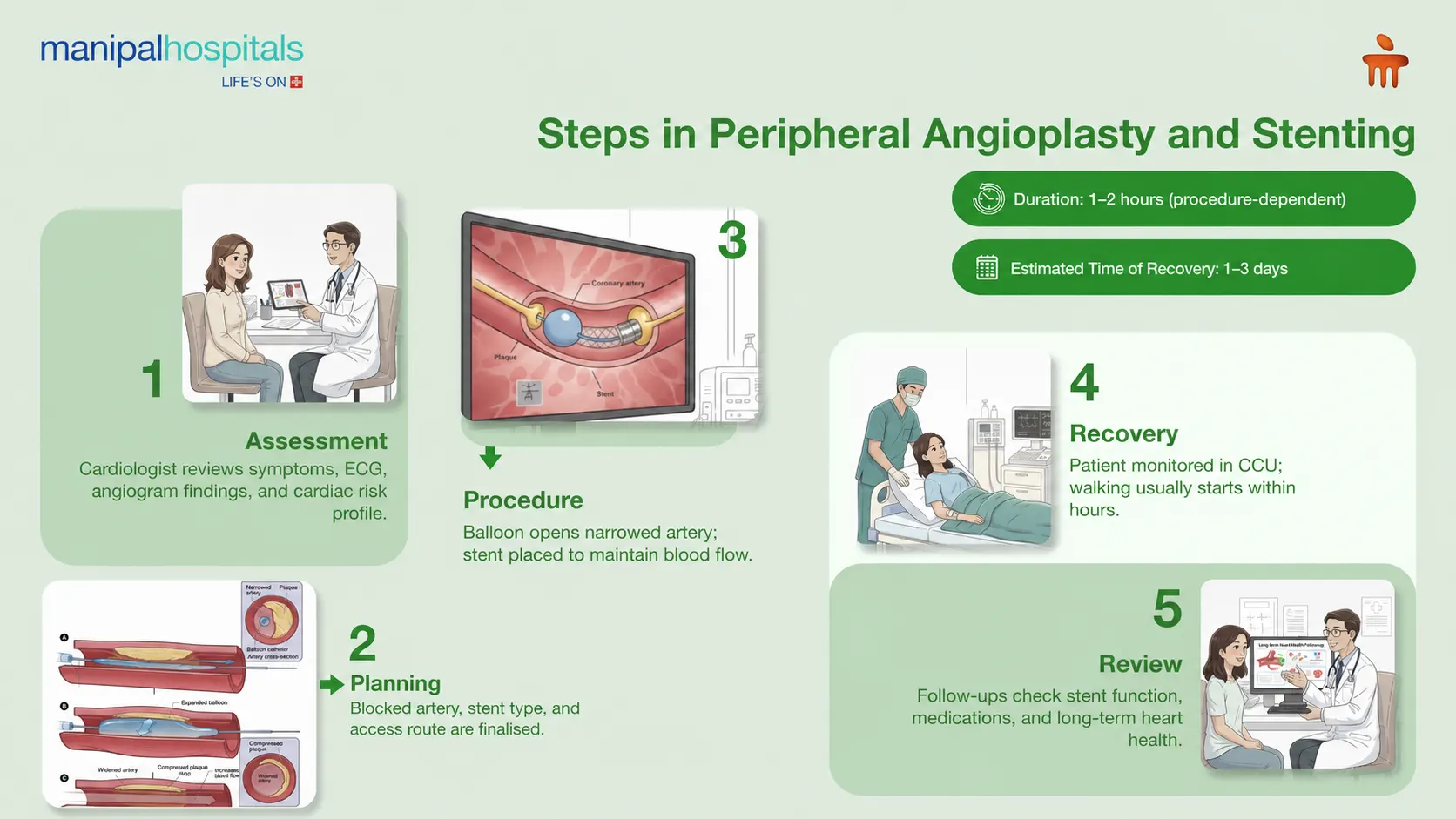
At Manipal Hospital Mysore, peripheral angioplasty in Mysore commences with femoral puncture under ultrasound guidance, accessing the contralateral common femoral artery. Hydrophilic guidewires navigate chronic total occlusions using support catheters, while digital subtraction angiography maps lesion length, calcification, and runoff. Balloon predilatation with compliant 4-8 mm diameters disrupts plaque, followed by self-expanding nitinol stents matching vessel anatomy. Drug-coated balloons deliver paclitaxel, reducing restenosis, while intravascular ultrasound confirms apposition and expansion.
Atherectomy devices debulk calcified lesions, enabling acute gain, while directional atherectomy extracts plaque selectively. Angioplasty and stenting in Mysore incorporate subintimal recanalisation for flush occlusions and the pedal-plantar loop technique for below-knee disease. Procedures last 60-120 minutes, with closure devices ensuring haemostasis. Post-procedure duplex confirms patency, while cilostazol and statins optimise long-term outcomes through multidisciplinary vascular care pathways.
Didn’t find what you were looking for?
Request a CallbackBenefits
Peripheral angioplasty in Mysore restores limb blood flow, preventing amputation through minimally invasive endovascular therapy.
-
Avoids major bypass surgery, preserving vein conduits.
-
Immediate claudication relief improves mobility rapidly.
-
Daycare procedure with early hospital discharge.
-
Limb salvage rates exceed 85% at one year.
What to Expect
Consultation and Planning
Your vascular or cardiology team reviews symptoms, walking limitations, wounds, and scan results. Imaging, such as CT angiography and Doppler studies, helps map the arteries and plan treatment.
Pre-procedure Preparation
You receive simple instructions regarding fasting and medications. Risk factors like diabetes, cholesterol, and smoking are addressed before the procedure.
During the Procedure
The angioplasty is performed under local anaesthesia with mild sedation. A small puncture allows doctors to reach the blocked artery. You may feel brief pressure or cramping when the balloon is inflated.
After the Procedure
The access site is sealed, and you rest under observation for a few hours. Most patients walk the same day.
Recovery and Follow-up
Discharge is usually within a day. Doctors explain medications, wound care, and follow-up visits to support long-term limb health.
Why Manipal Hospitals?
Manipal Hospital Mysore's Vascular Suite features biplane fluoroscopy, intravascular ultrasound, atherectomy platforms, drug-coated technologies, and pedal access capabilities, treating complex femoropopliteal, infrapopliteal, and aortoiliac disease comprehensively. Peripheral angioplasty in Mysore, supported by wound care specialists and a vascular laboratory, ensures complete limb revascularisation pathways. Multidisciplinary teams deliver durable patency rates through optimised pharmacotherapy, supervised exercise programmes, and surveillance protocols, establishing leadership in endovascular limb salvage.
-
Biplane imaging optimising complex lesion treatment.
-
Drug-coated balloons, atherectomy, IVUS optimisation.
-
Pedal access for critical limb ischaemia expertise.
-
Integrated wound care and surveillance programmes.
Centre of Excellence
The Peripheral Vascular Programme at Manipal Hospital Mysore combines cardiology, vascular medicine, and advanced imaging expertise under one coordinated service. The focus is on restoring blood flow to the limbs, reducing the risk of amputation, and supporting long-term mobility through careful planning, precise procedures, and structured follow-up care.
Services Offered
Services include femoropopliteal angioplasty, infrapopliteal artery revascularisation, aortoiliac stenting, carotid artery stenting, renal artery interventions, atherectomy procedures, and drug-coated balloon therapy. Peripheral angioplasty in Mysore is delivered through a comprehensive care pathway that addresses symptoms, improves circulation, and manages underlying vascular disease effectively.
Facilities & Services
Facilities include dedicated vascular intervention suites equipped with advanced imaging systems, atherectomy devices, drug-coated treatment platforms, intravascular ultrasound, and full vascular laboratory support. These resources allow angioplasty and stenting in Mysore to be performed with accuracy and safety, even in patients with complex or advanced limb artery disease.
Frequently Asked Questions
Peripheral angioplasty is advised for leg pain while walking, non-healing foot wounds, critical limb ischaemia, re-narrowing after bypass surgery, or sudden loss of blood flow to a limb.
Most procedures use femoral artery access. In selected cases, doctors may use antegrade, pedal, or upper limb access based on artery location and disease severity.
Not always. Some arteries respond well to balloon treatment alone. Stents are used if the artery recoils, tears, or needs added support to remain open.
Success rates are high, especially for larger leg arteries. Limb salvage outcomes are strong in critical cases, though smaller vessels may need close follow-up.
Stopping smoking, taking prescribed medicines, regular walking, foot care, and follow-up scans are essential to protect blood flow and prevent recurrence.
Consult our Experts



You’re on Our Indian Website
Visit the Global site for International patient services