8 Min Read
What happens when a twist on the field leaves the knee painful, swollen, and unreliable? Is it an ACL injury or a torn meniscus? In India, ACL tears strike around 1 in 1,000 active young adults annually, with meniscus injuries twice as common at 15–61 per 1,000, both surging among athletes due to soccer and cricket pivots yet demanding distinct paths from rehab to arthroscopy. Knowing the key differences matters because ACL injury symptoms and meniscus tear symptoms often overlap at first but lead to very different sports injury treatment paths. This blog walks through the typical signs of each problem, how clinicians confirm the diagnosis, when urgent care is needed, and practical next steps for recovery for ACL injury treatment in Millers Road, Bangalore.
Synopsis
- What are the ACL and the Meniscus?
- How Do ACL Tears and Meniscus Tears Happen?
- Key ACL Injury Symptoms
- Key Meniscus Tear Symptoms
- How is a diagnosis made?
- When is Urgent Care Needed?
- Initial Home Care: Do This Before Seeing a Doctor
- Treatment Options for ACL Injury
- Treatment Options for Meniscus Tear
- Rehabilitation and Return to Sport
- Prevention Strategies for Athletes
- Conclusion
What are the ACL and the meniscus?
To understand why these injuries cause different symptoms, it helps to know how the knee is built. The knee relies on strong ligaments for stability and specialised cartilage for cushioning and smooth movement. Two important structures involved in sports injuries are the ACL and the meniscus.
-
The anterior cruciate ligament (ACL) is a key stabiliser inside the knee that prevents the shin bone from sliding forward under the thigh bone and controls rotational stability. An anterior cruciate ligament tear is a major type of knee ligament injury because it directly affects joint stability.
-
The menisci are C-shaped cushions (medial and lateral) sitting between the femur and tibia. They absorb shock and improve joint fit; a torn meniscus damages cushioning and can cause mechanical symptoms like a locking knee.
Understanding the roles of these structures makes symptoms easier to interpret.
How Do ACL Tears and Meniscus Tears Happen?
The way an injury occurs often provides valuable clues about which structure inside the knee is damaged. Sports doctors frequently rely on the injury mechanism to differentiate between ligament tears and cartilage injuries. The following are the ways these injuries usually happen:
-
ACL tears commonly occur with a sudden pivot, cutting movement, or awkward landing, classic in football, basketball, or skiing. A direct blow in contact sports can also tear the ACL.
-
Meniscus tears can occur with twisting while the foot is planted, a deep squat, or with degeneration over time in older athletes. Meniscal injury sometimes accompanies ACL ruptures in high-energy injuries.
The activity context, a pivoting tackle vs a grinding twist, helps clinicians suspect ACL injury or a meniscal problem.
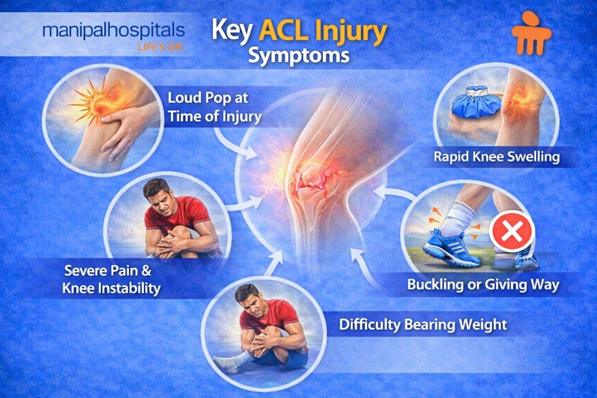
Key ACL Injury Symptoms
When considering ACL injury symptoms, look for a pattern:
-
Immediate loud pop or snap at injury time (a telling sign).
-
Rapid knee swelling after injury, usually within the first few hours, due to internal bleeding (haemarthrosis).
-
Intense pain at first, then a sense of knee instability or giving way, especially when trying to change direction.
-
Difficulty bearing weight and a feeling that the knee is “not trusted” on uneven ground.
-
Ongoing discomfort and, later, episodes of the knee buckling under load.
These ACL injury symptoms point to a serious knee ligament injury that often requires specialist assessment.
Key Meniscus Tear Symptoms
Meniscus tear symptoms tend to be distinct in other ways:
-
Joint line pain is a focal tenderness along the inner or outer edge of the knee.
-
A delayed swelling pattern; swelling may develop over 24–48 hours rather than immediately.
-
Mechanical symptoms such as locking knee, catching, or a sensation that the knee “sticks” when straightened.
-
Pain with twisting movements and difficulty squatting or kneeling.
-
In degenerative tears, chronic intermittent pain and stiffness are common.
While a meniscus tear can be painful, it usually causes less immediate instability than an ACL rupture. The nature of your symptoms helps specialists plan the right sports injury treatment.
How is a diagnosis made?
A clear diagnosis requires combining the patient’s history, physical examination, and imaging studies. Each step helps doctors confirm which structure inside the knee is injured. The following information is usually required:
-
The clinician observes gait, compares both knees, and performs tests, the Lachman test and pivot shift for ACL instability, and the McMurray or Thessaly tests for meniscal reproduction of pain or clicks.
-
MRI of the knee is the gold standard imaging for soft tissue: it visualises ACL disruption, meniscal tears, and associated cartilage or bone injuries.
-
X-rays are used to exclude fractures or check bone alignment.
A clear diagnosis guides whether conservative knee care or surgical options are most appropriate.
When is Urgent Care Needed?
Seek urgent evaluation if:
-
Severe immediate swelling and inability to bear weight.
-
Locking that prevents knee movement.
-
Suspected associated fractures or neurovascular compromise (numbness or poor blood flow).
-
A competitive athlete requiring an early decision on return-to-play.
Prompt assessment reduces long-term harm and clarifies whether ACL injury or meniscus damage needs early surgery.
Initial Home Care: Do This Before Seeing a Doctor
Initial steps reduce pain and protect the knee while arranging professional care:
-
Rest and avoid weight-bearing if the knee feels unstable.
-
Ice intermittently for 20 minutes to reduce swelling.
-
Compress with an elastic bandage and elevate the leg.
-
Use crutches if limping or instability prevents safe walking.
-
Over-the-counter analgesics (paracetamol or NSAIDs if appropriate) for pain control.
These measures are first-line sports injury treatment while awaiting imaging and specialist review.
Treatment Options for ACL Injury
Treatment for ACL injuries depends on activity level, severity of ligament damage, and personal goals such as returning to sports or maintaining daily mobility.
Conservative Management
-
Suitable for lower-demand patients or partial tears.
-
Emphasises bracing, activity modification, and a structured physiotherapy knee rehab programme focused on strength and proprioception.
-
Many can return to daily activities, but high-level pivoting sports often remain risky without reconstruction.
Surgical Management, ACL Reconstruction
-
Preferred for active athletes or those with recurrent knee instability.
-
The torn ligament is replaced with a graft (patellar tendon, hamstring, or allograft) using arthroscopic techniques.
-
Early surgery vs delayed reconstruction is decided case-by-case; timing may consider swelling resolution and recovery of range of motion.
Recovery
-
Post-op rehab is crucial; return to sport usually takes 6–12 months, depending on progress.
Treatment Options for Meniscus Tear
Choices depend on tear type and patient factors.
Conservative Management
-
Many small or degenerative tears improve with rest, physical therapy, and a gradual return to activity.
-
Targeted strengthening and mobility work address pain and function.
Surgical Management, Arthroscopic Repair or Meniscectomy
-
Meniscus repair is favoured when the tear is in the vascular zone and in younger patients, as it preserves tissue and reduces long-term osteoarthritis risk.
-
Partial meniscectomy trims torn fragments that cause locking or persistent pain; recovery is often quicker but may increase long-term joint wear.
The decision balances meniscus tear symptoms, the tear pattern on the MRI of the knee, and the patient’s activity goals.
Rehabilitation and Return to Sport
Rehab is the backbone of recovery for both injuries:
-
The early phase focuses on pain control, swelling reduction, and restoring the range of motion.
-
The strength phase rebuilds quadriceps, hamstrings, and hip stabilisers.
-
Neuromuscular training restores cutting, landing, and balance skills to reduce re-injury risk.
-
Return-to-sport decisions are criteria-based (strength symmetry, hop tests, sport-specific drills) rather than purely time-based.
A structured physiotherapy knee rehab plan dramatically improves outcomes and lowers reinjury risk.
Prevention Strategies for Athletes
Reducing risk is possible with training:
-
Neuromuscular training programmes that include the jump-landing technique reduce ACL injury risk.
-
Strengthening the hip and core improves knee alignment during play.
-
Proper footwear and adherence to sport-specific conditioning help lower overall sports injury treatment needs.
Prevention is a practical investment for anyone playing pivoting sports.
Conclusion
Clear symptom patterns, an audible pop, and rapid swelling pointing to ACL rupture versus joint-line pain and locking suggesting a meniscus tear help guide the right path from immediate care to imaging, rehab, and possible surgery. Early specialist assessment ensures the most effective sports injury treatment and a structured rehab plan for safe return to activity. For expert ACL and meniscal care, consult the orthopaedic and sports medicine teams at Manipal Hospital, Millers Road.
FAQ's
Not always. While rapid swelling often indicates ACL rupture, some tears present with delayed swelling or less dramatic bleeding; imaging and exams are the best way to be sure.
Small tears in the outer vascular zone can heal, especially in younger patients. Many degenerative tears improve with conservative care and strengthening.
Most athletes follow a 6–12 month rehabilitation (rehab) timeline with graduated testing; returning earlier increases the risk of reinjury.
Preserving meniscal tissue with repair reduces long-term arthritis risk. ACL reconstruction restores stability to the knee, but it does not completely eliminate the risk of developing future osteoarthritis, which is a degenerative joint disease, after a severe injury.
Describe the injury mechanics, any popping sound, timing of swelling, episodes of giving way, and sport or activity goals. This information helps tailor the recommendation for ACL injury treatment in Millers Road, Bangalore, or meniscal care.
Share this article on: