


 7 Min Read
Severe, sudden pain in the scrotum is never something to ignore. It can be worrisome, overwhelming, and deeply uncomfortable. In some cases, this sharp pain may signal testicular torsion, a true surgical emergency where time determines whether the testicle can be saved. The difficulty is that embarrassment, hesitation, or uncertainty often delays medical attention. Unfortunately, delays can lead to permanent damage within hours. Understanding what is happening inside the body, recognising early warning signs, and knowing what immediate care involves can make all the difference.
This blog explains what testicular torsion is, why it happens, what testicular torsion treatment involves, and what recovery and long-term health look like after urgent intervention.
Synopsis
- What Exactly Happens During Testicular Torsion?
- Why Does Testicular Torsion Occur?
- Recognising Testicular Torsion Symptoms Early
- Conditions That Can Mimic Testicular Torsion
- How Doctors Confirm the Diagnosis?
- What Does Testicular Torsion Treatment Involve?
- Recovery and Long-Term Outlook
- What Happens if Treatment is Delayed?
- Prevention and Awareness
- Conclusion
What Exactly Happens During Testicular Torsion?
The testicles are connected to the body by the spermatic cord, a structure that carries blood vessels, nerves, and the vas deferens. When torsion occurs, this cord twists upon itself. The twist blocks blood flow to the testicle.
Without oxygen-rich blood, tissue begins to suffer. The damage may become irreparable in as little as four to six hours. The longer the twist remains, the higher the risk of losing the testicle altogether. That is why testicular torsion is treated with urgency rather than watchful waiting.
Torsion most commonly affects adolescents between 12 and 18 years, but it can occur at any age - even in newborns.
Why Does Testicular Torsion Occur?
Understanding the underlying mechanism helps reduce confusion and guilt. In most cases, torsion is not caused by something a person did wrong.
The most recognised anatomical reason is a congenital variation called the “bell clapper deformity." In this condition, the testicle is not firmly attached inside the scrotum, allowing it to rotate more freely than normal.
Other recognised testicular torsion causes include:
-
Sudden growth during puberty
-
Minor trauma to the groin
-
Vigorous physical activity
-
Rapid temperature changes
-
A previous episode of intermittent torsion
-
Family history of torsion
In some cases, torsion occurs during sleep with no obvious trigger. It can quite literally begin in the middle of the night.
Recognising Testicular Torsion Symptoms Early
The pain of torsion is typically intense and abrupt. Many patients describe it as one of the worst pains they have ever felt.
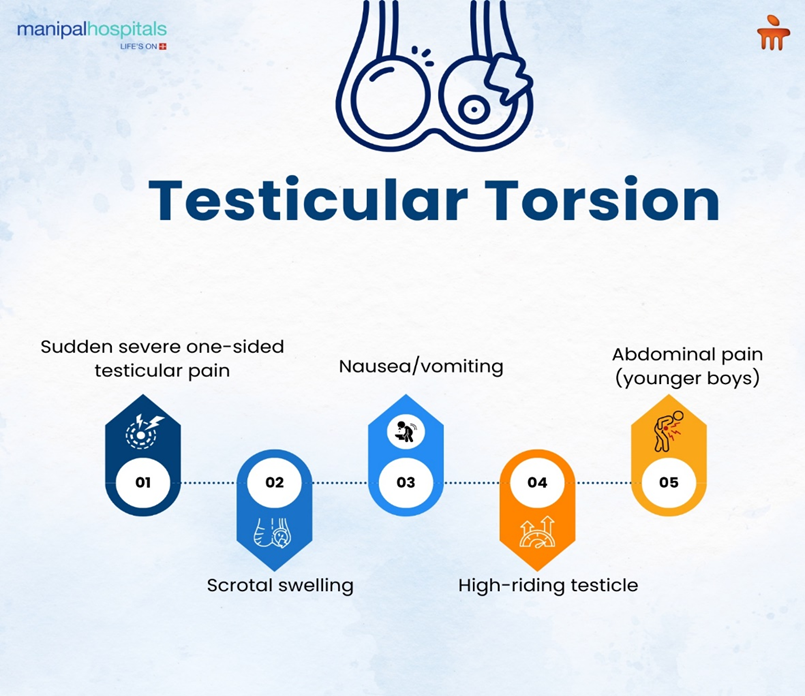
Common testicular torsion symptoms include:
-
Sudden, severe pain in one testicle
-
Swelling of the scrotum
-
Nausea or vomiting accompanying the pain
-
The affected testicle is sitting higher than usual
-
Redness or tenderness of the scrotal skin
-
Abdominal pain, especially in younger boys
Unlike infections, torsion does not usually develop gradually. The rapid onset is a key clue. If pain eases and then returns, this may represent intermittent torsion, a warning sign that full torsion could follow. Any sudden scrotal pain must be treated as torsion until proven otherwise.
Conditions That Can Mimic Testicular Torsion
Acute scrotal pain has several possible causes, and distinguishing them quickly is critical. The table below highlights important clinical differences that help doctors decide on urgency and management.
|
Condition |
Age Group |
Nature of Pain |
Associated Signs |
Urgency Level |
Key Diagnostic Clue |
|
Testicular torsion |
Adolescents |
Sudden, severe |
Nausea, high-riding testicle |
Immediate surgery |
Absent cremasteric reflex |
|
Epididymitis |
Young adults |
Gradual, worsening |
Fever, urinary symptoms |
Urgent but not a surgical emergency |
Relief with scrotal elevation |
|
Torsion of the testicular appendage |
Pre-teens |
Moderate, localised |
Small tender nodule |
Usually self-limiting |
“Blue dot” sign on scrotum |
|
Incarcerated inguinal hernia |
Infants & elderly |
Persistent pain |
Groin swelling |
Surgical emergency |
Irreducible groin mass |
|
Trauma-related injury |
All ages |
Post-impact |
Bruising |
Depends on severity |
Clear injury history |
This distinction is not something patients are expected to make themselves. The safest rule remains simple: sudden scrotal pain requires emergency evaluation.
How Doctors Confirm the Diagnosis?
Speed matters more than exhaustive testing. Clinical examination is often enough to raise a strong suspicion.
Doctors look for:
-
Position of the testicle
-
Swelling and tenderness
-
Presence or absence of the cremasteric reflex
-
Signs of infection
An urgent Doppler ultrasound may be performed to assess blood flow. Reduced or absent blood flow strongly supports the diagnosis. However, if clinical suspicion is high, surgery is not delayed for imaging. Time saved equals tissue saved.
What Does Testicular Torsion Treatment Involve?
The only definitive testicular torsion treatment is surgery. This procedure is called orchidopexy.
Under anaesthesia, the surgeon untwists the spermatic cord and assesses the viability of the testicle. If blood flow returns and the tissue appears healthy, the testicle is secured to the scrotal wall to prevent recurrence. The opposite testicle is also fixed during the same surgery, as anatomical risk often exists on both sides.
If the testicle has suffered irreversible damage, removal (orchidectomy) becomes necessary. While this sounds alarming, one healthy testicle is usually sufficient for normal hormone production and fertility.
Surgery is ideally performed within 6 hours of symptom onset for the highest salvage rates.
Recovery and Long-Term Outlook
Most patients recover well after prompt intervention. Mild discomfort and swelling may persist for a few days, but normal activity can typically resume within a few weeks.
Long-term considerations include:
-
Monitoring for testicular atrophy
-
Assessment of fertility if only one testicle was removed
-
Hormone levels in rare complicated cases
-
Psychological reassurance, especially in adolescents
When treated early, fertility and hormonal function are usually preserved. The key factor is timing, not the severity of initial pain.
What Happens if Treatment is Delayed?
Delays beyond 8–12 hours significantly increase the likelihood of testicular loss. Beyond 24 hours, salvage rates drop dramatically.
Untreated torsion can result in:
-
Permanent tissue death
-
Infection of necrotic tissue
-
Reduced fertility
-
Psychological distress
-
Rare autoimmune reactions affecting the opposite testicle
This is why emergency departments prioritise acute scrotal pain. Waiting at home to “see if it settles” can change outcomes permanently.
Prevention and Awareness
There is no guaranteed prevention strategy for spontaneous torsion, but awareness reduces the risk of delay. Parents should educate teenage boys about reporting groin pain immediately. Men should not dismiss sudden discomfort out of embarrassment. Even a brief episode of severe pain that resolves warrants medical assessment. So, if you or someone near you experiences sudden scrotal pain, it is ideal to seek emergency care without hesitation.
In cases where specialised care is needed, prompt access to expert urological services and urgent testicular torsion treatment ensures rapid surgical intervention and optimal outcomes.
Conclusion
Testicular torsion is a race against time. It is not rare, not trivial, and not something to wait out. Rapid recognition, immediate evaluation, and decisive surgical management are what preserve function and prevent loss.
If sudden scrotal pain occurs, treat it as urgent until proven otherwise. Quick action protects not only physical health but also long-term fertility and well-being.
At Manipal Hospital Malleshwaram, our experienced urologists offer emergency testicular torsion treatment in Malleshwaram, Bangalore, when minutes truly matter.
FAQ's
Yes. Intermittent torsion can occur when the testicle twists and then untwists spontaneously, causing temporary pain. Without surgical fixation, full torsion may recur at any time. Preventive orchidopexy eliminates this risk.
If one healthy testicle remains functional, testosterone production is usually normal. Hormonal imbalance is uncommon unless both testicles are affected or complications arise.
In rare cases, a trained clinician may attempt manual untwisting in an emergency setting. However, even if pain improves, surgery is still required to secure the testicles and prevent recurrence.
Yes, neonatal torsion can occur before or shortly after birth. It often presents as a firm, discoloured scrotum rather than severe pain, as newborns cannot express discomfort.
Routine fertility testing is not always necessary if one testicle remains healthy. However, semen analysis may be recommended later in life if concerns about fertility arise.
Share this article on:


