6 Min Read
Modern medicine has steadily moved towards treatments that are safer, gentler, and focused on faster recovery. One of the most significant advancements supporting this shift is endoscopic surgery. This minimally invasive approach has transformed how doctors diagnose and treat many medical conditions without the need for large incisions or prolonged hospital stays.
At Manipal Hospitals Pune, endoscopic surgery is performed using advanced technology and experienced clinical expertise, ensuring accurate diagnosis, effective treatment, and a smoother recovery journey for patients.
This guide explains what endoscopic surgery is, its key benefits, common types, recovery expectations, and answers a question many patients ask: Is endoscopy painful?
Synopsis
What Is Endoscopic Surgery?
Many patients wonder, what is endoscopic surgery, and how is it different from traditional surgery?
Endoscopic surgery is a minimally invasive procedure that allows doctors to view and treat internal organs using a thin, flexible instrument called an endoscope. This device contains a high-resolution camera and light source that transmits real-time images to a monitor, helping surgeons perform procedures with precision.
Depending on the condition, the endoscope is inserted:
-
Through natural body openings such as the mouth, nose, or rectum, or
-
Through small skin incisions, usually just a few millimetres wide
Specialised instruments passed through the endoscope enable surgeons to remove abnormal tissue, stop bleeding, take biopsies, or repair damaged areas without opening up large sections of the body. This approach significantly reduces trauma to surrounding tissues.
Is Endoscopy Painful?
One of the most common concerns patients have is: Is endoscopy painful?
The reassuring answer is no, endoscopy is generally not painful.
Most endoscopic procedures are performed under conscious sedation, which makes you relaxed and drowsy, or general anaesthesia for more complex surgeries. During the procedure, patients typically feel no pain and often have little to no memory of it.
After the procedure, mild and temporary discomfort may occur, such as:
-
Slight throat irritation after upper GI endoscopy
-
Temporary bloating or gas
-
Mild soreness at incision sites
These symptoms usually resolve within a few hours to a day. At Manipal Hospitals Kharadi, patient comfort and safety are prioritised at every stage, from preparation to recovery.
Benefits of Endoscopic Surgery
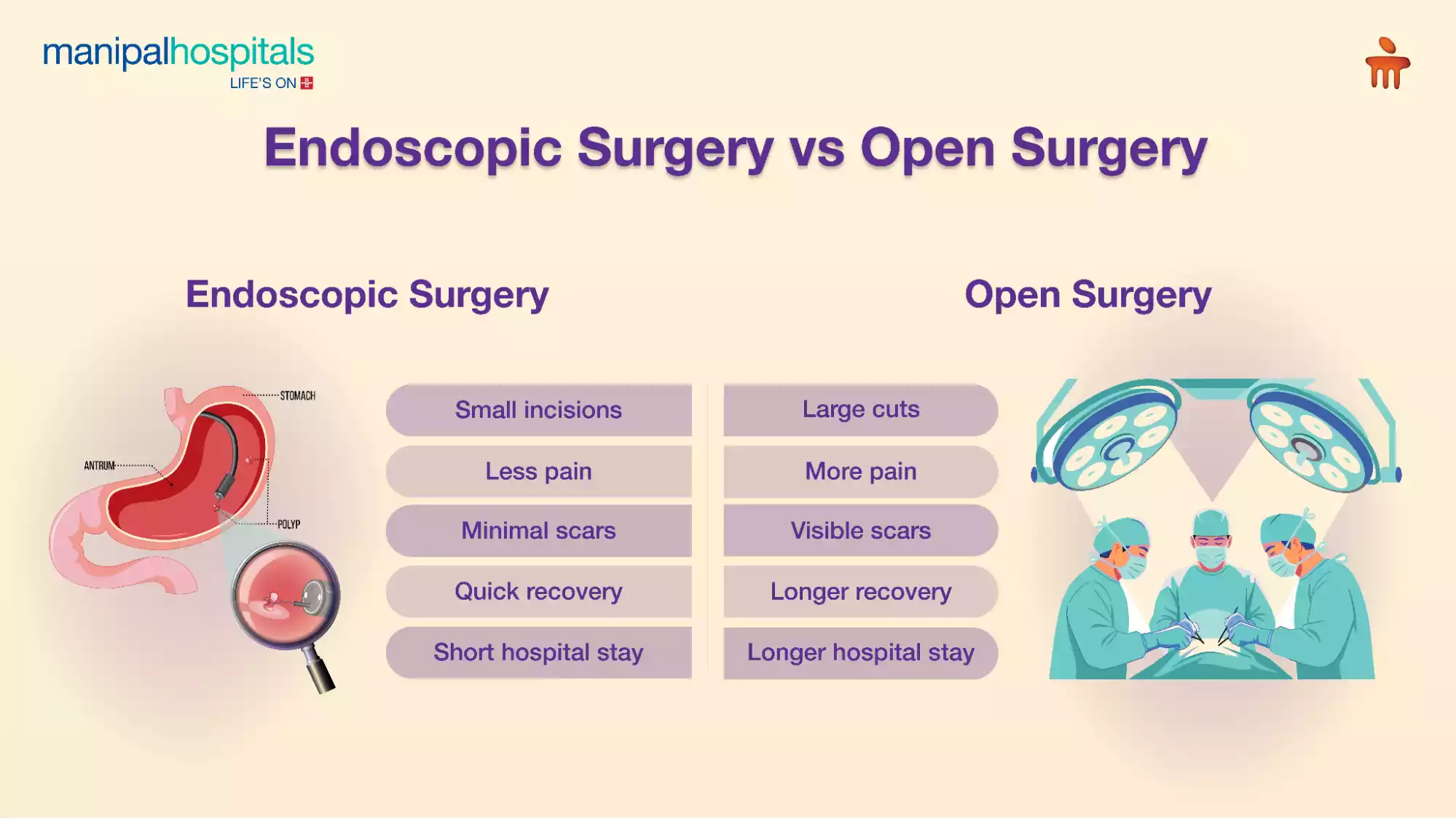
Choosing endoscopic surgery over traditional open surgery offers several important advantages:
-
Minimal Scarring
Since the procedure involves very small incisions or natural openings, visible scarring is minimal.
-
Less Pain and Faster Healing
Smaller incisions cause less tissue damage, resulting in reduced post-operative pain and quicker healing.
-
Lower Risk of Infection
With fewer and smaller wounds, the risk of infection and surgical complications is significantly reduced.
-
Reduced Blood Loss
Endoscopic surgery allows precise control, helping minimise blood loss during the procedure.
-
Shorter Hospital Stay
Many endoscopic procedures are performed as day-care surgeries, allowing patients to return home the same day.
-
Faster Recovery
Patients often resume daily activities within a few days. Studies show that recovery time can be reduced by up to 50% compared to open surgery.
Common Types of Endoscopic Procedures
Endoscopic surgery is used across multiple medical specialities. At Manipal Hospital Kharadi, specialists routinely perform the following procedures:
-
Gastrointestinal (GI) Endoscopy
GI endoscopy is widely used to diagnose and treat digestive system disorders with high accuracy.
Common procedures include:
-
Upper GI Endoscopy (EGD):
Used to examine the oesophagus, stomach, and upper small intestine. It helps diagnose acid reflux, ulcers, gastritis, infections, and celiac disease.
-
Colonoscopy:
Examines the large intestine and rectum. It is the gold standard for detecting colorectal cancer and allows removal of precancerous polyps during the same procedure.
Laparoscopic Surgery (Abdominal & Pelvic)
Laparoscopy involves inserting an endoscope through small abdominal incisions to operate on internal organs.
It is commonly used for:
-
Gallbladder removal
-
Hernia repair
-
Appendix removal
-
Gynaecological surgeries
Today, over 90% of gallbladder surgeries are performed laparoscopically due to excellent outcomes and faster recovery.
Arthroscopy (Joint Surgery)
Arthroscopy allows doctors to diagnose and treat joint problems using a small camera inserted into the joint.
It is commonly used for:
-
Ligament injuries (ACL tears)
-
Meniscus tears
-
Cartilage damage
-
Shoulder and rotator cuff injuries
Patient satisfaction rates for arthroscopic procedures consistently exceed 90%.
Bronchoscopy (Lung & Airway Examination)
Bronchoscopy enables doctors to examine the lungs and airways using a bronchoscope passed through the nose or mouth.
It is used to:
-
Diagnose lung infections and tumours
-
Identify airway blockages
-
Remove foreign objects
-
Collect biopsy samples
Recovery After Endoscopic Surgery
Recovery after endoscopic surgery is usually smooth and quick. After the procedure, patients are monitored until the effects of sedation wear off.
Most patients can:
-
Eat light meals within hours
-
Walk and move around on the same day
-
Resume normal activities within a few days
Your doctor at Manipal Hospital Pune will provide personalised after-care instructions based on the procedure performed.
Post-Procedure Care: Do’s and Don’ts
Do:
-
Arrange for someone to accompany you home
-
Rest for the remainder of the day
-
Follow dietary and medication instructions
-
Watch for unusual symptoms such as fever or severe pain
-
Attend follow-up appointments
Don’t:
-
Avoid heavy lifting or strenuous exercise until advised
-
Do not consume alcohol for 24 hours
-
Do not ignore persistent pain or bleeding
-
Avoid important decisions for 24 hours after sedation
Conclusion
Expert Endoscopic Care at Manipal Hospitals Kharadi
At Manipal Hospitals Kharadi, patients benefit from advanced endoscopic technology, skilled specialists, and a patient-first approach. From accurate diagnosis to faster recovery, every aspect of care is designed to deliver safe and effective outcomes.
If you have symptoms that require evaluation or have been advised to undergo endoscopic surgery, consult our expert today to explore the most suitable treatment options.
FAQ's
Endoscopic surgery is used to diagnose and treat conditions affecting the digestive system, joints, lungs, abdomen, and pelvic organs.
Endoscopy is not painful due to sedation. Mild discomfort afterwards is temporary.
It is considered very safe, with a low risk of complications when performed by experienced specialists.
Most diagnostic procedures take 15–60 minutes. Surgical procedures may take longer.
Many patients return to work within 1–2 days, depending on the procedure and job type.
Share this article on: