6 Min Read
Knee pain can slowly creep into your life—starting as mild discomfort and eventually making everyday activities difficult. Many patients keep wondering, How do you know if you need a knee replacement, yet delay seeing a specialist until the condition becomes severe.
This comprehensive guide breaks down the key signs, symptoms, and medical reasons for knee replacement, along with structured tables and pointers to help you evaluate your condition clearly. If you’re considering consultation, our Orthopaedics in Delhi-NCR are known for advanced diagnostics and precision joint-replacement expertise.
Synopsis
- Understanding the Basics: When Is a Knee Replacement Needed?
- Key Signs You Need a Knee Replacement (Quick Checklist)
- How Do You Know If You Need a Knee Replacement? Detailed Breakdown
- How Do You Know If You Need a Knee Replacement vs. Physiotherapy?
- Patient Experience Indicators
- How Our Orthopaedics in Delhi-NCR Help Diagnose Knee Replacement Need
- When Is a Knee Replacement Needed? (Definitive Indicators)
- Conclusion
Understanding the Basics: When Is a Knee Replacement Needed?
A knee replacement becomes necessary when the knee joint is damaged to the extent that pain, stiffness, and mobility limitations interfere with daily life.
Most commonly, the damage is due to:
-
Osteoarthritis (most common)
-
Rheumatoid arthritis
-
Post-traumatic arthritis
-
Knee deformity
-
Severe cartilage wear
If you're wondering when knee replacement needed or when is a knee replacement is needed, the answer lies in the symptoms you experience daily—many of which are listed below.
Our Orthopaedics in Delhi-NCR regularly assess these conditions using state-of-the-art imaging and gait analysis.
Key Signs You Need a Knee Replacement (Quick Checklist)
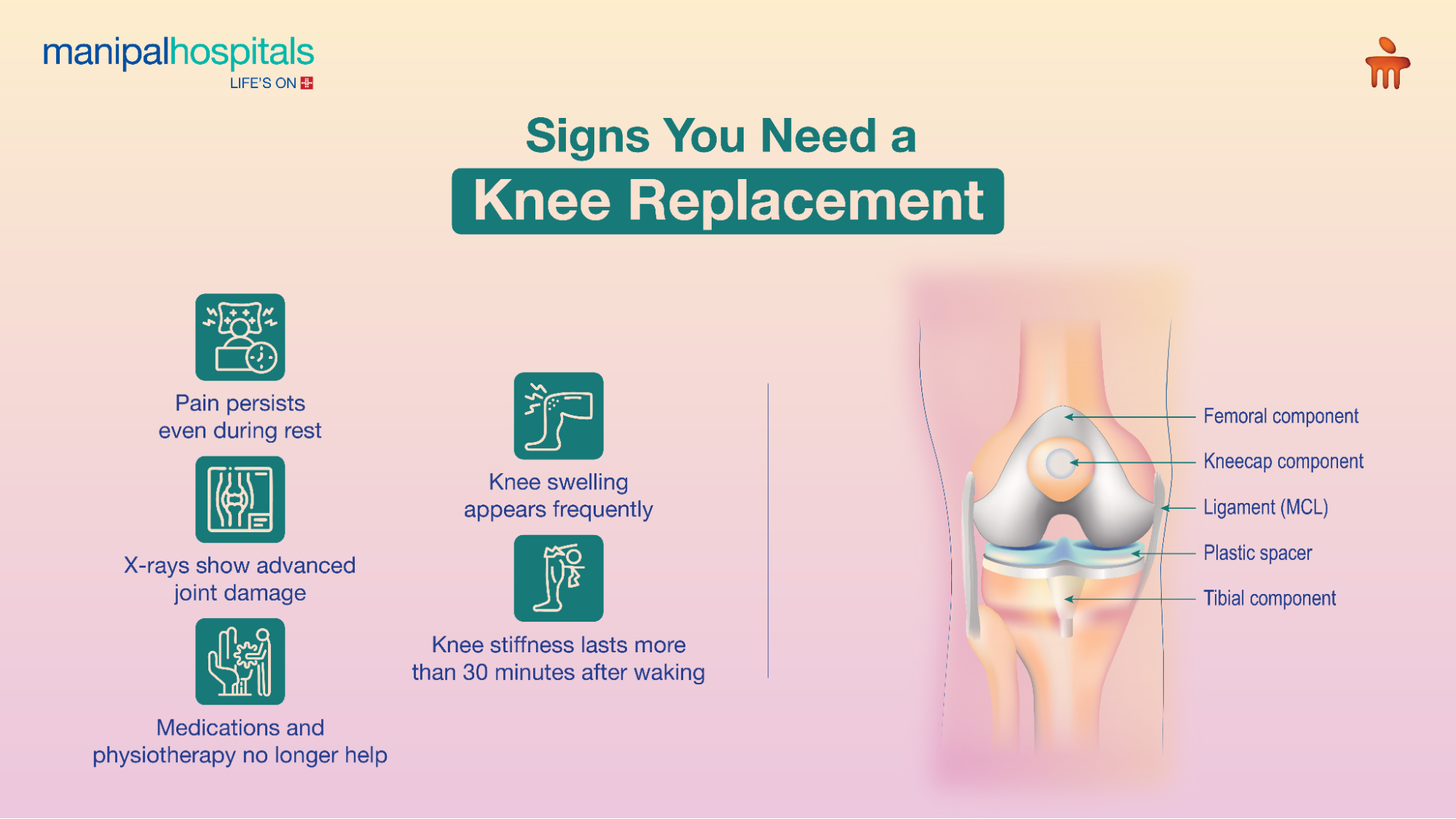
Use this quick list to assess whether it's time to consult a specialist. If you relate to several of these, it may be time to evaluate how to know if you need a knee replacement.
-
Pain persists even during rest
-
Walking, climbing stairs, or standing becomes difficult
-
Knee stiffness lasts more than 30 minutes after waking
-
Knee swelling appears frequently
-
Your knee feels unstable or gives out
-
Medications and physiotherapy no longer help
-
X-rays show advanced joint damage
-
Quality of life is decreasing
Our Orthopaedics in Delhi-NCR use a structured scoring system to help patients determine joint-replacement readiness.
How Do You Know If You Need a Knee Replacement? Detailed Breakdown
Here’s a detailed explanation of the most important indicators:
1. Persistent Pain: The #1 Indicator
One of the strongest signs you need a knee replacement is persistent and severe pain.
Symptoms of Needing Knee Replacement (Pain-Related)
-
Constant dull ache in the knee
-
Sharp pain when walking
-
Pain that interrupts sleep
-
Pain even while resting
If you frequently ask yourself, “How do I know if I need a knee replacement?”, chronic pain is usually your body’s earliest warning.
2. Severe Stiffness and Restricted Mobility
If bending, straightening, or rotating the knee is becoming difficult, it’s time to evaluate how to know when you need a knee replacement.
-
Mobility Signals
-
Difficulty bending the knee past 90 degrees
-
Knee feels “locked”
-
You struggle getting up from a chair
-
Walking long distances becomes impossible
Our Orthopaedics in Delhi-NCR assess mobility loss with gait trackers and motion-capture tools.
3. Structural Changes in the Knee
Bone deformities are among the strongest signs of knee replacement requirement.
-
Structural Warning Signs
-
Bowed legs (varus deformity)
-
Knock knees (valgus deformity)
-
Reduced joint space on X-ray
-
Knee malalignment
4. Reduced Quality of Life
Wondering how do you know when you need a knee replacement?
Ask yourself this:
Has your knee pain started affecting:
-
Sleep?
-
Work productivity?
-
Exercise?
-
Family outings?
-
Daily tasks?
-
If “yes” to several, the knee may no longer be functioning adequately.
5. Treatments Aren’t Working Anymore
Before knee replacement is advised, patients typically try:
|
Treatment Attempted |
Did It Help? |
Next Step |
|
Physiotherapy |
Temporary relief |
Consider evaluation |
|
Pain medications |
Less effective over time |
Get imaging done |
|
Steroid injections |
No relief after 2–3 doses |
Consult surgeon |
|
Bracing/supports |
Minimal help |
Surgical planning |
If all non-surgical treatments fail, it’s a strong sign that joint replacement may be the next step.
Our Orthopaedics in Delhi-NCR always attempt conservative cures before recommending surgery.
Table: Key Signs You Need a Knee Replacement
|
Symptom Category |
Description |
Severity Level |
Meaning |
|
Pain |
Constant, night pain |
High |
Possible knee replacement needed |
|
Stiffness |
Difficulty bending/straightening |
Medium–High |
Joint degeneration |
|
Swelling |
Frequent inflammation |
Medium |
Cartilage wear |
|
Instability |
Knee gives way |
High |
Ligament weakening |
|
Limited Motion |
Reduced mobility |
High |
Joint surface damage |
|
X-ray Evidence |
Bone-on-bone friction |
Very High |
Strong surgical indication |
Reasons for Knee Replacement: A Scientific View
|
Cause |
Why It Leads to Surgery |
Symptoms |
|
Osteoarthritis |
Irreversible cartilage loss |
Pain, stiffness, grinding |
|
Rheumatoid Arthritis |
Autoimmune destruction of the joint lining |
Swelling, heat, deformity |
|
Trauma/Injury |
Fractures or ligament tears damage cartilage |
Instability, limited motion |
|
Bone Deformity |
Misalignment damages joint surfaces |
Abnormal gait, chronic pain |
|
Old Implants |
Worn-out previous implants |
Loosening, pain |
Our Orthopaedics in Delhi-NCR specialise in managing all these conditions.
How Do You Know If You Need a Knee Replacement vs. Physiotherapy?
|
Scenario |
Physiotherapy Can Help |
Knee Replacement Recommended |
|
Early arthritis |
Yes |
No |
|
Mild stiffness |
Yes |
No |
|
Moderate cartilage wear |
Yes |
No |
|
Bone-on-bone arthritis |
No |
Yes |
|
Severe deformity |
No |
Yes |
|
Failure of 6+ months of conservative treatment |
No |
Yes |
If your symptoms fall into the right column, you may no longer benefit from exercises alone.
Patient Experience Indicators
Many patients report patterns that help identify signs of needing knee replacement:
-
“I can’t walk for more than 10 minutes.”
-
“I hear grinding or popping sounds.”
-
“My knee feels unstable.”
-
“Painkillers barely help now.”
-
“I stopped travelling due to knee issues."
-
“My knee pain causes mood swings or depression.”
If these resonate with you, a medical evaluation can help determine how to know if you need a knee replacement more clearly.
How Our Orthopaedics in Delhi-NCR Help Diagnose Knee Replacement Need
Our specialists follow a complete diagnostic pathway:
-
Physical Examination
-
Range of motion
-
Instability tests
-
Swelling detection
-
-
Digital Imaging
-
X-rays
-
MRI
-
CT scan (for deformities)
-
-
Functional Assessment
-
Walking pattern analysis
-
Climb-test evaluation
-
-
Joint Degeneration Scoring
-
International scoring guidelines
-
Pain–mobility correlation index
-
Our Orthopaedics in Delhi-NCR use advanced robotic planning tools for personalised knee replacement strategies.
When Is a Knee Replacement Needed? (Definitive Indicators)
You likely need a knee replacement if:
-
Pain is constant
-
You can’t walk without support
-
The knee is severely deformed
-
X-ray shows bone-on-bone contact
-
Daily activities are severely limited
If you consistently wonder, “How do you know if you need a knee replacement?”, these are conclusive signs.
Conclusion
Identifying how to know if you need a knee replacement requires evaluating pain, mobility, joint structure, and quality of life. Delaying treatment often worsens joint damage, making recovery more challenging.
Our Orthopaedics in Delhi-NCR provide early diagnosis, personalised treatment options, and advanced minimally invasive knee replacement techniques that ensure faster recovery and long-term comfort.
FAQ's
You can tell based on persistent pain, stiffness, mobility loss, deformity, and lack of relief from other treatments. A specialist evaluation confirms it.
Constant pain, knee instability, swelling, deformity, and severe cartilage wear.
Mild arthritis usually responds to physiotherapy. Knee replacement is recommended only when arthritis becomes severe and unmanageable.
Clicking sounds, night pain, swelling that keeps returning, and decreased walking tolerance.
Experienced specialists such as our Orthopaedics in Delhi-NCR, who use advanced imaging and functional assessments.
Share this article on: