6 Min Read
While diagnosing conditions of the digestive tract and surrounding organs, traditional imaging methods may sometimes fall short in terms of precision. This is where Endoscopic Ultrasound (EUS) emerges as a game-changer. This advanced diagnostic tool claims to achieve up to 90% of accuracy in diagnosing complex gastrointestinal issues. This comprehensive guide will explain what Endoscopic Ultrasound is, how the EUS procedure works, and when your doctor might recommend it.
Synopsis
What is Endoscopic Ultrasound (EUS)?
Endoscopic Ultrasound (EUS) is a sophisticated, minimally invasive procedure combining endoscopy with high-frequency ultrasound. Unlike standard endoscopy, which only views the inner lining of the digestive tract, the EUS procedure provides detailed images of organs and structures below the surface and located next to the gastrointestinal tract, including the pancreas, bile ducts, and lymph nodes.
A thin endoscope with an ultrasound transducer is guided into the body to create precise cross-sectional images. This allows specialists to detect abnormalities and stage conditions with remarkable accuracy.
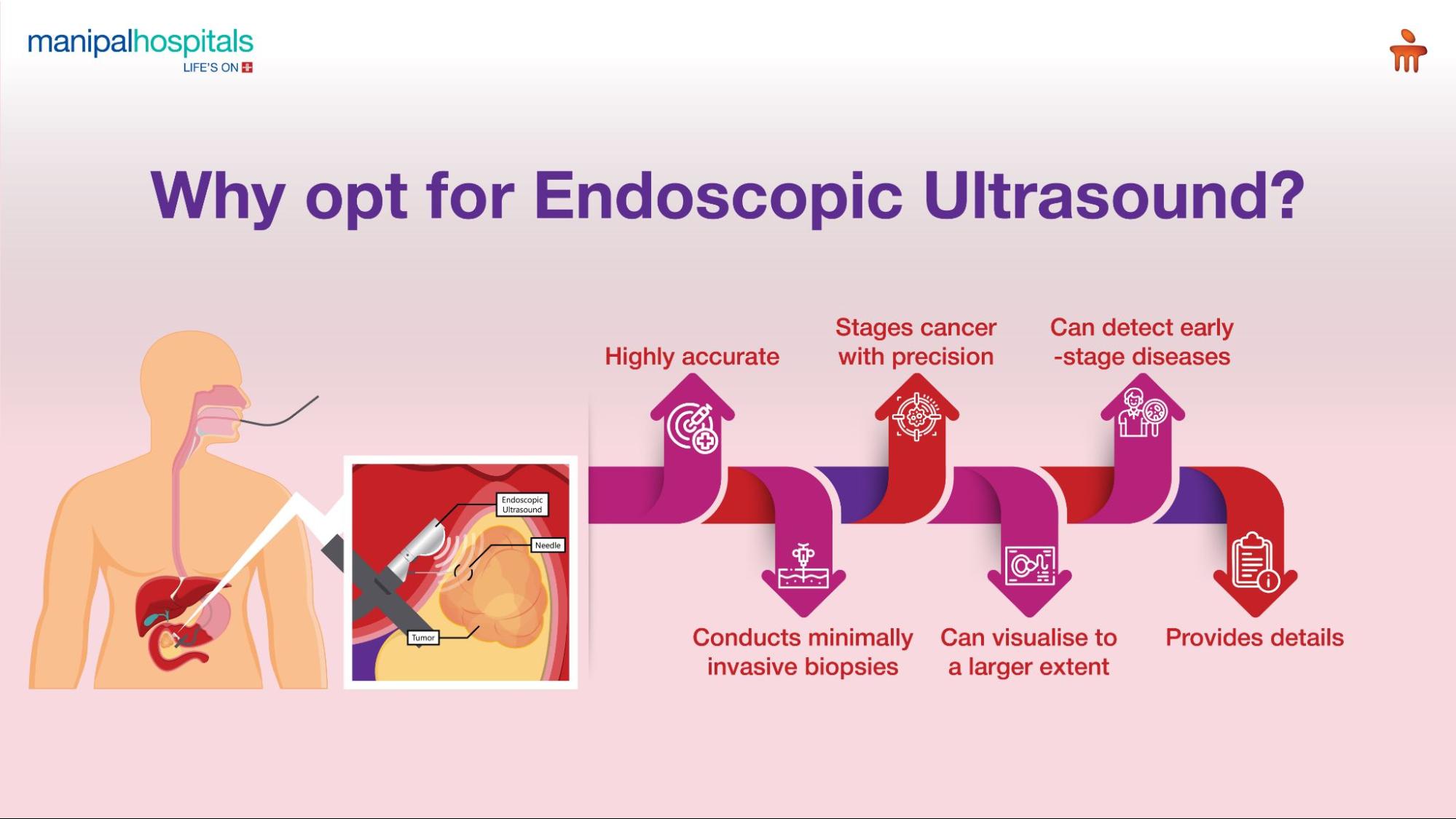
How does the EUS procedure work?
The EUS procedure time varies between 30 and 90 minutes and is typically performed on an outpatient basis. This essentially involves:
-
Preparation- The patient is asked to fast for several hours before the procedure, usually from midnight, to ensure their stomach and duodenum are empty.
-
Sedation- The patient receives sedation to make them feel comfortable and ensure they are relaxed or asleep and do not feel any pain.
-
The procedure- The specialist gently inserts the endoscope (usually through the mouth or rectum). The ultrasound probe at its tip then produces real-time images of internal organs.
-
Biopsy (if required)- If an abnormality is detected, the EUS guides a fine-needle aspiration (FNA) or biopsy to collect tissue or fluid samples for definitive diagnosis.
When is an EUS recommended?
Doctors often recommend an endoscopic ultrasound test for a detailed diagnosis, besides staging purposes, especially when other imaging techniques like CT scans or MRIs fail to provide sufficient detail. Some common purposes of conducting the test include:
-
Cancer staging- It is highly effective for staging cancers of the esophagus, stomach, or pancreas, and helps determine tumour depth and lymph node involvement.
-
Pancreatic issues- It enables superior visualisation for evaluating pancreatic cysts, masses, pancreatitis, or unexplained abdominal pain.
-
Bile duct diagnosis- EUS is excellent for identifying small gallstones or blockages in the bile ducts.
-
Submucosal lesions- Determining the origin and nature of lumps or growths located underneath the GI tract lining is easier with this procedure.
-
Therapeutic guidance- EUS can guide procedures such as draining pancreatic pseudocysts.
Key benefits of EUS
The advantages of choosing an endoscopic ultrasound test are significant:
-
High Diagnostic Accuracy: EUS provides exceptionally detailed images for precise abnormality identification, with high accuracy for conditions like pancreatic masses.
-
Precise Cancer Staging: For many GI cancers, EUS offers the most accurate way to determine the extent of the disease, vital for treatment planning.
-
Minimally Invasive Biopsy: EUS-guided fine-needle aspiration (FNA) allows for safe and targeted tissue collection from hard-to-reach areas.
-
Early Detection: Its ability to detect small lesions and early-stage diseases often before symptoms become severe is a major advantage.
Endoscopy Vs Endoscopic Ultrasound
While both procedures use an endoscope, the difference between endoscopy and endoscopic ultrasound is distinct in their diagnostic capabilities:
|
Aspect |
Endoscopy |
Endoscopic Ultrasound |
|
Technique |
Uses a flexible tube with a camera to view the inside of the digestive tract |
Combines endoscopy with an ultrasound probe to create detailed internal images |
|
Purpose |
Examines the inner lining of the gastrointestinal (GI) tract |
Evaluates deeper layers of the GI tract and nearby organs |
|
Visualisation |
Surface (mucosal layer) of the oesophagus, stomach, and intestines |
GI wall layers and adjacent organs such as the pancreas, bile ducts, and lymph nodes |
|
Uses |
Diagnosing ulcers, inflammation, bleeding, polyps, and tumours |
Detecting small tumours, staging cancers, and assessing pancreatic or biliary diseases |
|
Procedures |
Biopsy, polyp removal, and treatment of bleeding |
Fine-needle aspiration (FNA) or biopsy of tissues beneath the surface or near the GI tract |
|
Detail |
Focuses mainly on surface abnormalities |
Provides more detailed imaging of deeper tissues and surrounding structures |
Guidelines for EUS candidates
To ensure a smooth and safe EUS procedure, one must follow these guidelines before and after the test:
-
Follow all fasting instructions precisely (typically 6-8 hours without food or drink).
-
Inform your doctor about all medications you are taking, especially blood thinners.
-
Arrange for a responsible adult to drive you home after the procedure.
-
Discuss any allergies, medical conditions, or concerns with your healthcare team.
-
Do not consume any food or beverages after the specified fasting period.
-
Avoid driving or operating heavy machinery for 24 hours after sedation.
-
Never ignore any post-procedure symptoms like severe pain, fever, or difficulty swallowing; contact your doctor immediately.
Conclusion
Endoscopic ultrasound (EUS) is a highly advanced diagnostic procedure that enables detailed evaluation of the gastrointestinal tract and nearby organs. If you need a thorough examination of your digestive system or adjacent organs, an Endoscopic Ultrasound could provide the clarity needed for an accurate diagnosis and effective treatment plan. Manipal Hospitals is equipped with state-of-the-art EUS technology and a team of highly experienced gastroenterologists. For advanced diagnostic imaging, get in touch with our expert gastroenterology team at Manipal Hospitals Broadway, as we leverage advanced technologies like EUS to provide unparalleled diagnostic accuracy, helping our patients receive timely and effective care.
FAQ's
Endoscopic ultrasound (EUS) is usually performed under sedation to ensure patient comfort. During the procedure, you are relaxed and unlikely to experience pain or significant discomfort, allowing the doctor to carry out a thorough and accurate examination safely.
EUS is considered a safe procedure when performed by experienced specialists. However, as with any medical procedure, there may be minor risks such as bleeding, infection, or reactions to sedation, though these are uncommon.
Preliminary findings may be discussed shortly after the procedure. If tissue samples or biopsies are taken, the results may take a few days as they need to be analysed in a laboratory.
Yes, EUS is widely used to detect and stage cancers of the digestive tract, pancreas, and surrounding structures. It also allows doctors to collect tissue samples through fine-needle aspiration for accurate diagnosis and treatment planning.
Once the sedation wears off and your swallowing reflex returns to normal, you can usually resume eating and drinking. Your doctor may recommend starting with light meals before returning to your regular diet.
Share this article on: