




 8 Min Read
Imagine being woken up in the middle of the night by a pain so sharp and intense that it feels centred directly behind one of your eyes. This sensation does not fade slowly; it arrives with full force in a matter of minutes. For those who live with a cluster headache, this is a reality that can occur multiple times a day for weeks or months at a time. Despite how alarming the symptoms are, many people suffer for years before receiving an accurate diagnosis. It is frequently mistaken for a severe migraine or a persistent sinus infection because the pain is so localised.
There is currently no absolute cure for cluster headaches, but that does not mean the condition can’t be managed. By identifying your specific triggers and understanding the biological roots of the condition, you can control your cluster attacks. This blog will explain the primary cluster headache causes, the symptoms that help doctors identify the condition, and the various options available for professional care and home management.
Synopsis
What is a Cluster Headache?
A cluster headache is a neurological disorder characterised by recurrent, severe headaches on one side of the head. The name comes from the way the attacks arrive in "clusters"—meaning you might have one to eight headaches a day for a period of several weeks, followed by a period of remission where the pain disappears entirely for months or even years.
There are 2 main types:
-
Episodic: This is the most common form. The headaches occur daily for a period of one week to a year, followed by a pain-free remission period of at least three months.
-
Chronic: In this form, the attacks occur for more than a year without a remission period, or with remissions that last less than one month.
Because the pain is so focused and the attacks are relatively short (usually lasting between 15 minutes and three hours), the traditional approach to treating a normal headache often fails. Understanding that this is a specific neurological cycle is the first step in finding the right cluster headache therapy.
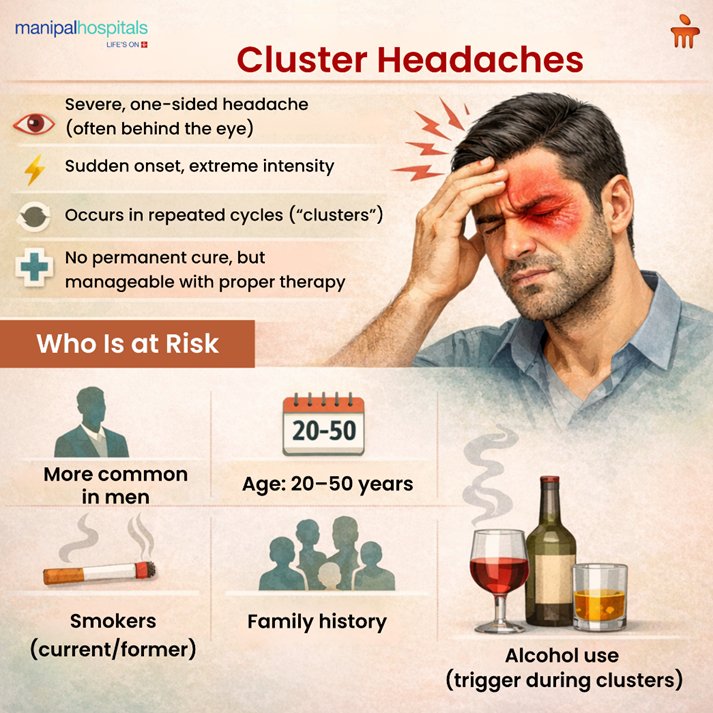
Cluster Headaches Vs Migraines
It is very common for patients to confuse these 2 conditions. However, the treatment that works for a migraine might be completely ineffective for a cluster headache. The following table highlights the primary differences to help you identify which one you may be experiencing:
|
Feature |
Cluster Headache |
Migraine |
|
Pain Location |
Always one side, centred behind the eye |
Can be one side or both; often in the temples |
|
Pain Quality |
Sharp, piercing, and constant |
Pulsating or throbbing |
|
Duration |
15 minutes to 3 hours |
4 hours to 72 hours |
|
Frequency |
1 to 8 times per day during a cluster |
Varies; usually not multiple times a day |
|
Patient Behaviour |
Restless; prefers to pace or move around |
Prefers to lie down in a dark, quiet room |
|
Physical Signs |
Red/watery eye, drooping eyelid, runny nose |
Nausea, vomiting, sensitivity to light/sound |
Primary Cluster Headache Causes
The exact reason why some people develop this condition is still being researched, but neurologists have identified several key cluster headache causes related to the brain's internal clock and nerve pathways.
-
Hypothalamus Abnormalities: The hypothalamus is the part of the brain that regulates your body’s biological clock. In people with this condition, the hypothalamus becomes overactive during an attack. This explains why the headaches often occur at the exact same time every day or during specific seasons.
-
Trigeminal Nerve Activation: The trigeminal nerve is the main nerve responsible for sensation in your face. When this nerve is stimulated, it causes the intense, piercing pain behind the eye that is characteristic of the condition.
-
Blood Vessel Dilation: During an attack, the blood vessels behind the eye widen significantly. This sudden dilation puts pressure on the surrounding tissues and nerves, contributing to the severe pain.
-
Hormonal Shifts: Sudden changes in levels of cortisol and melatonin have been observed during cluster periods, further linking cluster headache causes to the brain's regulatory systems.
Recognising the Symptoms and Physical Signs
Unlike many other headaches, a cluster headache produces visible physical changes on the face. These signs are very helpful for a doctor when they are making a diagnosis.
Common symptoms include:
|
Unilateral Pain |
The pain is strictly limited to one side of the head and does not switch sides during a cluster period. |
|
Eye Involvement |
The eye on the affected side may become very red and watery, and the pupil may appear smaller. The eyelid might also droop or swell. |
|
Nasal Congestion |
You may experience a very runny or stuffy nose, but only on the side where the head pain is occurring. |
|
Facial Sweating |
Excessive sweating on the forehead or the side of the face where the pain is located. |
|
Restlessness |
Because the pain is so intense, most people find it impossible to stay still. They may pace the room, sit and rock, or press their hand against their head. |
Who Is Most at Risk?
While anyone can develop this condition, there are certain demographic factors that make it more likely. Identifying if you fall into these categories can help you and your doctor narrow down the cluster headache causes specific to your life.
-
Gender: Men are statistically more likely to develop cluster headaches than women. Historically, the ratio was much higher, though it has become more balanced in recent years.
-
Age: Most people experience their first attack between the ages of 20 and 50, though the condition can start at any age.
-
Smoking: A very high percentage of people who suffer from these headaches are current or former smokers. Smoking is considered a significant trigger and a risk factor.
-
Alcohol Use: During a cluster period, even a small amount of alcohol can trigger an attack almost immediately.
-
Family History: If a close relative has experienced these headaches, your own risk increases slightly, suggesting a possible genetic link.
Professional Treatment: Modern Cluster Headache Therapy
Because the pain of an attack arrives so quickly, the goal of cluster headache therapy is two-fold: stopping the current attack (acute treatment) and preventing future ones (preventative treatment).
Acute Treatments (Stopping the Pain)
-
Oxygen Therapy: This is one of the most effective ways to stop an attack. Inhaling 100% oxygen through a non-rebreathing mask with a reservoir bag at a flow rate of at least 12–15 litres per minute can provide relief within 15 minutes. It is a safe and reliable cluster headache therapy with no side effects.
-
Triptans: These are medications often used for migraines, but in the case of a cluster headache, they are usually administered as a nasal spray or an injection so they can work faster.
-
Local Anaesthetics: Lidocaine nasal drops can sometimes be used to numb the nerve pathways and provide temporary relief.
Preventative Treatments (Stopping the Cycle)
-
Calcium Channel Blockers: Medications like Verapamil are often the first choice for preventing the start of a cluster cycle.
-
Corticosteroids: A short course of prednisone can be used to break a cluster cycle while other long-term medications take effect.
-
Nerve Blocks: An injection of an anaesthetic and a steroid around the occipital nerve at the back of the head can provide relief for several weeks.
-
Galcanezumab: A CGRP monoclonal antibody injection, Galcanezumab is recognised as a first-line preventative specifically for episodic cluster headaches.
-
Neuromodulation: Non-invasive Vagus Nerve Stimulation (nVNS) is a common prescription for both acute and preventative treatment, especially for those who can’t tolerate high-dose medications like Verapamil.
Lifestyle Management and Home Remedies
While medical intervention is necessary for severe cases, there are several home remedies for cluster headaches that can help you manage the intensity of the attacks and identify your triggers.
-
Maintain a Consistent Sleep Schedule: Since the hypothalamus is involved, keeping your biological clock stable is very helpful. Go to bed and wake up at the exact same time every day, even on weekends.
-
Avoid Alcohol During Clusters: If you are in a cluster period, it is best to avoid alcohol entirely, as it is a nearly universal trigger for an immediate attack.
-
Temperature Regulation: Some people find that home remedies for cluster headaches, like applying a very cold compress to the back of the neck or the temple, can slightly dull the sensation during the onset of an attack.
-
Deep Breathing and Relaxation: While it won't stop the pain, practising controlled breathing can help manage the intense anxiety and restlessness that accompany the attack.
-
Keep a Headache Diary: Tracking when your headaches start, what you ate, and how long they lasted is one of the most important home remedies. This data is invaluable for your doctor.
Conclusion
Living with a cluster headache is a profound challenge that requires patience and the right medical support. The sudden, piercing pain can make you feel as though your life is no longer your own. However, by understanding the cluster headache causes, you can move away from the mystery of the pain and toward a solution.
For patients seeking cluster headache therapy in Bangalore, Manipal Hospitals, Bangalore, offers a dedicated neurology department. So you can consult our specialist today!
FAQ's
Currently, there is no permanent cure for cluster headaches that will ensure they never return. However, with the right cluster headache therapy, most people can achieve long periods of remission and successfully stop attacks when they do occur.
While stress is a common trigger for tension headaches, it is not usually one of the primary cluster headache causes. However, the stress of dealing with the pain can certainly make the experience more difficult to manage.
Because the condition is linked to the hypothalamus (the brain's clock), attacks often occur during the REM (dreaming) stage of sleep. This is why they are sometimes called "alarm clock headaches."
While food triggers are less common in clusters than in migraines, some people find that home remedies for cluster headaches like avoiding nitrites (found in processed meats) can reduce the frequency of attacks.
While the pain is extreme, a cluster headache itself is not life-threatening and does not cause permanent brain damage. However, the intensity of the pain can lead to significant emotional distress, which is why professional treatment is so important.
Share this article on:




